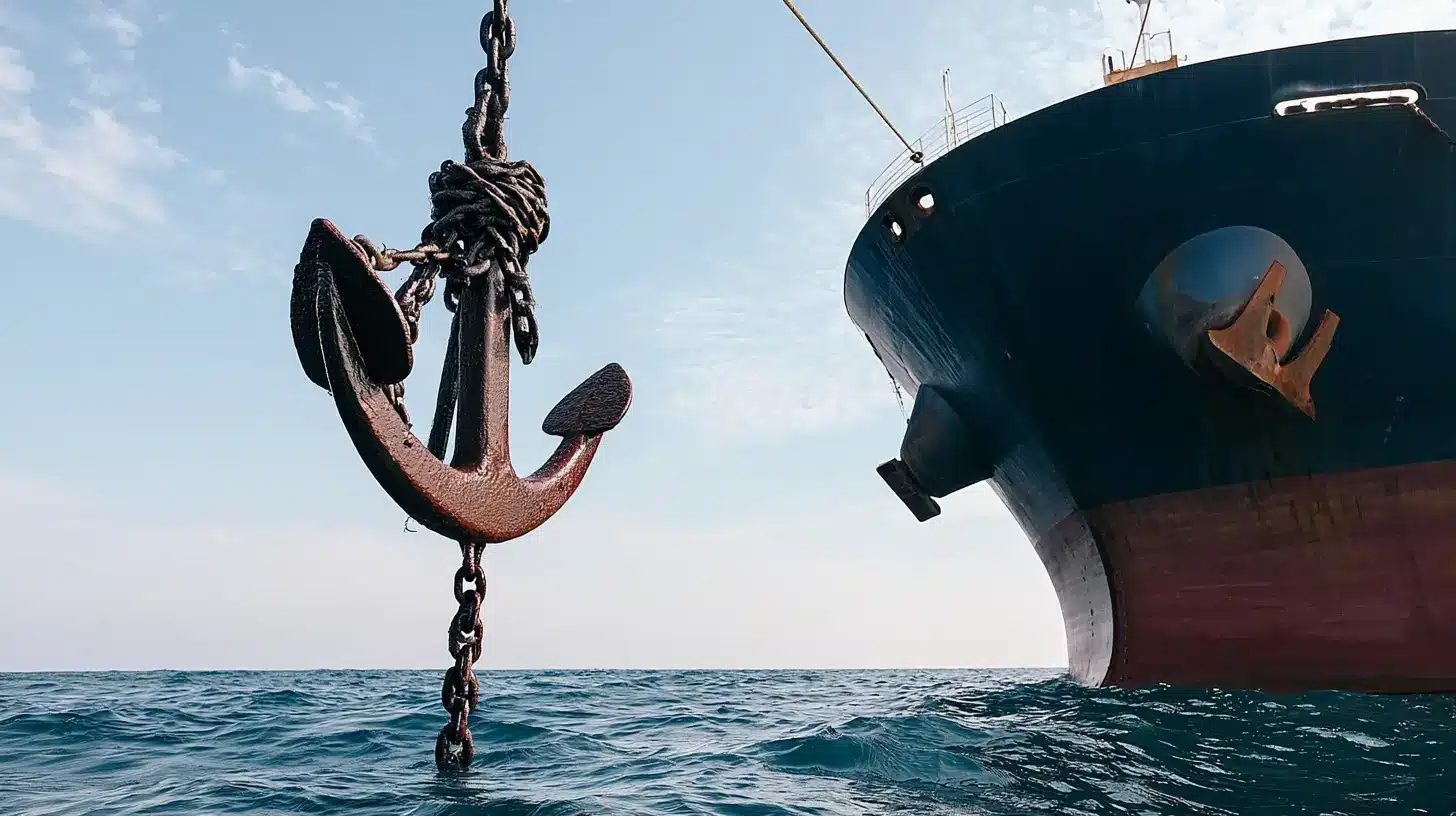
A ship anchor helps keep a vessel from drifting when it needs to wait, stop, or hold position on the water. Its holding power comes from more than its weight.
The anchor’s design, flukes, chain, scope, and seabed conditions all affect how well it holds. Once set, the anchor digs into the seabed and resists forces from wind, waves, and currents. D
ifferent anchor designs work better in different seabed conditions, so choosing the right type is important for safe anchoring.
Factors such as water depth, chain length, and the forces acting on the vessel also affect how securely an anchor holds.
Knowing these basics helps explain how vessels remain in position when anchored and why an anchor may sometimes lose its grip and begin to drag.
What is a Ship Anchor?
A ship anchor is a heavy metal device connected to a vessel by an anchor chain or cable. It is lowered to the seabed to hold the ship in one spot rather than letting it drift with wind or current.
Anchoring is usually a temporary measure. A cargo ship, for example, may anchor outside a busy port while it waits for a berth to open up. Once conditions allow, the crew raises the anchor and the ship continues on its way.
According to the U.S. Naval Institute, the equipment tied to anchoring, including the anchor, chain, and windlass, is sometimes referred to together as ground tackle. That single term covers everything a crew needs to secure a vessel offshore.
Why Do Ships Use Anchors?
Ships rely on anchors for a handful of practical situations, not as a catch-all solution. Ships use anchors to hold position when waiting outside a busy port, loading or unloading cargo, stopping during a voyage, waiting for a berth, or securing the vessel when needed.
Anchoring depends heavily on water depth and seabed conditions, so it is not a solution for every situation a ship might face at sea.
A recreational boater heading out for the day faces the same basic question on a smaller scale, and the same logic that explains the parts of a boat applies here: every component, including the anchor, has a specific job to do when the vessel needs to hold still.
How Does a Ship Anchor Work?
An anchor holds a ship through a sequence of steps rather than a single action. Understanding each stage explains why anchoring a large vessel takes more than simply dropping metal into the water.
- The Anchor Reaches the Seabed: The crew lowers the anchor from the bow until it sinks to the bottom. Reaching the seabed is only the first step. The anchor is not considered set until it has actually dug in and started resisting force.
- The Flukes Dig Into the Bottom: Once the anchor is on the seabed, the ship moves back slightly or the chain is put under tension. This pulls the anchor along the bottom, causing its flukes to rotate and dig in. The seabed then pushes back against the flukes, creating resistance.
- The Anchor Chain Helps Keep the Pull Low: A length of chain lying along the seabed keeps the pull on the anchor closer to horizontal instead of straight up. Naval sources note that the amount of chain paid out is normally five to seven times the water depth, which keeps that angle low and the flukes buried.
Picture pulling a stake sideways along the ground rather than yanking it straight upward. The sideways pull keeps it buried, and that is exactly what the chain does for an anchor.
What Happens When the Ship Pulls on the Anchor?Wind, waves, and current all place force on the hull. That force travels down the chain to the anchor, which resists it through contact with the seabed. If the forces become too strong, or the seabed will not hold, the anchor can start to drag rather than stay fixed in place. A dragging anchor is one of the clearest signs that the holding setup has been overwhelmed, and crews watch for it closely during rough weather. |
What are the Main Parts of a Ship Anchor?
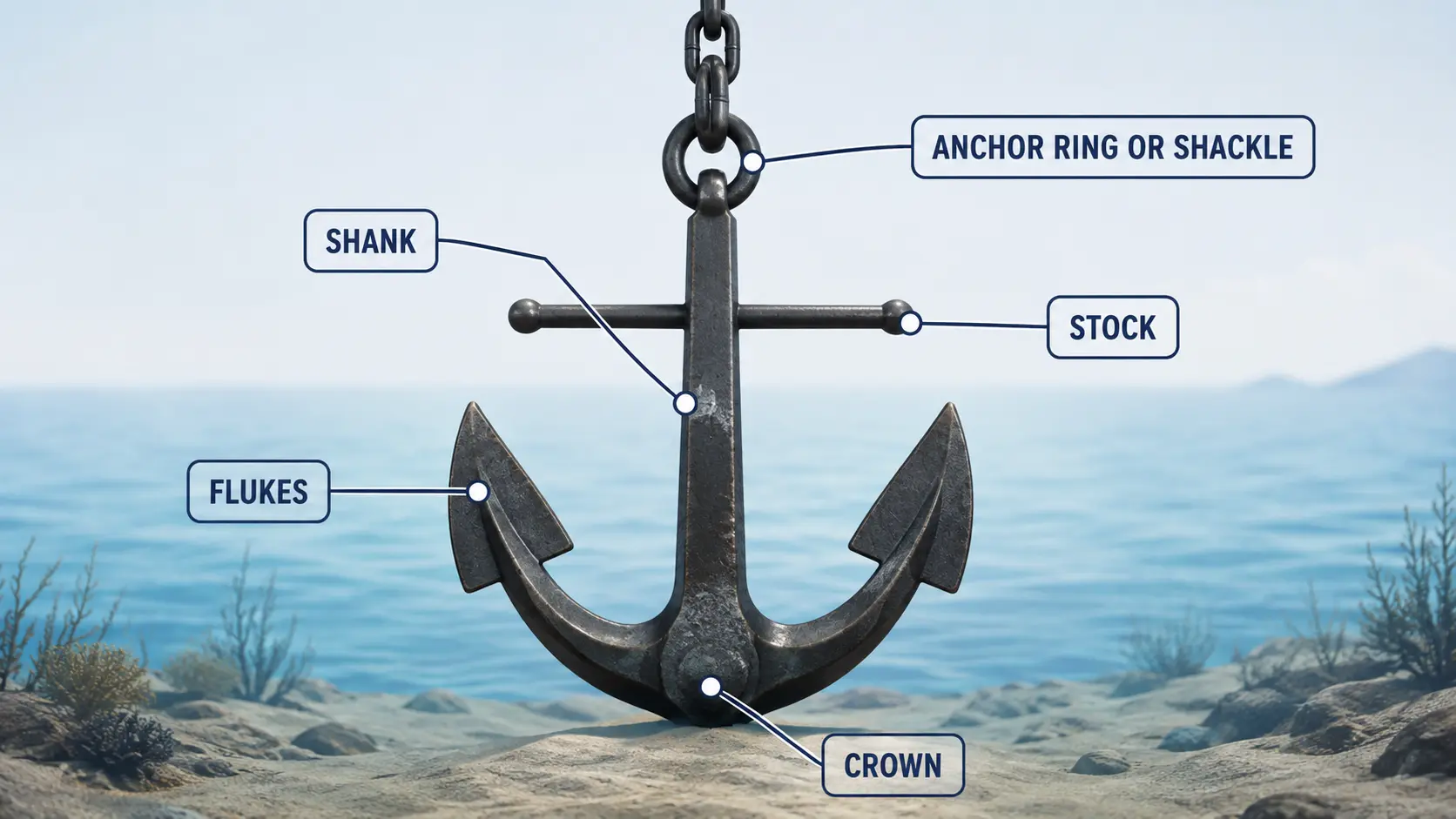
A ship anchor has several distinct parts, each with its own job. Knowing these parts makes it easier to understand how the whole system holds together.
- Shank: The shank is the main shaft of the anchor. It links the upper attachment point to the working parts below, transferring force from the chain down to the flukes.
- Flukes: The flukes are the broad or pointed surfaces that dig into the seabed. They do most of the actual gripping, so their shape and angle matter a great deal to overall holding power.
- Crown: The crown sits at the base of the anchor, joining the shank and the flukes. It helps the anchor rotate into its working position as tension is applied.
- Tripping Palms: Small projections at the crown that act as a backup, helping the flukes bite into the seabed if they fail to engage on the first attempt.
- Anchor Ring or Shackle: The connection point between the anchor and the chain. It is a separate piece of hardware from the anchor itself, though the two work as one unit once joined.
- Stock: A stock is a crossbar near the top of some anchor designs that helps the anchor tip onto its side and dig in correctly. Many modern ship anchors are stockless, relying instead on pivoting flukes to achieve the same result.
The shank, flukes, crown, ring or shackle, and stock each play a specific role in how an anchor sets and holds. Together, these parts help the anchor grip the seabed and keep the vessel secure.
Most oceangoing ships do not carry just one anchor. A typical vessel carries two bower anchors at the bow, one on each side, plus a spare anchor kept in reserve in case one is lost during operations.
What Holds a Ship Anchor in Place?
No single factor explains how a ship anchor holds a vessel steady. It comes down to several elements working together as one system.
- Anchor design: determines how the anchor digs into the bottom.
- Flukes: grip and penetrate the seabed once tension is applied.
- Seabed type: sand, mud, gravel, and rock all behave differently.
- Anchor chain: controls the angle of pull on the anchor.
- Scope: the length of chain paid out relative to water depth.
- Wind, waves, and current: the forces the anchor must resist.
Holding power depends on the entire anchoring setup, not the anchor alone. Change any one of these factors and the whole system responds differently.
What are the Different Types of Ship Anchors?
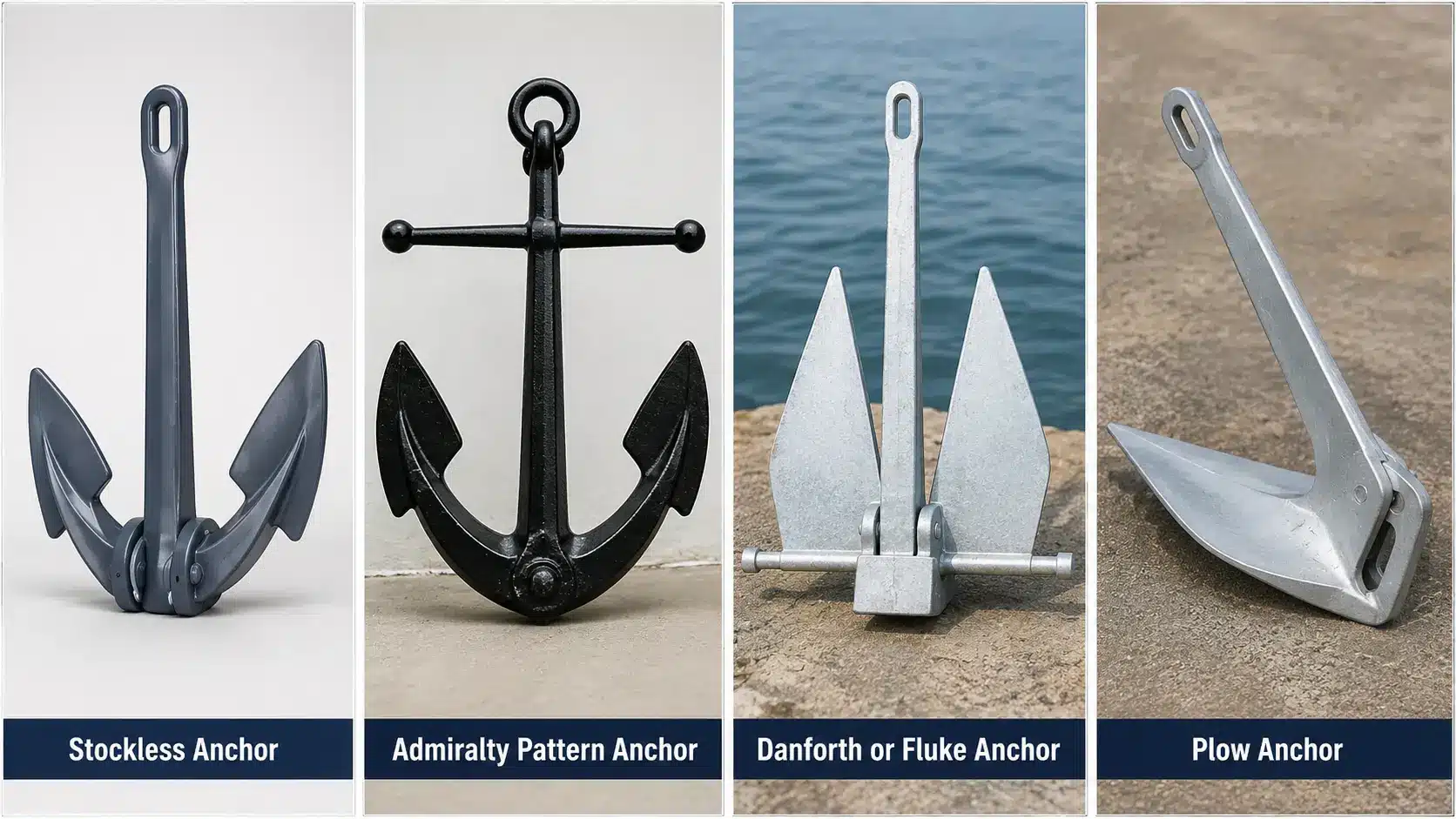
Different anchor designs suit different vessels and seabed conditions. The six types below cover most of what appears on ships and boats today.
1. Stockless Anchor
The stockless anchor is the standard choice on larger vessels because it stows easily into a hawsepipe without a protruding crossbar. Its flukes pivot at the crown, letting them dig in once tension is applied.
2. Admiralty Pattern Anchor
The Admiralty pattern anchor is the traditional design, built with a stock and large fixed flukes. It has mostly been replaced by stockless designs on modern ships, though it remains a recognized symbol of seafaring.
3. Danforth or Fluke Anchor
The Danforth anchor uses broad, flat flukes that perform well in soft bottoms such as sand or mud. It is more commonly seen on smaller boats than on large commercial ships.
4. Plow Anchor
The plow anchor takes its name from its plow-shaped design, which cuts into the bottom as tension is applied. It handles a range of bottom conditions and is popular among smaller craft.
5. Mushroom Anchor
The mushroom anchor is shaped like an inverted mushroom and holds mainly through suction and its own weight rather than by digging in with flukes. It is best suited to permanent moorings and calm, sheltered waters, such as mooring buoys and navigation aids that stay in place for long stretches of time.
6. Claw Anchor
The claw anchor uses a curved, three-pronged design that resets quickly if the vessel swings with the wind or current. It performs well in rocky, grassy, or mixed seabeds where other anchor types may struggle to get a solid bite.
Each anchor type uses a different design to grip the seabed and suit specific conditions. Stockless anchors are common on larger vessels, while Admiralty, Danforth, plow, mushroom, and claw anchors each serve their own purpose based on vessel size, mooring needs, and bottom conditions.
How to Choose the Right Anchor
Picking the correct anchor comes down to matching the design to the vessel and the conditions it will face, rather than choosing on size or price alone.
- Vessel size and weight: Larger, heavier vessels need anchors with greater holding power to match their displacement.
- Seabed type: Sandy and muddy bottoms suit fluke and plow anchors, rocky or mixed bottoms call for claw anchors, and soft mud or silt favors mushroom anchors for permanent installations.
- Anchoring duration: A short stop favors a stockless or plow anchor that sets and releases easily, while a permanent mooring is better served by a mushroom anchor.
- Exposure to weather: Anchorages exposed to strong wind and current often call for high-holding-power designs built for that added strain.
Ship and equipment suppliers such as Blue Ocean Marine Equipment stock several of these designs, including stockless, high-holding-power, and mushroom anchors, which gives a useful real-world sense of how anchor weight and style scale up for different vessels.
What is Anchor Chain and Why is it Important?Anchor chain connects the anchor to the ship and does far more than simply link the two together. Its weight and length shape how well the anchor performs. The chain’s own mass helps keep the pulling angle low, which in turn keeps the flukes buried in the seabed. In maritime usage, the term anchor cable can refer to either the chain itself or the full length of line and chain used for anchoring, sometimes called the anchor rode. |
What Is Scope in Ship Anchoring?
Scope describes the relationship between the length of chain paid out and the depth of the water. A longer scope keeps more chain lying along the bottom, which lowers the angle of pull on the anchor.
Vessel anchoring guidance from USC Sea Grant outlines how scope calculations factor into safe anchoring practice. As a simple example, a ship anchoring in ten fathoms of water might pay out fifty to seventy fathoms of chain to achieve a workable scope.
Common Ship Anchor Terms to Know
A handful of terms come up again and again in anchoring conversations. The table below covers the most useful ones.
| Term | Simple Meaning |
|---|---|
| At anchor | A vessel is secured by its anchor |
| Drop anchor | Lower the anchor into the water |
| Weigh anchor | Raise the anchor |
| Anchor’s aweigh | The anchor is clear of the seabed |
| Dragging anchor | The anchor has lost its hold and is moving |
| Anchor rode | The chain or line connecting the vessel to the anchor |
| Ground tackle | Anchors, chains, and related equipment |
| Holding ground | Seabed where an anchor can grip effectively |
| Hawsepipe | Opening through which the anchor chain passes |
| Windlass | Machine used to handle the anchor chain |
Knowing these basic anchoring terms makes it easier to understand how ships secure themselves and how crews describe the anchor’s position, movement, and equipment.
What Happens When a Ship Drops Anchor?
Dropping anchor follows a fairly consistent sequence on most vessels, regardless of size.
The crew first selects a suitable anchoring location and lowers the anchor from the bow. Once it reaches the seabed, the vessel moves back while paying out the chain.
The flukes then dig into the bottom, and the crew checks that the anchor has properly set.
Once secure, the ship remains within its anchoring range, much like a captain planning stops for a Caribbean sailing trip has to think ahead about where the anchor will actually hold overnight.
What Causes a Ship Anchor to Drag:
Several conditions can cause an anchor to lose its grip and drag along the bottom instead of holding firm.
- Strong wind
- Heavy waves
- Strong currents
- Poor seabed conditions
- Incorrect scope
- An anchor that never properly set
- Forces that exceed the anchor’s holding ability
Dragging does not always mean the anchor is too light for the job. It often means the anchor failed to engage the seabed correctly, or that conditions simply exceeded what the anchoring setup could handle.
This is one reason experienced crews planning routes through the Mediterranean sailing region pay close attention to seabed type before choosing where to anchor for the night.
Final Thoughts
A ship anchor is a key part of a vessel’s anchoring system. It helps keep the ship from drifting by gripping the seabed with its flukes.
The anchor chain and scope also play an important role by helping control the angle and force placed on the anchor.
How well an anchor holds depends on several factors, including its design, seabed type, water depth, wind, waves, and current. Understanding these factors makes the anchoring process easier to follow.
Basic terms such as flukes, shank, crown, scope, anchor rode, dragging anchor, and an anchor’s aweigh also help explain what happens during anchoring.
A vessel waiting outside a port or stopping during a voyage relies on these same basics to stay safely in position, and the right anchor for a smaller boat, similar to picking one of the best pontoon boats for a day on the water, comes down to matching the gear to the conditions.
Frequently Asked Questions
How Does a Ship Anchor Hold Such a Heavy Ship?
The anchor’s grip on the seabed, combined with chain and scope, provides holding power, not the anchor’s weight alone.
Does an Anchor Hold a Ship by Its Weight?
Weight helps the anchor reach the bottom, but holding power mainly comes from the flukes gripping the seabed.
How Deep Does a Ship Anchor Go?
Depth depends on the water, anchor design, seabed type, and the specific anchoring requirements at that location.
What Does Anchor’s Aweigh Mean?
It means the anchor has lifted clear of the seabed, and the vessel is free to move.