
You paddle out, look at the water, and every wave seems to move differently, so where do you even start?
Parts of a wave sound like technical jargon until you match them to what you actually see at the lineup, and then the peak, face, and lip start making sense fast.
Here you get wave anatomy broken down in plain language made for beginners of surfing, using the surf terms you will hear at the lineup.
By the end, you will know how a wave forms, what each part does, and where the safest spots to ride are.
What are the Parts of a Wave in Surfing
A breaking wave is made of several distinct sections, and each one plays a different role in how the wave rides. Here are some of the main surfing wave parts explained:
| Part | What It Is | Why It Matters for Surfing |
|---|---|---|
| Peak | The highest point of the wave, and the spot where it first breaks. | Your takeoff spot. |
| Face | The smooth, open surface you ride once you are up on your board. | The main area you surf. |
| Lip | The curled top edge of the wave, the part that pitches forward and breaks. | Where the wave’s power comes from. |
| Curl / Barrel | The hollow section inside a breaking wave, formed as the lip folds over. | The advanced, hollow ride surfers chase. |
| Shoulder | The softer, unbroken edge of the wave, usually the calmest place to paddle. | Best for beginners. |
| Trough | The lowest point between two waves, right before the next one lifts you. | Where you reset before the next set. |
| Impact zone | The area where the wave crashes with the greatest force. | The zone to avoid getting caught in. |
| Whitewater | The foamy, broken wave left over after the crash. | Where most beginners learn to ride. |
That is a lot of names to hold in your head at once, and reading them in a table only gets you so far.
Up next, you will see these same parts laid out on an actual wave, so the words finally have a shape to match.
Reading a Wave from Top to Bottom
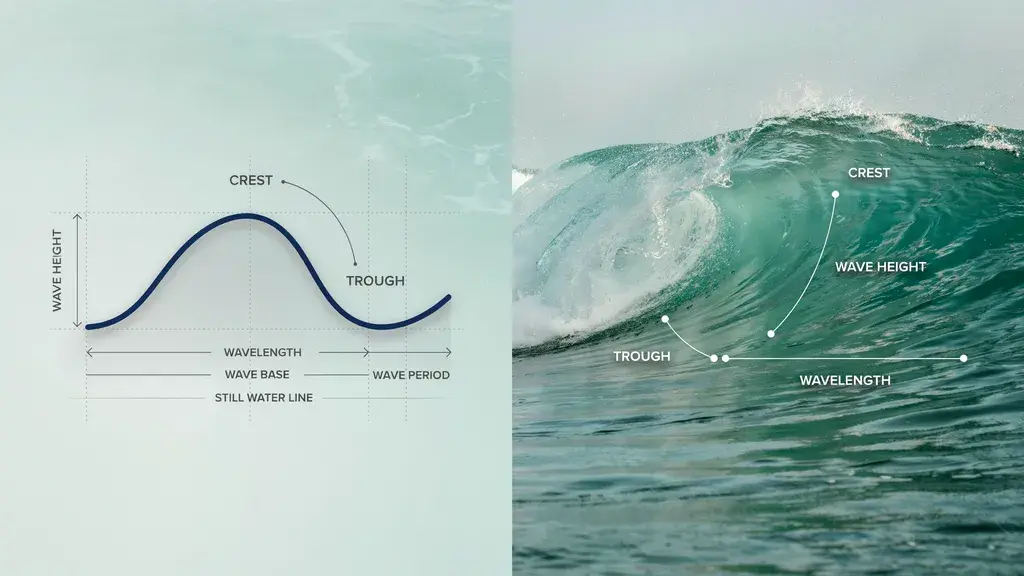
Stand on the beach and watch one wave all the way through, and you’re actually watching four things happen in about ten seconds.
It starts as a crest. Before a wave ever thinks about breaking, it’s just the highest ridge of a bump moving toward shore. Surfers call this same high point the peak once it commits to breaking, but crest is the term for any wave, anywhere, breaking or not.
It hollows out into a barrel. As the crest gets ahead of the water underneath it, the top pitches forward faster than the base can follow. That gap between the curling lip and the wave’s face is the barrel. Some surfers skip that search and ride above the wave instead, a different skill worth exploring once you’ve got wave reading down.
It collapses into white water. The moment the crest outruns its base, it slams down, trapping air beneath. Trapped air scatters light instead of letting it pass through, which is why the churned-up water turns white instead of staying blue or green,
It settles into a trough. Once the energy’s spent, the water dips back down below resting level before the next wave starts building it back up.
Reading about wave parts only gets you so far. Seeing them labeled on an actual wave shape makes the whole picture click into place much faster.
How a Wave Forms
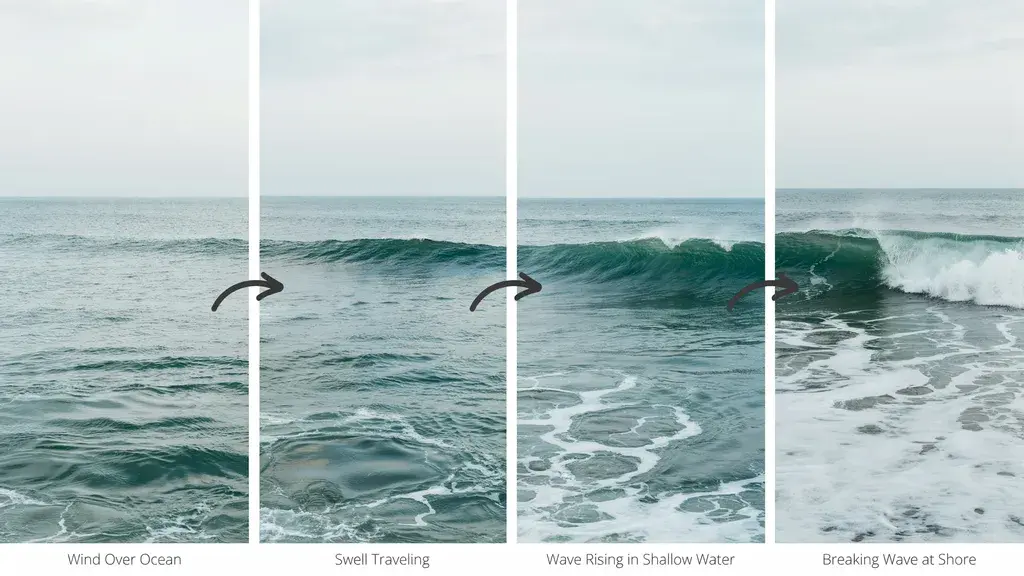
A wave does not start at the beach. It builds far out at sea, long before it ever reaches the sand.
- Wind transfers energy to the surface of the water.
- The resulting swell travels across the open ocean.
- As the swell reaches shallow water, the wave begins to rise.
- The peak forms, and the lip starts to curl.
- The wave breaks, turning into whitewater or a rideable face.
Key Concept
Waves are energy moving through water, not the water itself traveling to shore.
A wave’s shape keeps changing right up until the moment it breaks.
Types of Wave Shapes Surfers Must Recognize
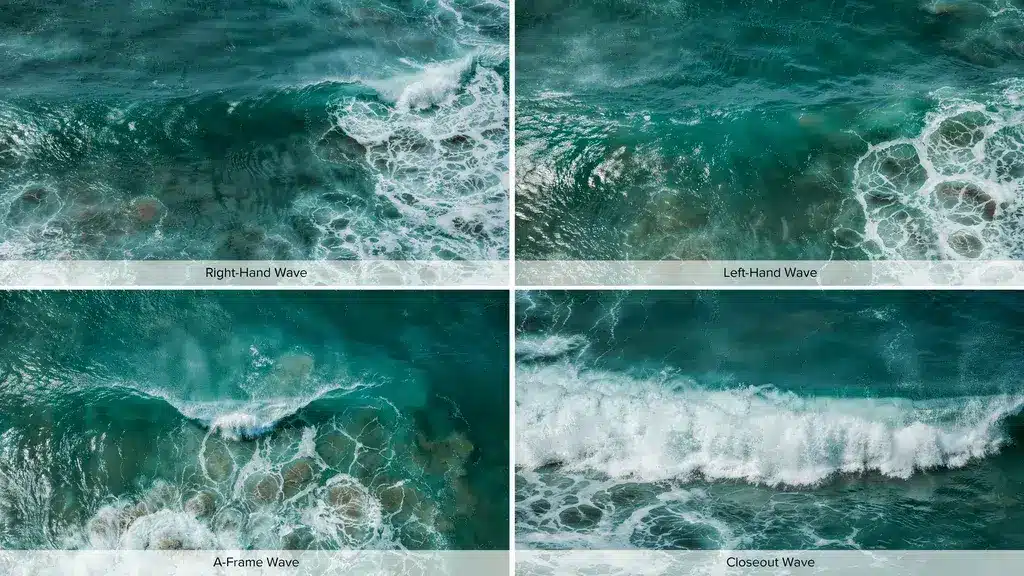
Not every wave breaks the same way, and the shape of a wave decides how it should be ridden and the surf spot that matches your skill level.
Common Wave Shapes
- Right-hand wave: breaks toward the surfer’s right.
- Left-hand wave: breaks toward the surfer’s left.
- A-frame wave: peaks in the middle and splits both ways.
- Closeout wave: breaks all at once, leaving little room to ride.
Wave Anatomy Explained Like a Surf Map
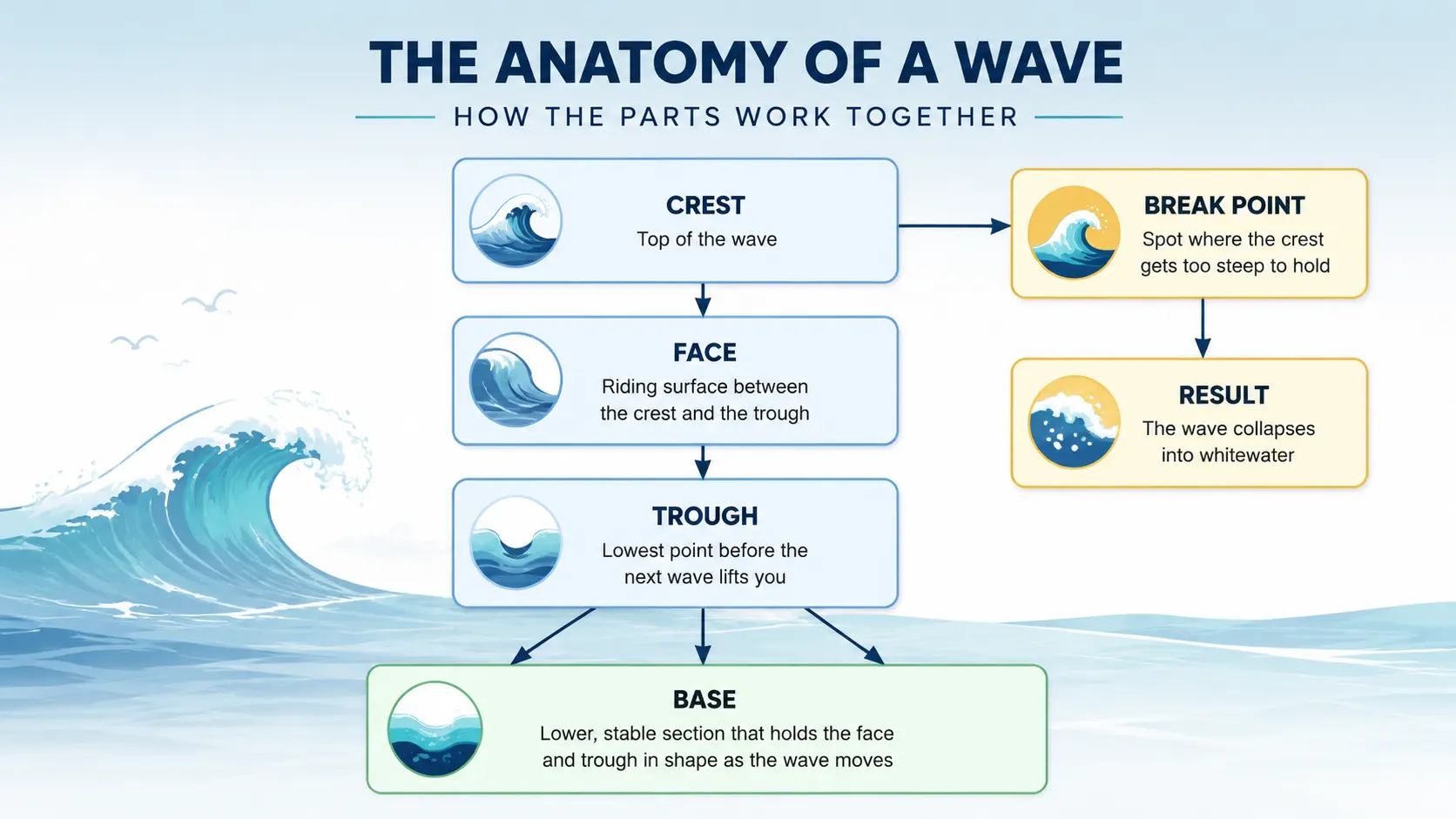
Understanding the wave anatomy starts with thinking of a wave as a map you read before every session. Once you know where each landmark sits, choosing where to paddle gets a lot simpler.
| Why It Matters: Knowing the break point helps you decide where to paddle. Reading the crest and base together improves your timing for takeoff. |
Wave Speed, Energy, and Movement
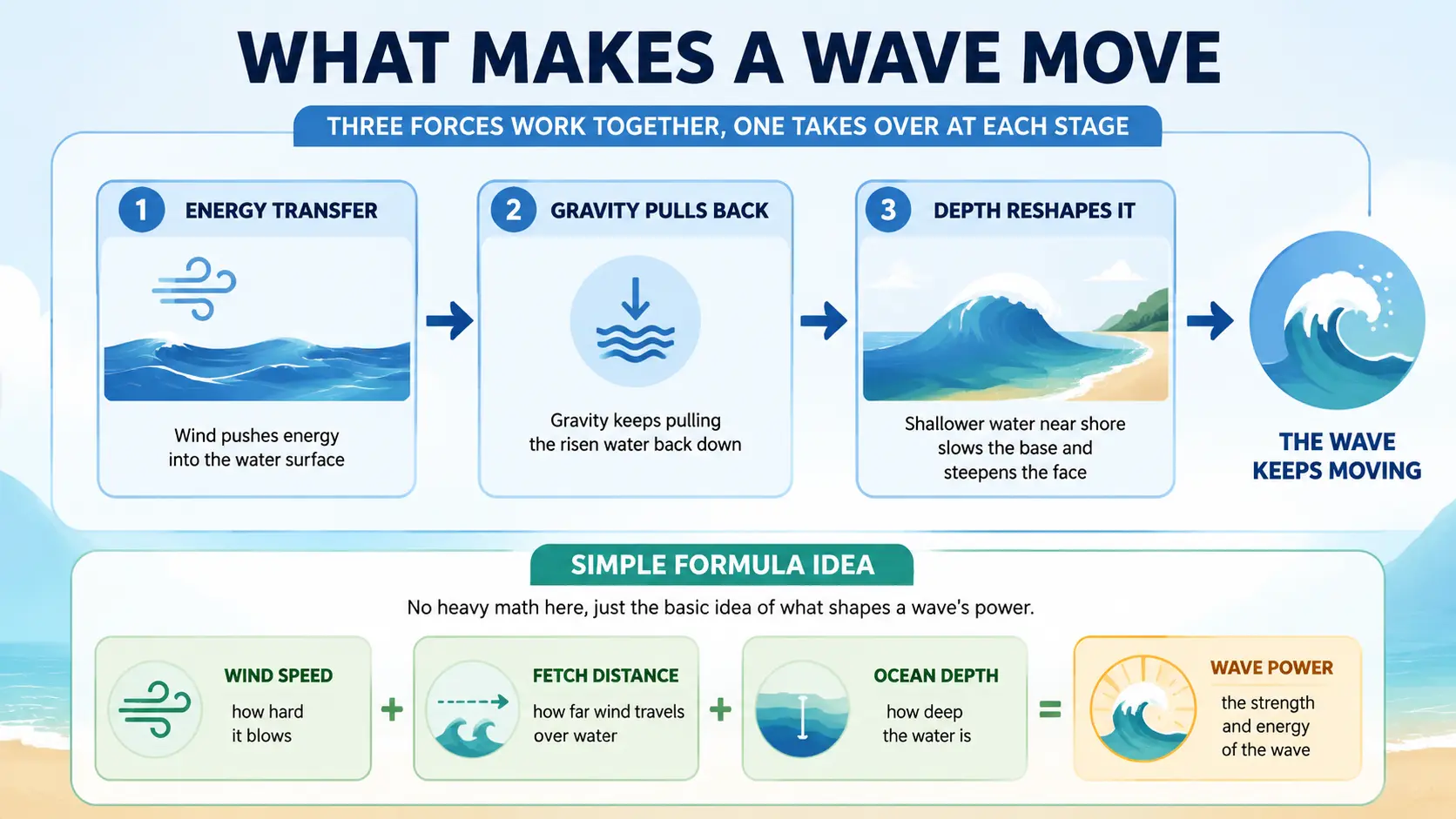
As per NOAA NDBC, speed and energy decide how a wave feels the moment you paddle for it, and a handful of ocean factors control both.
What Controls Wave Speed
Wind strength out at sea sets the pace long before a wave reaches the coast. Ocean depth then shapes that speed near shore, since shallower water slows the base and steepens the face. Swell size adds more, with bigger swells holding their speed and shape longer.
Energy Transport in Waves
A wave moves energy through the water, not the water itself, which is why the surface rises and falls without traveling toward you. Bigger amplitude means more power as the wave nears shore. That extra power makes takeoff timing harder to judge, especially for beginners.
Putting Speed and Energy Together
Slow waves give beginners more room to get up before things pick up pace. Fast waves demand quicker reflexes, so they suit surfers who already read sets well. Clean, well-spaced energy keeps rides smooth, and matching your skill to a wave’s pace keeps sessions safer.
Wave Frequency, Period, and Surf Conditions
A few science terms explain why some days feel glassy and others feel messy.
|
Term |
What It Means | What It Means for Surfing |
|---|---|---|
| Frequency | How often do waves arrive at the lineup | More frequent waves mean shorter gaps between rides |
| Period | The time between the crest of one wave and the crest of the next | A longer period usually brings stronger, cleaner waves |
| Wave Quality | Result of a wave’s period length | Long period means better quality; short period means choppier, more beginner-friendly conditions |
These terms explain what you feel in the water, and the physics behind them explains why it happens in the first place.
More Wave Terms You’ll Hear in the Lineup
Once you know the parts of a wave, a few more words will still come up every time you paddle out. These describe the wave before it even reaches you.
- Swell: The energy traveling toward shore before it turns into a breaking wave. A swell is what you’re actually reading when you check a surf forecast.
- Groundswell: A swell that traveled a long distance from a storm far out at sea. Groundswells tend to be more organized, with longer periods and cleaner shape.
- Wind swell: A swell created by wind blowing closer to shore. It usually arrives choppier and less predictable than a groundswell.
- Set: A group of waves that arrive together, followed by a lull. Surfers watch for sets to time their paddle-out and know when the bigger waves are coming.
- Break: Either the spot where waves consistently break, like “the break at Malibu,” or the act of a wave breaking itself.
- Glassy: Smooth, unrippled water with little to no wind, usually the best condition for clean waves.
- Choppy: Rough, bumpy water surface caused by wind, which makes waves harder to read and ride.
- Onshore wind: Wind blowing from the ocean toward the beach. It makes waves messier and crumbles the face faster.
- Offshore wind: Wind blowing from the land toward the ocean. It holds the wave’s shape up longer and can make it more hollow.
- Duck dive: A technique for pushing your board underwater to get through an oncoming wave while paddling out.
Mini Surf Quiz – Test Your Wave Knowledge
☐ What is the rideable part of a wave called?
☐ Where does a wave first break?
☐ What is whitewater used for?
☐ Which wave shape splits in both directions?
☐ What is the curling hollow part called?
Answer Key: 1) The face. 2) The peak. 3) Learning to catch and ride your first waves. 4) An A-frame wave. 5) The curl, also called the barrel or tube.
Conclusion
The day you decided to try surfing, you already got past the hardest part, the fear of paddling into the unknown.
Everything after that is just learning to read what is in front of you, and now you have a real head start.
You know your peak from your shoulder, your face from your whitewater, and you can spot a break point before it catches you off guard.
That is what knowing the parts of a wave actually gives you: the ability to turn a messy-looking ocean into something you can read and work with, and it will keep building every time you paddle out.
Frequently Asked Questions
What are the Parts of Waves?
A wave is made up of the peak, face, lip, curl, shoulder, trough, and whitewater. Each section behaves differently, which is why surfers read the whole shape before deciding where to paddle and take off.
What is Each Part of a Wave Called?
The main parts are the peak, face, lip, curl or barrel, shoulder, trough, and whitewater. Surfers use these names to describe where a wave breaks and which section is safest to ride.
What are the 7 Characteristics of Waves in Physics?
Waves are generally described by height, length, period, frequency, speed, direction, and energy. In surfing, period and speed matter most, since they decide how clean or choppy the conditions feel.
What is the Middle Line in a Wave Called?
The middle line sits between the crest and the trough and is often called the base or resting level. It marks the calmer point a wave returns to before building up again.