The first time you swim a full mile, the distance feels a lot longer than it sounds.
You push through the last few laps, look at the clock, and start wondering: Was that fast, slow, or somewhere in the middle?
The answer depends on far more than fitness. A beginner taking 45 minutes, a regular swimmer finishing in 30 minutes, and a trained athlete breaking 20 minutes can all be normal mile swim times for their level.
Your stroke, pacing, pool, and experience shape the number you see.
What Counts As a Mile In Swimming?
Before you can measure your own time, you need to know which mile you are actually swimming. This trips up more people than you would expect.
Swimming has three distances called a mile, and they are not the same length.
The pool mile is 1,650 yards or 1,500 meters. It is the distance used in most short-course yard pool events, including the 1650 yard swim time you see logged at USMS meets.
The open water or nautical mile is 1,760 yards or 1,609 meters, which is a true mile. Triathlon swims add a third version, often called the swimmer’s mile, which is 1,500 meters or roughly 0.93 miles, the same distance used in the Olympic triathlon swim leg.
The pool mile mix-up goes back to the 1,500-meter freestyle being the longest event on the Olympic program.
Pool meets adjusted their mile event to match that distance. Swimmers kept calling it a mile even though it falls about 110 yards short of the real thing.
Open water races usually stick to the true 1,609-meter distance. That gap is also why your open water time and your pool mile time will never quite match up.
|
Type Of Mile |
Distance |
Laps In A 25 Yard Pool |
Laps In A 25 Meter Pool |
Laps In A 50 Meter Pool |
|---|---|---|---|---|
|
Pool Mile |
1,650 yd / 1,500 m |
33 |
30 |
15 |
|
Open Water Mile |
1,760 yd / 1,609 m |
35.2 |
32.2 |
16.1 |
|
Swimmer’s Mile (Triathlon) |
1,640 yd / 1,500 m |
32.8 |
30 |
15 |
I always ask which mile a swimmer means before comparing times, since 110 yards adds up fast once you are talking about pace per hundred.
How Long Does It Take to Swim a Mile?
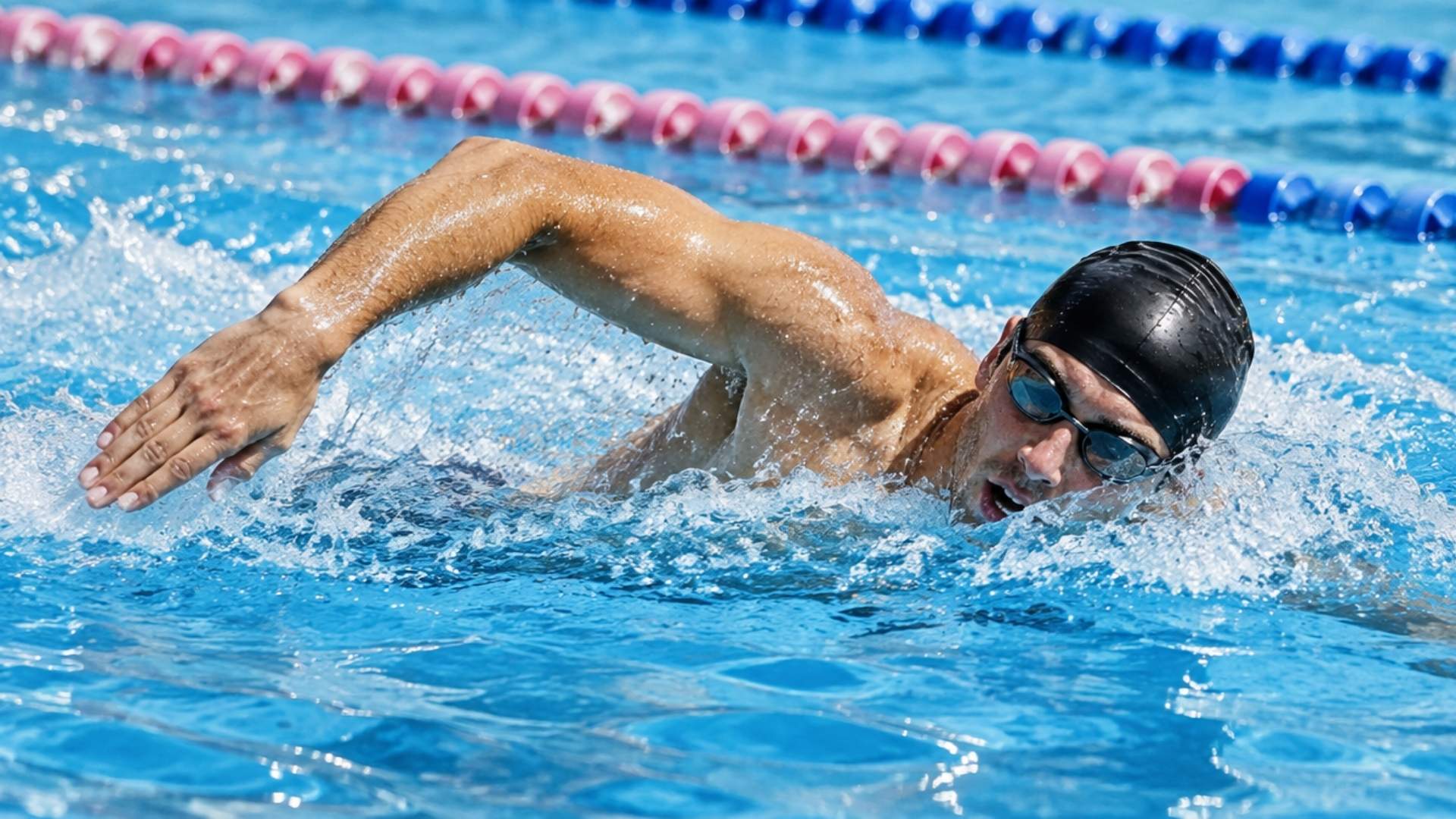
This is the question I get asked most at the pool. The honest answer changes a lot by level. Here is the average time to swim a mile broken down by where you likely stand right now.
New Swimmer
If you cannot yet swim continuously and are still working on breathing and floating, finishing a mile is not really the goal yet.
Most new swimmers need 50 to 65 minutes with frequent rest stops just to cover the distance, and that is completely normal.
The priority here is comfort in the water, not pace, so short sets with plenty of wall breaks matter more than any watch reading.
Beginner
Once you can swim continuous laps, expect a beginner mile swim time of 40 to 50 minutes in a pool.
Technique is still developing at this stage, so most of the time goes toward staying relaxed rather than pushing pace.
Open water usually adds another 5 to 10 minutes because of sighting and no wall push-offs. Sticking with freestyle and shorter practice sets speeds up progress from here.
Recreational Swimmer
Swimming two or three times a week for fitness puts you in the 30 to 40 minute range for a pool mile. Your 1-mile swim pace here typically sits around 2:00 to 2:25 per 100 yards.
By this point, your stroke technique has usually settled into something efficient, even without formal coaching. Endurance becomes the main limiting factor rather than raw swimming ability or comfort in the water.
Intermediate Swimmer
With consistent training and cleaner technique, a mile drops to roughly 25 to 32 minutes. This is where interval sets start paying off, and your pace per 100 lands closer to 1:35 to 2:00.
Swimmers at this level usually train three to five times a week. They have started adding structured sets like descending intervals, which is exactly what pushes the time down from the recreational range.
Advanced Swimmer
Years of structured training show up here. A good mile swim time for an advanced amateur is 20 to 25 minutes, which means holding a pace under 1:30 per 100 yards for the full distance.
Getting here usually takes dedicated technique work on top of volume. Pacing this consistently over a mile depends on stroke efficiency holding up even as fatigue sets in during the back half.
Competitive Swimmer
High school, college, and masters competitors racing the 1650-yard swim typically finish between 15 and 20 minutes. Elite professionals can dip under 15 minutes at a pace well under 1:00 per 100 yards.
Reaching this level takes years of structured training and race-specific pacing strategy. It also takes technique refined enough that almost no energy is wasted over the full distance of the swim.
What 67,000 Swimmers Actually Clocked
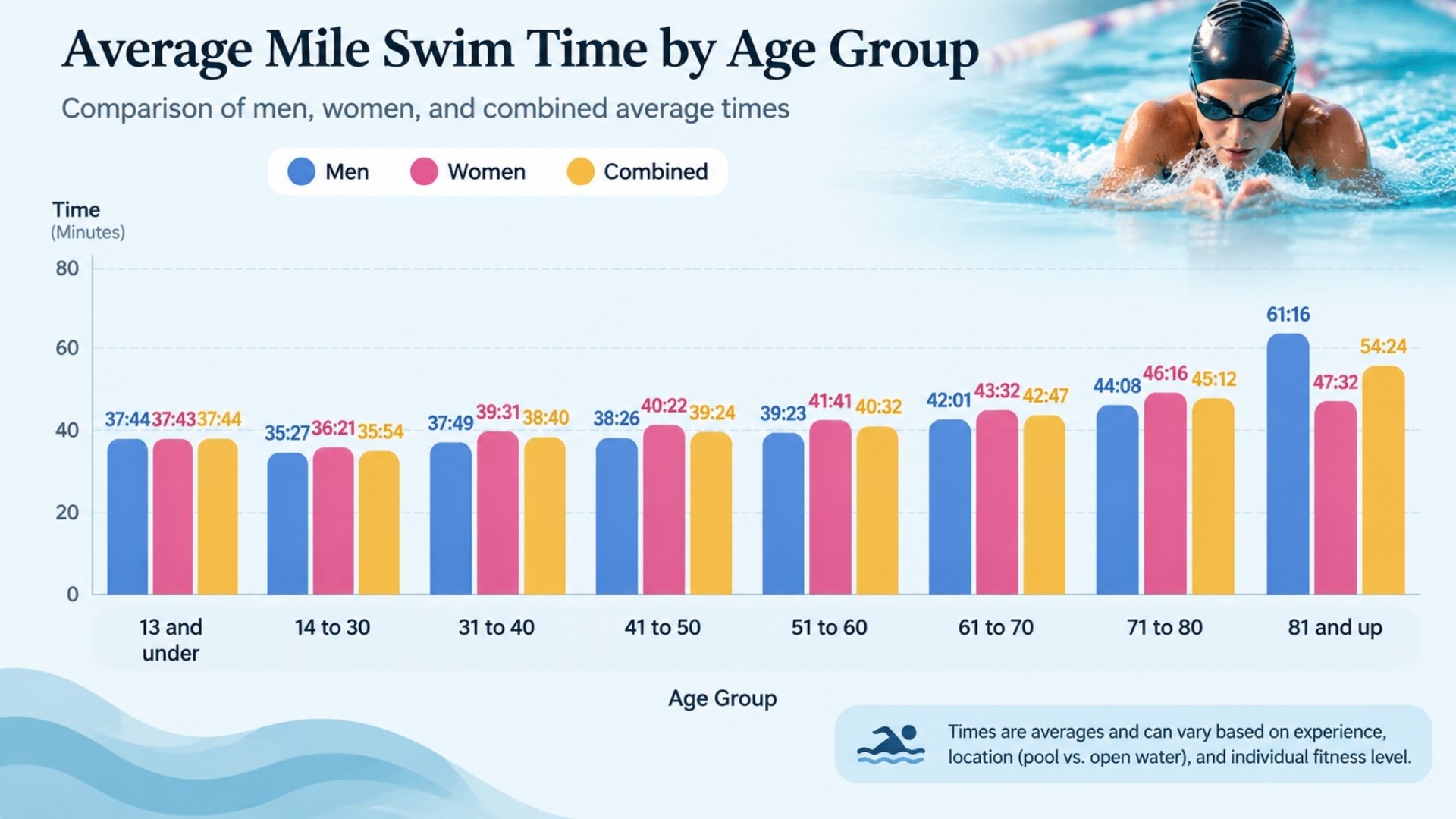
Textbook ranges are useful, but they do not tell you how thousands of real swimmers actually perform on race day.
For that, look at the Midmar Mile, the largest open water swimming event in the world, held annually in South Africa.
One published analysis of the event’s public results, by SwimCompetitive.com, reviewed 67,278 open water mile swims dating back to 2003. The numbers give a far more grounded picture than any generic estimate.
Across all ages and ability levels combined, the average mile swim time was 37:39.
Men averaged 37:05, and women averaged 38:14, a gap of roughly 3 percent. That lines up with what sports science generally shows: long-distance swimming depends far more on technique than raw strength.
The 14 to 30 age group posted the fastest average across the board. That tracks with peak conditioning and the highest concentration of active competitive swimmers in that bracket.
Every decade after that adds a few minutes, mostly from a natural decline in muscle mass and a drop in training volume.
The gender gap stays tight even at the extreme ends.
As of 2026, the fastest widely recognized 1650-yard freestyle times in the U.S. sit at 14:10.03 for men, set by Ahmed Jaouadi at the 2026 NCAA Championships, and 14:59.62 for women, set by Katie Ledecky in December 2025, a gap of about 5.7 percent.
This open water dataset lands even closer, at roughly 3 percent. That is a much smaller gap than you see in pure strength sports.
How to Time and Track Your Own Mile Swim
Guessing your pace gets you nowhere. Here is how I keep tabs on my own mile time, and what I would suggest to anyone serious about tracking progress.
- Use a swim watch or smart goggles: A GPS swim watch or goggles with a heads-up display gives you live splits, so you don’t have to do math mid-stroke.
- Keep a written swim log: I log every timed swim, the conditions, and how I felt. Patterns show up over weeks that a single swim never reveals.
- Test on a fixed schedule: I retest my mile every four to six weeks, not every session. This gives training enough time to actually show up in the result.
- Count laps with a plan, not memory: Whether it is a lap counter or a set pool routine, knowing your lap count going in keeps your split times accurate.
- Record your stroke on video occasionally: A side view or underwater clip shows technique issues that are invisible from inside your own head while swimming.
Consistency in how you test matters more than the tool you use. Comparing a rested pool swim to a tired open water one will never give you an honest read on progress.
How a Triathlon Swim Stacks Up Against a Mile
If you are timing your mile with a race in mind, it helps to know how that effort compares to an actual triathlon swim leg, since most triathlons do not use a true mile distance.
|
Triathlon Type |
Swim Distance |
Typical Swim Time |
|---|---|---|
|
Sprint |
0.47 mi / 750 m |
15 to 25 minutes |
|
Olympic |
0.93 mi / 1,500 m (swimmer’s mile) |
25 to 35 minutes |
|
Half Ironman (70.3) |
1.2 mi / 1,900 m |
35 to 50 minutes |
|
Full Ironman |
2.4 mi / 3,800 m |
60 to 90 minutes |
An Olympic triathlon swim is the closest comparison to a true mile, and it is swum in open water with a wave start, sighting, and often choppier conditions than a lake training swim.
That is part of why age group Ironman swimmers commonly hold a pace of about 2:00 per 100 meters, even when their pool mile pace is noticeably faster.
Pool Mile vs Open Water: Why the Clock Never Matches
Your pool mile and your open water mile will never match, and that gap is not a technique failure on your part. In a pool, you get a wall push-off and a streamlined glide every 25 or 50 yards.
That is essentially free speed you do not get anywhere in open water. Open water also brings currents, chop, and reduced visibility.
These push you off your straight line without you even noticing, adding real distance on top of the mile you meant to swim.
I train almost all of my distance work in a pool. The first few times I swam open water, my time was a good 8 to 10 minutes slower than my pool pace for the same distance.
That gap came almost entirely from sighting errors and swimming a longer actual path than 1,609 meters.
Budgeting 10 to 20 percent extra time for an open water mile compared to your pool time is a fair rule of thumb for most swimmers.
How Your Mile Time Changes by Stroke
Freestyle is the stroke most people use for a timed mile, but knowing how other strokes compare helps with training variety and injury prevention.
Here is roughly how a recreational swimmer’s mile time shifts by stroke, using a 32:30 freestyle mile as the baseline.
|
Stroke |
Approximate Mile Time |
Notes |
|---|---|---|
|
Freestyle |
32:30 |
Fastest and most efficient for distance |
|
Backstroke |
37:20 |
Comparable endurance demand, harder to pace |
|
Breaststroke |
42:15 |
Slower per stroke cycle but easier on the shoulders |
|
Butterfly |
47:00+ |
Rarely sustained for a full mile, power-intensive |
These are rough comparisons rather than fixed rules, since your own stroke strengths can shift the gaps significantly in either direction.
How to Swim a Mile Faster
My own mile time has come down from that rough 40-minute first attempt to somewhere in the low 20s. I am aiming to break 20 minutes this season by tightening my back half pacing.
- Build your aerobic base first: Three to five swims a week with sets like 3×500 yards or a steady 1,000-yard swim build the endurance a fast mile depends on.
- Fix technique before adding speed: Drills like catch-up and fingertip drag cleaned up my stroke more than any amount of extra yardage did on its own.
- Add interval sets: Sets like 10×100 yards on a tight interval train your body to hold pace under fatigue instead of fading in the back half.
- Practice negative splits: Swimming the second half of your mile faster than the first teaches pacing discipline and usually shaves real time off the total.
- Do not skip dryland work: Core and upper body strength training outside the pool gave me more usable power per stroke without changing my technique.
Final Thoughts
No single “right” mile swim time exists because every swimmer brings a different level of fitness, technique, and experience to the pool.
A realistic benchmark comes from comparing your pace, distance, and conditions rather than chasing someone else’s clock.
Whether you are working toward your first nonstop mile or trying to improve your personal best, knowing how long it takes to swim a mile gives you a better way to measure progress.
Frequently Asked Questions
Should I Aim for Time or Distance First as a New Swimmer?
Focus on distance first. Build toward swimming a mile comfortably and continuously before tracking your time as a baseline for future training.
How Many Calories Does a Mile Swim Actually Burn?
Most moderate-paced freestyle swimmers burn roughly 400 to 500 calories per mile. Pace, stroke, and body weight can shift that figure significantly.
Can I Swim a Mile Every Day?
Intermediate and advanced swimmers can often manage a daily mile, but beginners should build up gradually. Swimming a full mile every day too soon can increase the risk of shoulder overuse and burnout.
Does Swimming in a Wetsuit Change My Mile Time?
Yes. A wetsuit adds buoyancy and reduces drag, which can improve open water mile times. The amount varies based on the swimmer and suit fit.
What Is Considered a Fast 1650 Yard Swim Time?
Strong competitive swimmers may finish in the high teens to low 20 minutes, while national-level competitors can reach roughly 16 to 18 minutes, depending on age and sex.
What Is a Swimmer’s Mile?
A swimmer’s mile is 1,500 meters, or about 0.93 miles. It is commonly used for the Olympic triathlon swim leg and is shorter than a true mile.