
Swimming becomes much easier when you understand how each movement works.
Different strokes change your speed, effort, and the way your body moves through the water.
Thetypes of swimming strokes include competitive styles like freestyle, backstroke, breaststroke, and butterfly, along with other strokes used for learning and recreation.
Knowing the differences can help you choose the right stroke for fitness, skill, or confidence in the water.
What Are the Main Types of Swimming Strokes?
When people talk about swimming strokes, they usually mean the techniques used to move through the water, from competitive strokes to simpler styles used for learning, recreation, and practical swimming.
The four recognized competitive strokes arefreestyle, backstroke, breaststroke, and butterfly, according to U.S. Masters Swimming’s Swimming 101 guide.
Other styles, including sidestroke, elementary backstroke, combat sidestroke, and dog paddle, are also worth knowing because they serve different purposes.
One small terminology point is worth clearing up before getting started: freestyle and front crawl are often used interchangeably, but they are not technically the same thing.
Technically, freestyle refers to a competition category in which swimmers may choose any stroke, and front crawl simply happens to be the one nearly everyone picks.
How Many Types of Swimming Strokes Are There?
There are four competitive swimming strokes: freestyle, backstroke, breaststroke, and butterfly.
If you include recreational and specialized styles like sidestroke, elementary backstroke, combat sidestroke, Trudgen, and dog paddle, most swimmers say the total is closer to eight or nine.
Types of Swimming Strokes to Know
Nine strokes cover most of what you’ll see in a pool, from the four you’ll find in every swim meet to the styles built for safety, survival, or simply getting a beginner comfortable in the water.
Each one moves the body differently, so knowing what sets them apart makes it easier to pick the right one for your goal.
1. Freestyle or Front Crawl
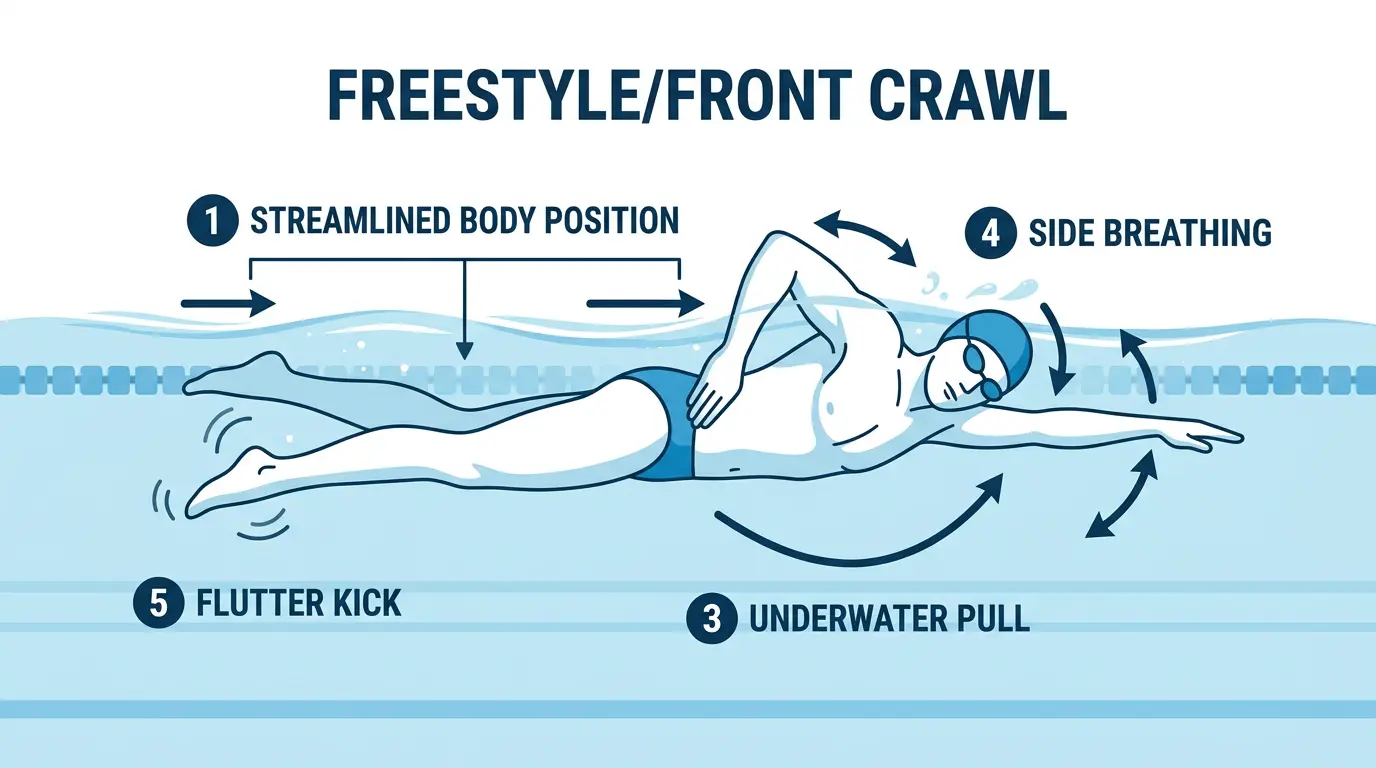
Freestyle technically allows any stroke, but front crawl has become synonymous with freestyle because it is the fastest of the competitive strokes, as U.S. Masters Swimming explains
Swimmers keep a flat, face-down position, alternate arms in a windmill motion, and maintain a steady flutter kick, breathing by turning the head to the side.
Advanced swimmers often refine their pull using the Early Vertical Forearm (EVF) technique, angling the forearm vertically early in the stroke to catch more water.
Interestingly, the legs contribute only around 10% of total propulsion in freestyle, with most of the power coming from the arms and torso rotation.
Quick facts
- Best for: Speed, distance, and lap swimming, weight loss, full-body conditioning
- Difficulty: Beginner to intermediate
- Main movement: Alternating arms with a flutter kick
- Breathing: Turn the head to the side
- Muscles worked: Shoulders, lats, and core, with quads and hamstrings from the kick
2. Backstroke
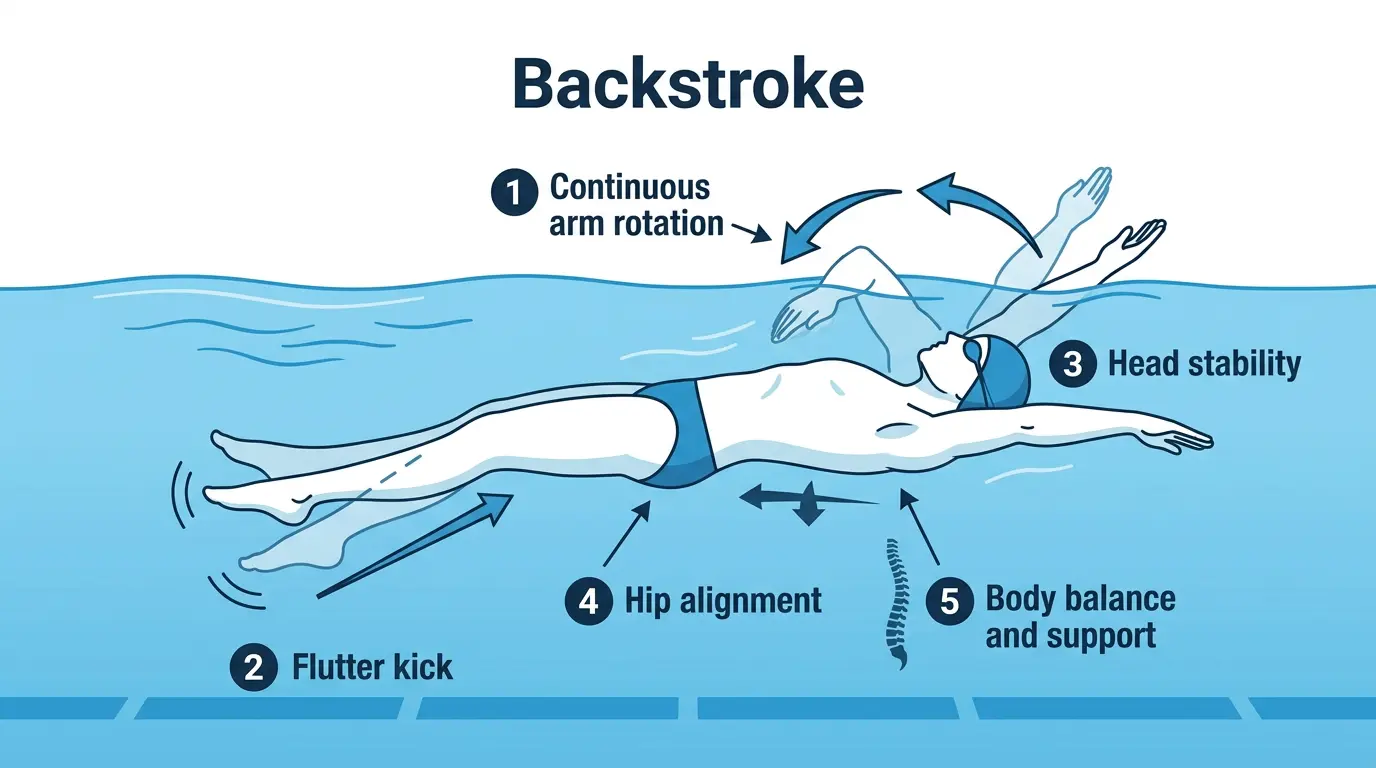
Backstroke stands apart because swimmers move on their backs, keeping their faces above the surface the entire time.
Arms alternate in a windmill pattern similar to front crawl, paired with a flutter kick, while the body rotates slightly with each stroke.
Swimmers stay on their backs during the race, using lane markings, flags, and their stroke count to help judge their position in the pool.
It’s also a stroke doctors and physical therapists often recommend for people managing back pain, since the on-your-back position takes pressure off the spine while still building strength through the upper back and core.
Quick facts
- Best for: Fitness and swimming with the face above water, back pain relief, and low-impact recovery days
- Difficulty: Beginner to intermediate
- Main movement: Alternating arms with a flutter kick
- Position: On the back
- Muscles worked: Upper back, shoulders, glutes, and hamstrings
3. Breaststroke
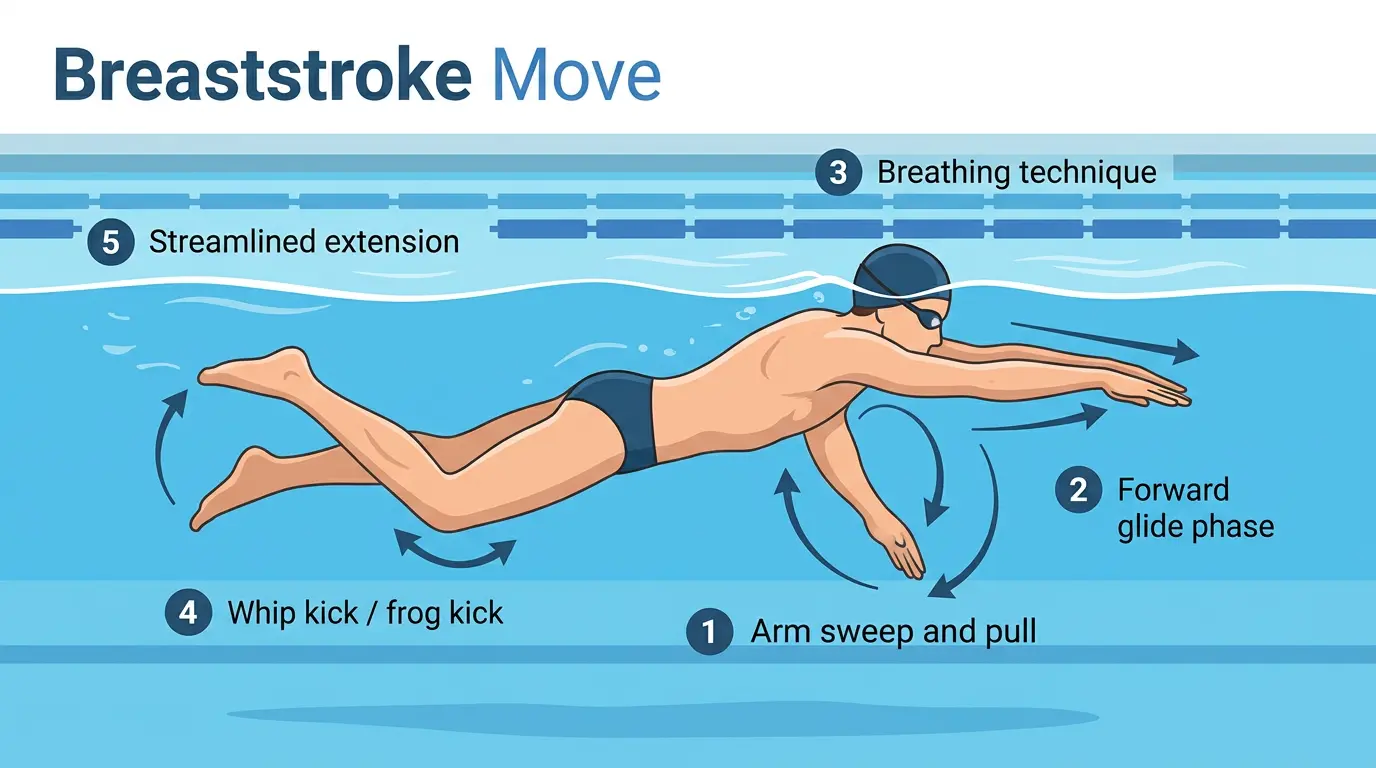
Breaststroke follows a pull, breathe, kick, and glide sequence that repeats each cycle.
Both arms pull simultaneously in a heart-shaped motion while the legs perform a whip kick, snapping outward before drawing back together.
Breaststroke is sometimes called the “frog stroke,” a nod to how the arm pull and whip kick mimic a frog’s swimming motion. It’s also an efficient calorie burner, with a steady 30-minute session burning roughly 200 calories.
The basic version suits beginners well, though competitive breaststroke demands precise timing, which is part of why it’s slower than freestyle.
Quick facts
- Best for: Controlled swimming, technique practice, beginners, kids, and low-impact cardio
- Difficulty: Intermediate
- Main movement: Simultaneous arm pull with a whip kick
- Kick: Breaststroke kick
- Muscles worked: Hips, inner thighs, hamstrings, chest, and shoulders
4. Butterfly
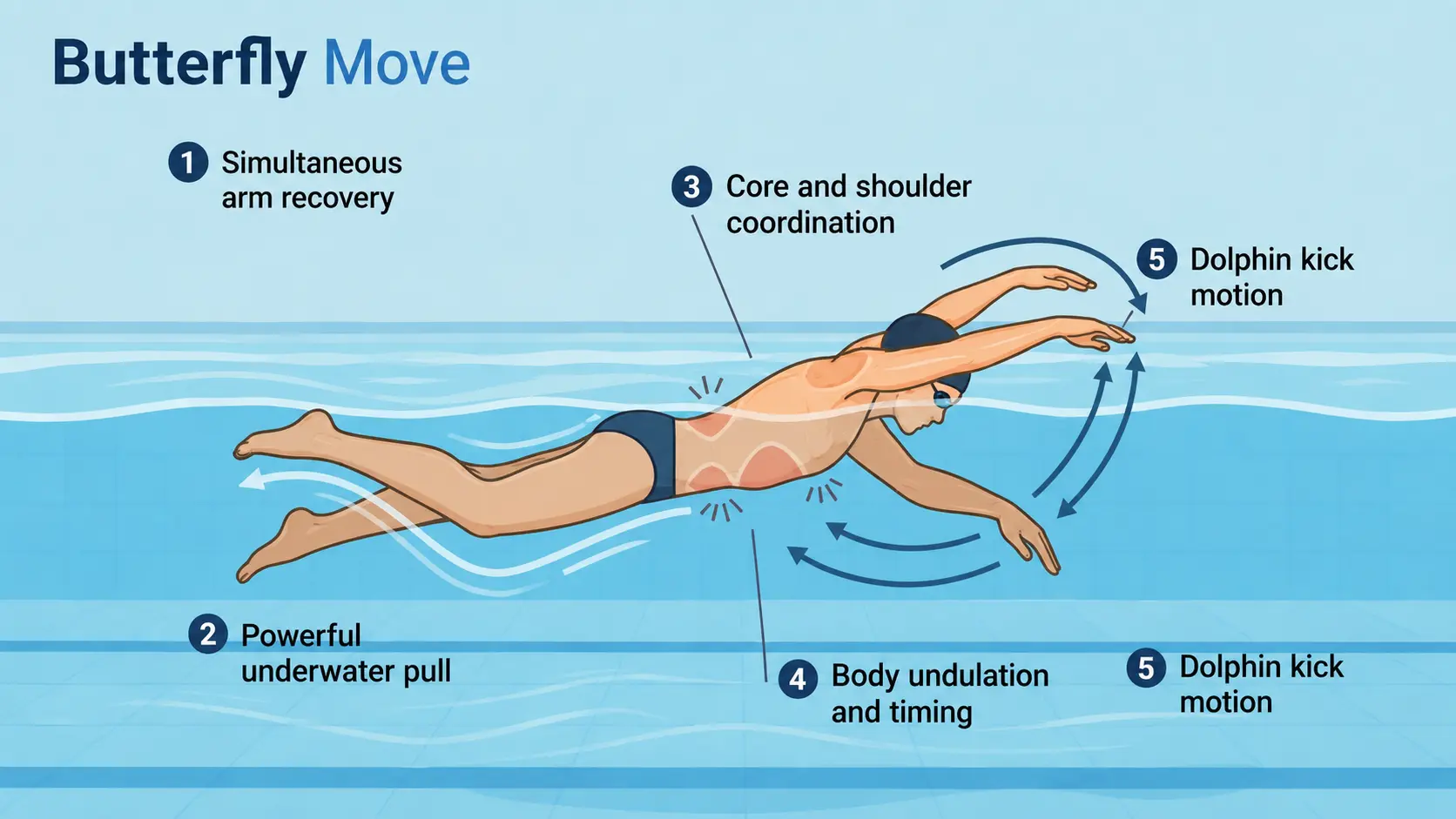
The butterfly stroke is instantly recognizable: both arms sweep forward together while the body undulates in a wave-like motion powered by a dolphin kick. Breathing is tightly timed to match the arms and hips.
Because it demands considerable strength, timing, and coordination, butterfly is often introduced after swimmers have developed a strong foundation in the other strokes.
Quick facts
- Best for: Power, conditioning, competition, building upper-body strength and power
- Difficulty: Advanced
- Main movement: Simultaneous arms with a dolphin kick
- Main challenge: Coordinating the arms, kick, body, and breathing
- Muscles worked: Chest, shoulders, arms, and core
5. Sidestroke
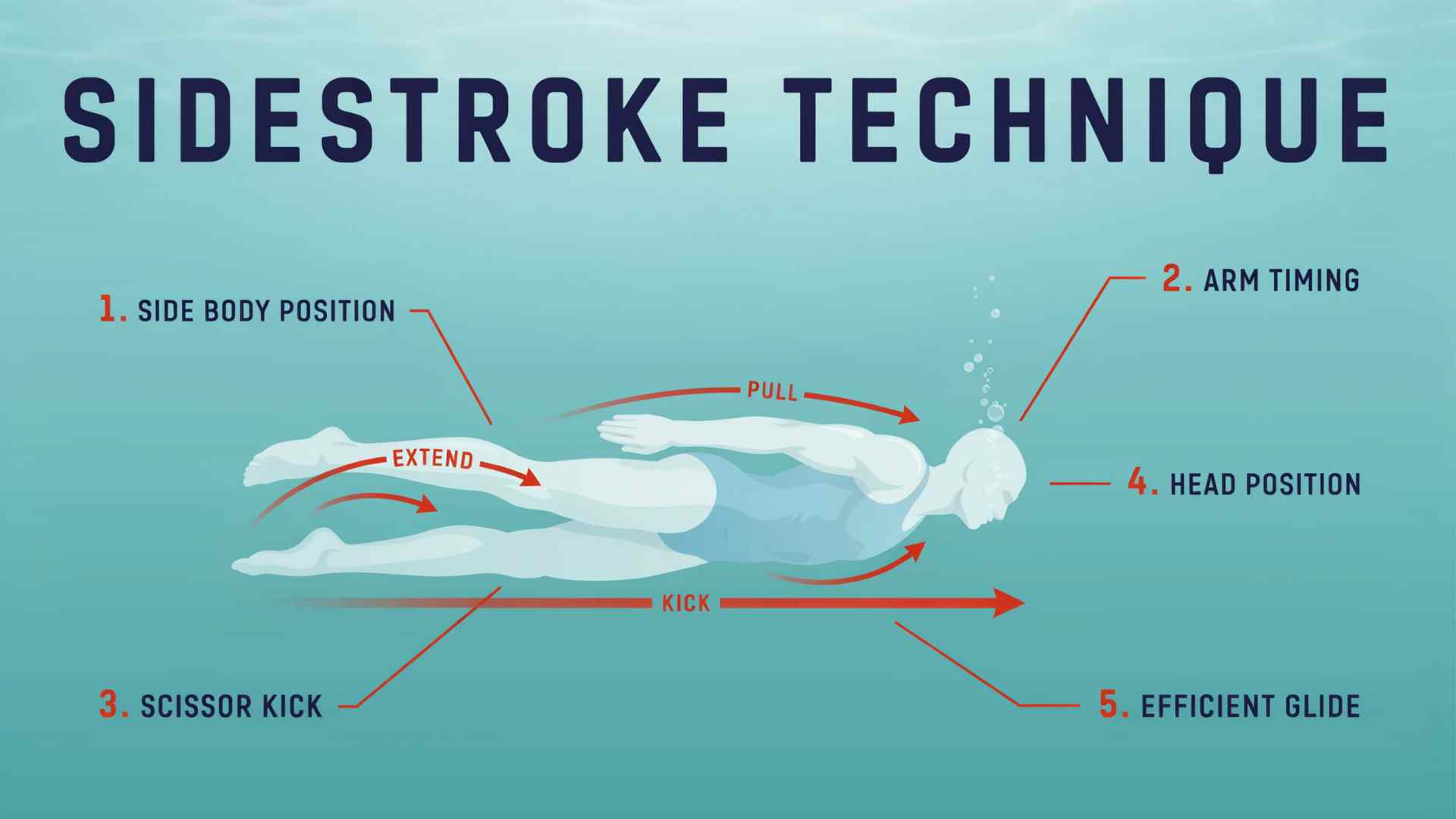
Sidestroke is swum lying on one side, with one arm reaching forward while the other pulls back, paired with a scissor kick that closes the legs together.
Its smooth, economical movement can make it useful when a swimmer needs to conserve energy, including during longer sessions or open water swimming where efficient movement can matter more than pure speed.
Quick facts
- Best for: Efficient movement, practical swimming, low-impact swimming, and older or beginner swimmers
- Difficulty: Beginner to intermediate
- Position: On the side
- Kick: Scissor kick
- Muscles worked: Obliques, shoulders, and inner/outer thighs from the scissor kick
6. Elementary Backstroke
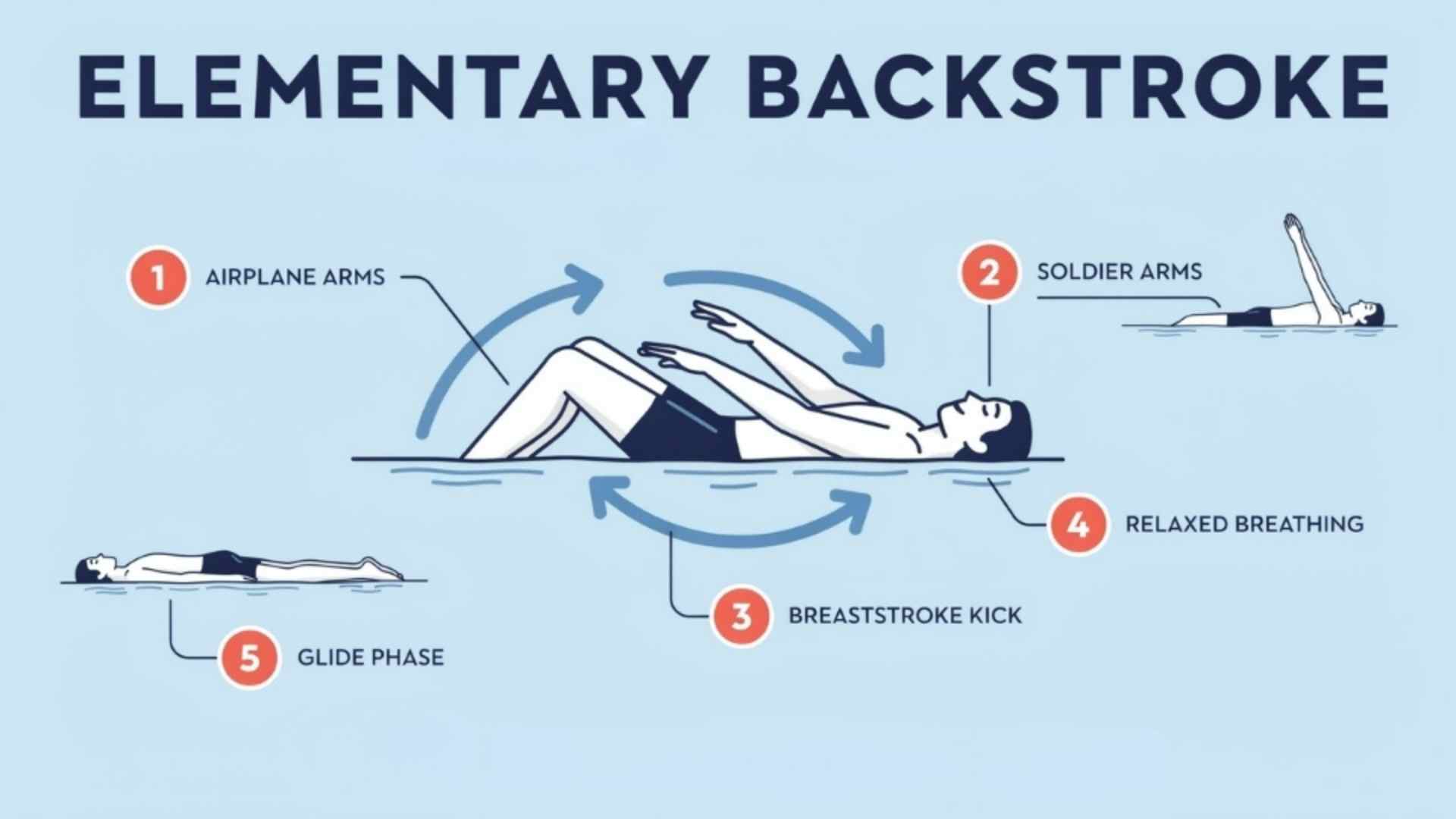
Elementary backstroke shares its face-up position with regular backstroke, but everything else is simplified.
Arms move together instead of alternating, sweeping out and down in a motion often taught as airplane, then soldier, while the legs perform a breaststroke-style kick. Its simplified movements can make it useful in beginner instruction and water confidence practice.
Quick facts
- Best for: Beginners, kids, and nervous first-time swimmers
- Difficulty: Beginner
- Position: On the back
- Kick: Breaststroke-style kick
- Muscles worked: Chest, inner thighs, and hip flexors from the breaststroke-style kick
7. Combat Sidestroke
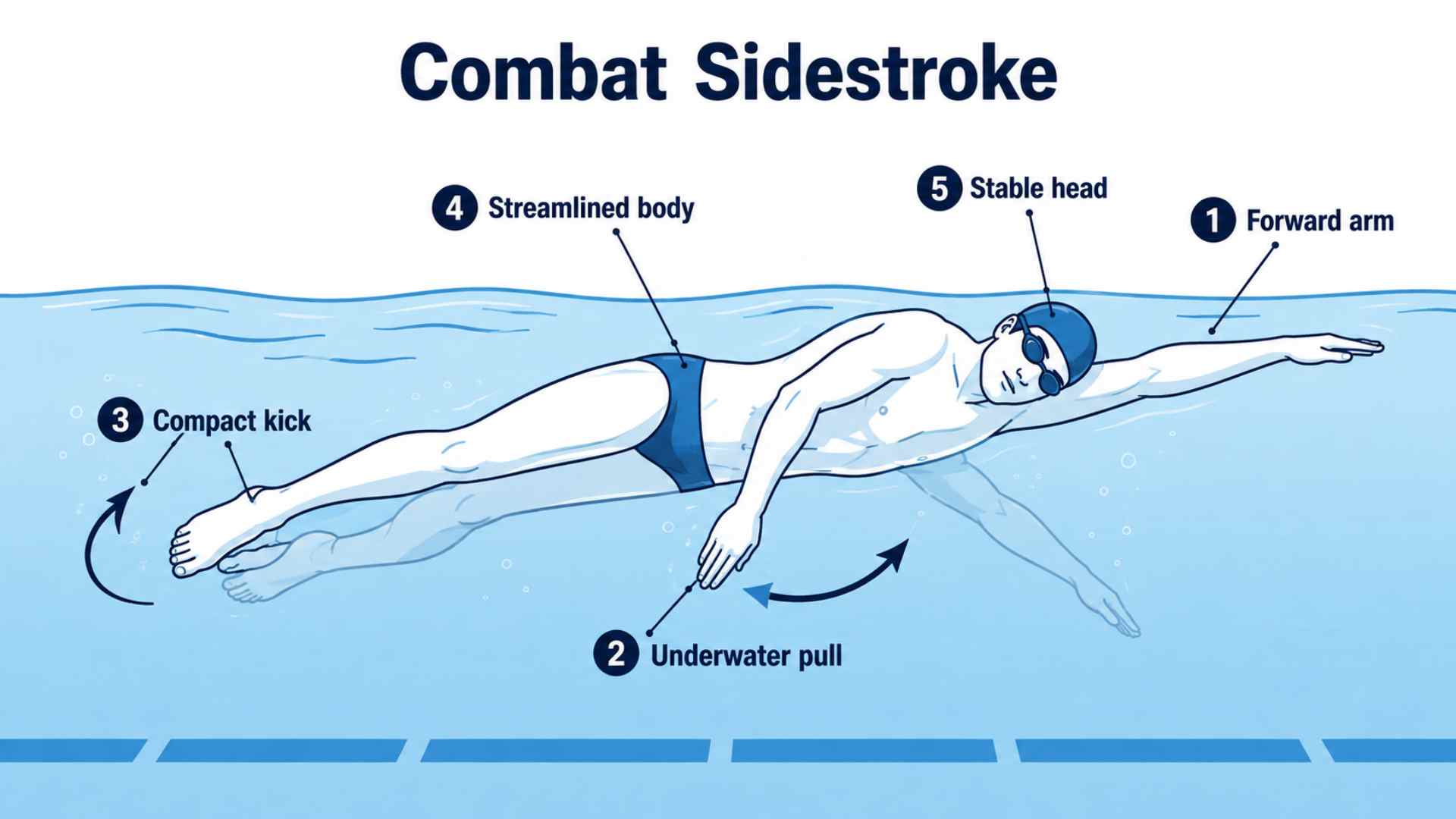
Combat sidestroke is a modified sidestroke associated with U.S. Navy SEAL training.
It is designed for efficient movement through the water and uses a streamlined body position with modified arm and leg movements. Unlike the sidestroke, it uses a modified kick and pull built for endurance.
Quick facts
- Best for: Distance swimming and fitness-focused adults, not typically taught to kids
- Difficulty: Advanced
- Position: Side
- Style: A combination of swimming movements
- Muscles worked: Core, shoulders, and hips, built for sustained endurance
8. Trudgen Stroke
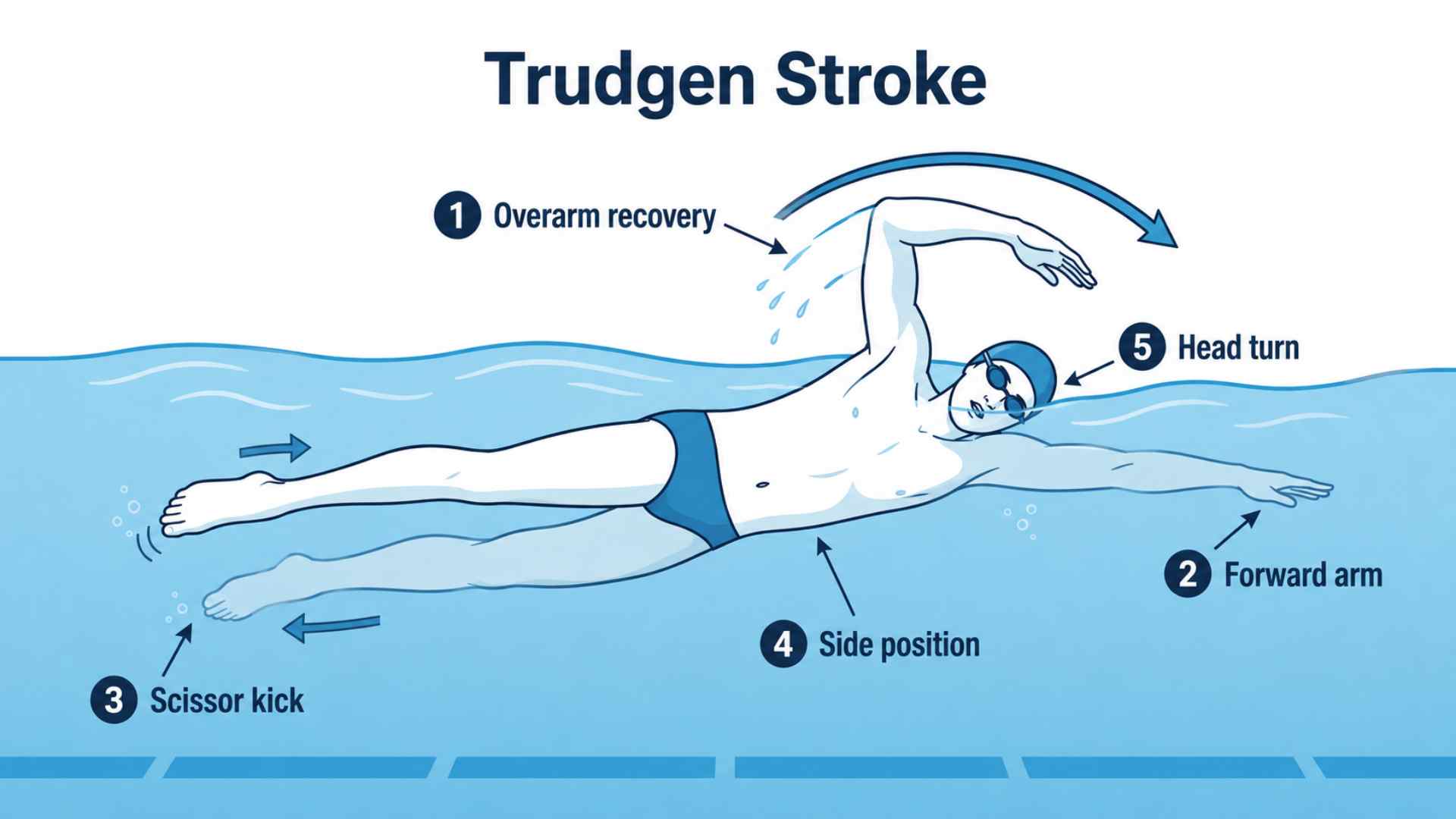
The Trudgen stroke swims on the side, alternating overarm strokes above water with a scissor kick below it, named after English swimmer John Trudgen, who popularized it in the 1870s.
It’s related to the sidestroke but moves faster due to its overhead arm recovery. It became less common as front crawl developed into the dominant fast swimming technique.
Quick facts
- Best for: Intermediate swimmers wanting a faster alternative to sidestroke
- Difficulty: Intermediate
- Position: Side
- Kick: Scissor kick
- Muscles worked: Shoulders and obliques from the overarm recovery, plus thighs from the scissor kick
9. Dog Paddle
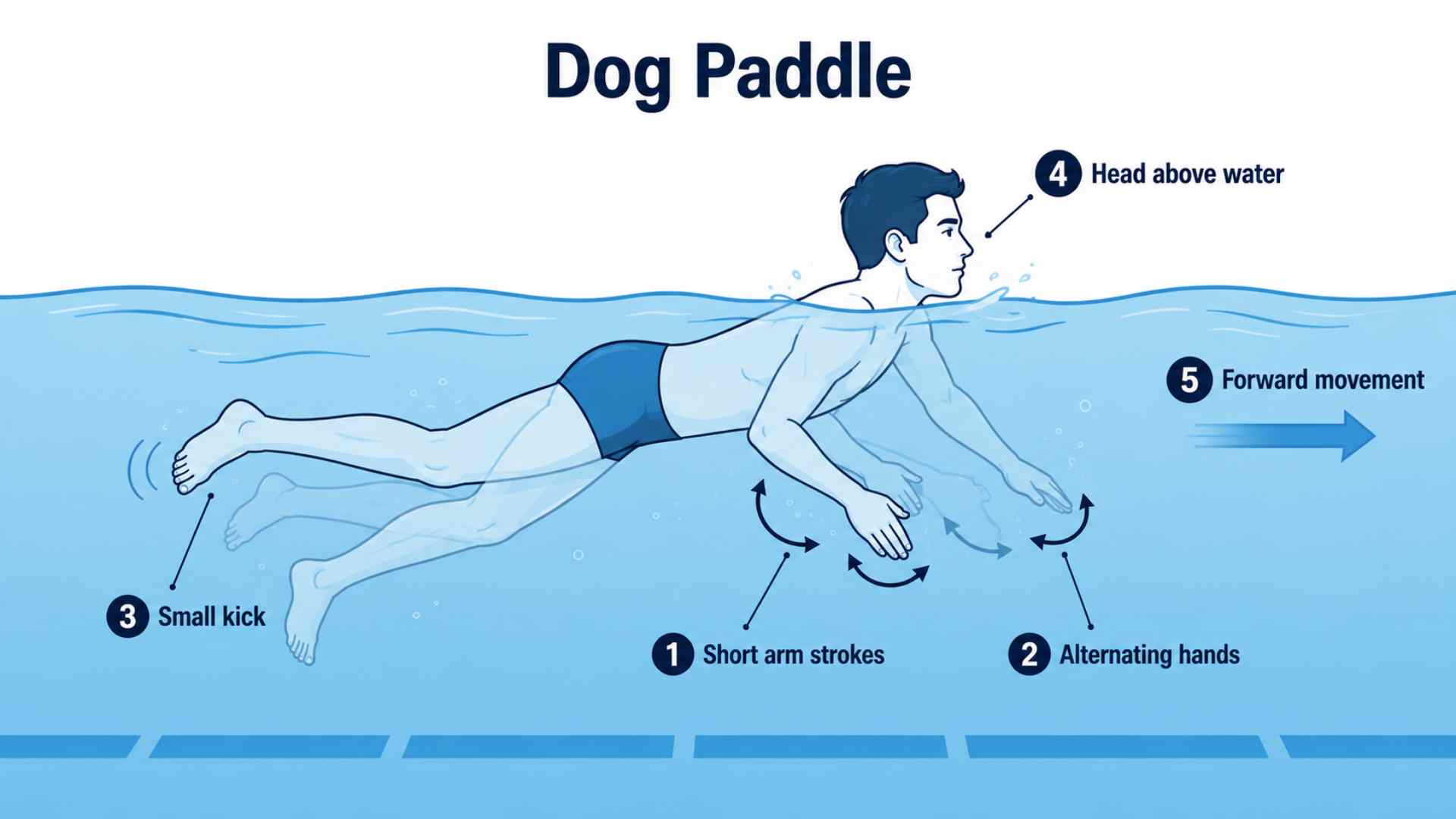
The dog paddle is the stroke most people learn without instruction: the body stays upright or nearly flat, with short, quick arm strokes below the surface and a simple kick to stay afloat.
Children often default to it naturally when first learning to move through water. It can help beginners stay afloat and move short distances, but it is generally less efficient than the formal swimming strokes.
Quick facts
- Best for: Young kids and absolute beginners building water confidence
- Difficulty: Beginner
- Movement: Short arm strokes with simple kicking
- Limitation: Not ideal for efficient distance swimming
- Muscles worked: Shoulders and arms, with minimal leg engagement
Each swimming stroke has its own rhythm, technique, and purpose, so there is no single style that works best for every swimmer.
How the Main Swimming Strokes Compare
Reading through nine strokes one at a time is useful, but sometimes what you really want is a quick side-by-side look instead of scrolling back through every section.
| Swimming stroke | Body position | Main kick | Difficulty | Best known for |
|---|---|---|---|---|
| Freestyle | Front | Flutter | Beginner to intermediate | Speed and distance |
| Backstroke | Back | Flutter | Beginner to intermediate | Swimming on the back |
| Breaststroke | Front | Whip | Intermediate | Controlled movement |
| Butterfly | Front | Dolphin | Advanced | Power and coordination |
| Sidestroke | Side | Scissor | Beginner to intermediate | Efficient movement |
| Elementary backstroke | Back | Breaststroke style | Beginner | Learning and confidence |
| Combat sidestroke | Side | Scissor style | Advanced | Efficient swimming |
| Trudgen | Side | Scissor | Intermediate | Historical swimming style |
| Dog paddle | Front or upright | Simple | Beginner | Basic water movement |
Knowing where a stroke fits on that spectrum makes it easier to decide which one to practice next, whether your goal is competition, fitness, or feeling safer in the water.
How to Start Learning Different Swimming Strokes
Learning to swim well works best as a progression, starting with basic swimming techniques before moving into complete strokes and faster lap swimming.
- Start with water confidence by floating, breathing, kicking, and getting comfortable putting your face in the water.
- Learn basic body position. Keep the body streamlined and balanced before swimming quickly.
- Start with simpler stroke movements. Practice kicking and arm movements before combining them into a full stroke.
- Build toward freestyle and backstroke. Work on alternating arms, kicking, and breathing together.
- Add breaststroke and butterfly as technique improves, since they need more precise timing and coordination.
- Practice technique before speed. Focus on controlled movement and breathing over swimming fast.
- Consider professional lessons. A qualified swim teacher offers safer, more effective instruction for beginners and children.
For broader water competency and safety skills, the American Red Cross swimming safety guidancerecommends learning more than basic swimming skills alone. Knowing a swimming stroke is not the same as being water safe, so beginners should learn swimming and water safety skills together.
Progress at your own pace. Some swimmers move through these steps faster than others, and that’s completely normal.
The Four Competitive Swimming Strokes and How They Are Used
These four strokes also appear together in two major medley formats: the individual medley and the medley relay.
They also feature in two major event formats, with each event using a different stroke order.
| Event | Stroke order | How it works |
|---|---|---|
| Individual medley | Butterfly, backstroke, breaststroke, freestyle | One swimmer completes all four strokes in sequence |
| Medley relay | Backstroke, breaststroke, butterfly, freestyle | Four swimmers each complete one stroke |
A useful technical distinction: Freestyle and backstroke are long axis strokes, while breaststroke and butterfly are short axis strokes.
The classification reflects how the body moves around its main axis, helping explain the different movement patterns used by each stroke.
Together, these events show how the four competitive strokes can be used both individually and as part of a team.
Common Swimming Stroke Mistakes to Avoid
Even experienced swimmers pick up habits that slow them down or make certain strokes harder than they need to be. Catching these early pays off.
- Lifting the head too high during freestyle drops the hips and makes breathing feel rushed instead of relaxed.
- Kicking from the knees instead of the hips turns the flutter kick into a big, energy-wasting motion.
- Rushing the breaststroke sequence skips the glide phase, so the pull, breath, and kick overlap instead of flowing in order.
- Trying full butterfly before developing the dolphin kick and body rhythm can make the movement feel disconnected and inefficient.
- Using identical technique for every stroke ignores that each one has its own position, kick, and breathing rhythm to master.
Working on these mistakes one at a time tends to produce faster improvement than trying to fix everything at once.
Finding the Right Swimming Stroke Takes Practice
The right stroke depends on your goal, skill level, and comfort in the water.
Understanding the types of swimming strokes helps you choose the styles that fit your training and improve your technique.
Practice consistently, focus on form, and build your skills step by step. Try a new stroke from this guide and share your progress in the comments.
Frequently Asked Questions
What is the Fastest Swimming Stroke?
Freestyle, swum as front crawl, is generally the fastest of the four competitive strokes thanks to its continuous arm motion and steady flutter kick.
Which Swimming Stroke Is Easiest for Beginners?
Someone comfortable putting their face in the water might find front crawl intuitive, while a swimmer who prefers keeping their face above water often finds elementary backstroke easier to pick up.
Which Swimming Stroke Is Best for Long Distance Swimming?
Freestyle swimming is the go-to choice for long-distance events because its steady rhythm and low energy cost per stroke make it easier to sustain over many laps or miles.
Which Swimming Stroke Is the Hardest?
Butterfly is generally considered the hardest stroke because it demands significant upper-body strength along with precise timing.
Is freestyle the same as front crawl?
Not exactly. Freestyle is a competition category that allows swimmers to use any stroke, while front crawl is the specific technique most swimmers choose within that category because it’s the fastest.