Understanding how a jet ski works starts with one simple idea: the machine draws in water and pushes it out the back at high speed.
That water movement is what drives the craft forward.
A jet ski, or personal watercraft (PWC), runs on three core systems: the engine, the jet pump, and the steering nozzle.
Each one plays a specific role in turning fuel into speed on the water.
What is a Jet Ski?
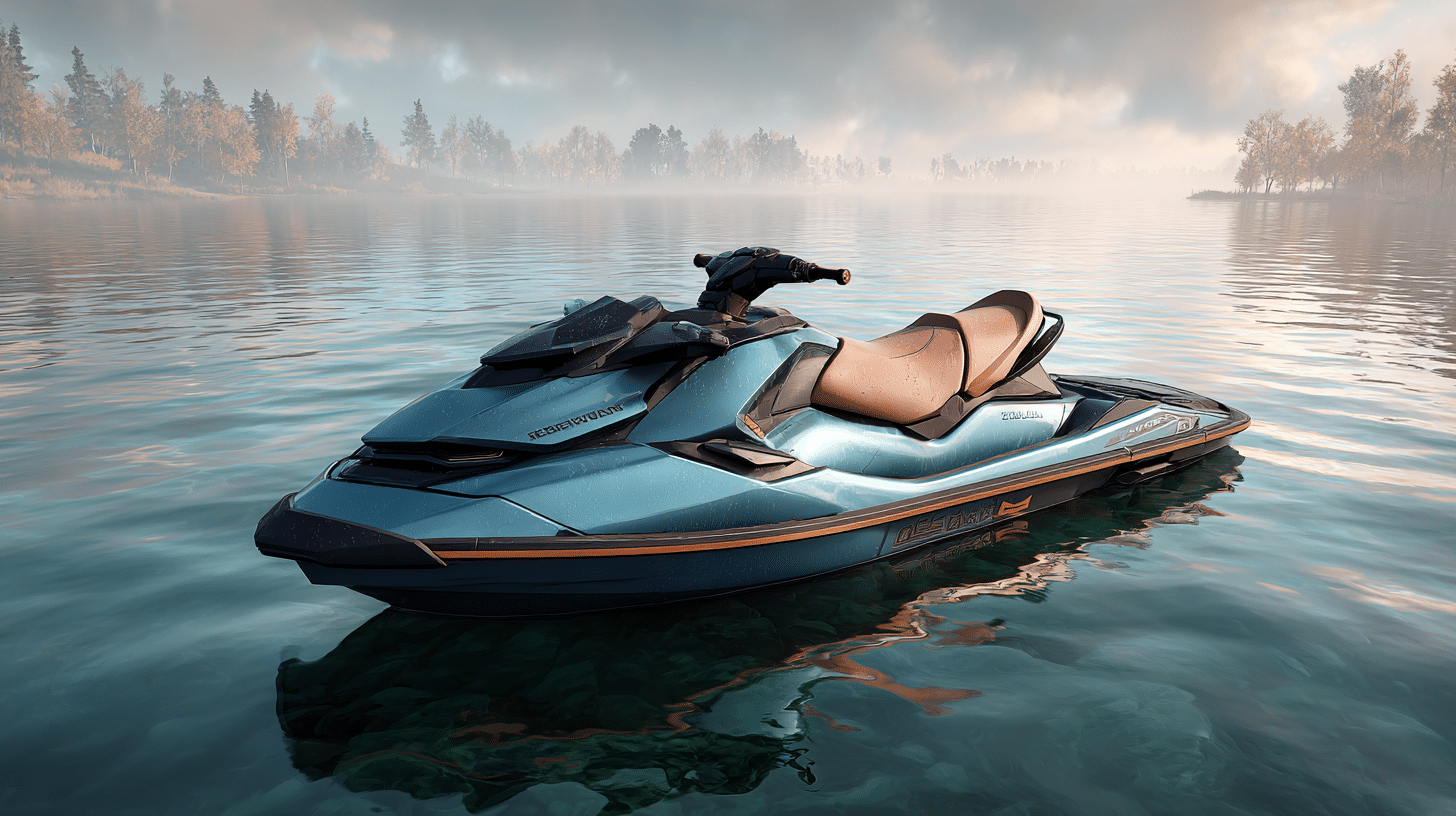
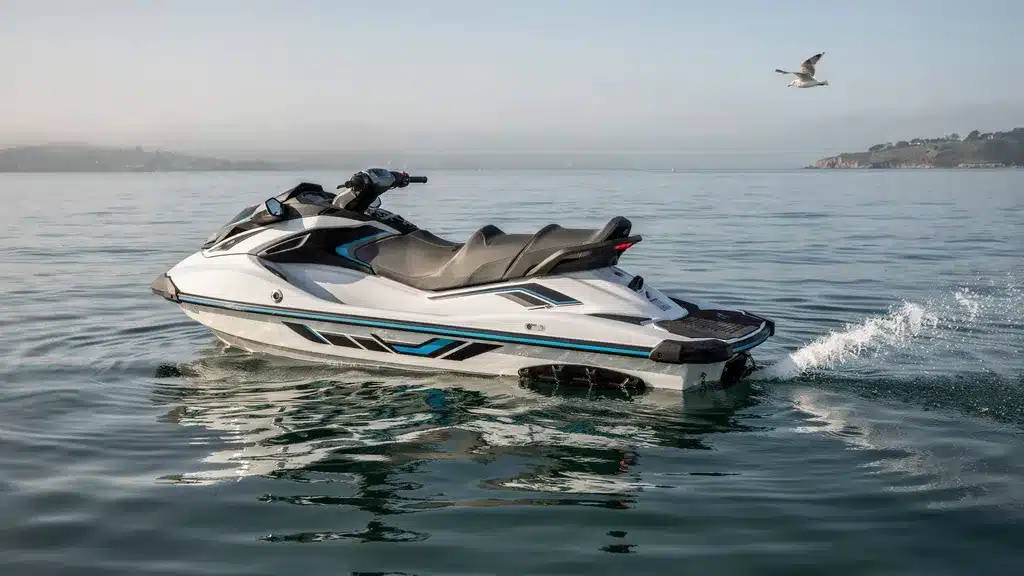
A jet ski is a small, motorized watercraft built for one to three riders. The term “Jet Ski” is actually a brand name owned by Kawasaki.
Other manufacturers use different names: Yamaha calls theirs a WaveRunner, and BRP uses Sea-Doo.
The correct name for all of these machines is personal watercraft, or PWC, according to the Virginia Department of Wildlife Resources.
PWCs come in two main styles: sit-down models, which are the most common today, and stand-up models, which are popular for sport riding.
Both types use the same internal jet drive system. The hull is made of fiberglass or a composite material and is shaped to glide across the water’s surface with minimal drag.
Is a Jet Ski Safe?Jet ski safety depends on rider behavior, conditions, and proper gear, including a kill switch lanyard, Coast Guard-approved life jacket, and protective eyewear. Common risks include high-speed collisions, shallow-water impacts, and loss of control in choppy conditions. Beginners should start slow in open, calm water and focus on understanding how the throttle controls both speed and steering before riding in more demanding conditions. |
The Origin of the Jet Ski
The modern jet ski traces back to Clayton J. Jacobson II, an American motocross enthusiast who developed the first functional personal watercraft in the 1960s.
Jacobson wanted to bring the thrill of dirt biking to open water.
His 1969 patent included all the core features still found in modern PWCs: an internal combustion engine, handlebar steering, and water-jet propulsion.
Kawasaki licensed his design and launched the first commercial Jet Ski in 1973.
The Jet Ski brand name became so widely used that it now refers to all personal watercraft, regardless of manufacturer.
Yamaha and BRP followed with their own models, the WaveRunner and Sea-Doo.
Watercraft Engine and Motor
Modern jet skis run on 4-stroke gasoline engines, similar to what you find in a car. Here is a breakdown of the key components:
- 4-stroke engine: Runs through four cycles: intake, compression, combustion, and exhaust to produce power without needing oil mixed into the fuel
- Fuel injection system: Delivers a precise fuel-and-air mix to the combustion chamber for consistent power output at high RPM
- Direct drive system: Connects the engine directly to the jet pump shaft, with no gearbox needed to transfer power
- Engine shaft: Spins at high speed to turn the impeller inside the pump housing
- High RPM design: Marine engines are built to sustain high revolutions per minute because water resistance demands constant, strong output
Together, these components form a compact, high-output system built for open-water use. The direct connection between the engine and the pump means power is transferred with very little mechanical loss.
How Does Water Get Into a Jet Ski Engine?
Water does not enter the engine itself. This is one of the most common points of confusion for new riders.
The engine runs on gasoline and air, just like a car engine. Water plays a separate role in the propulsion and cooling systems.
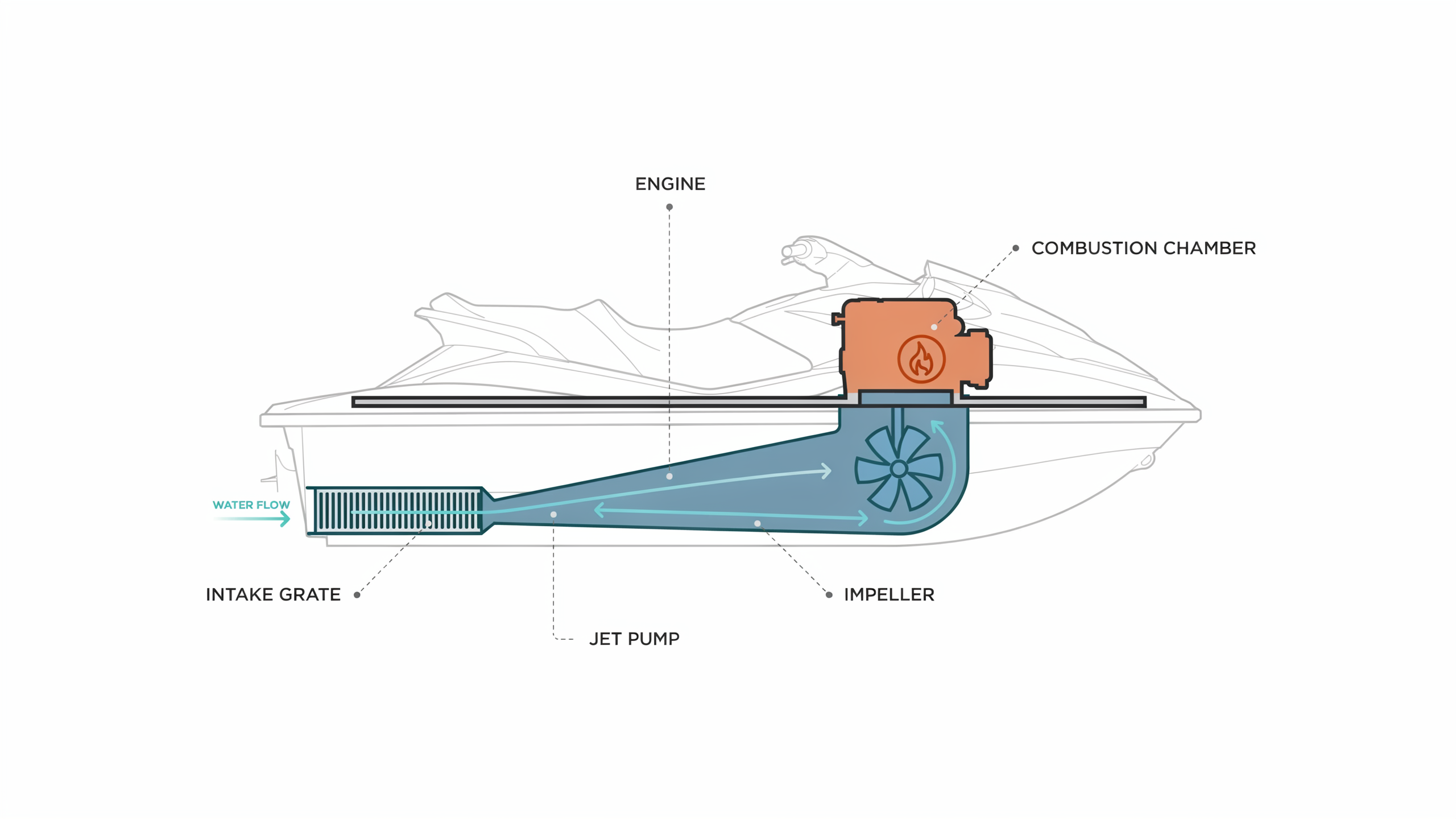
Water enters the craft through an intake grate on the underside of the hull near the front.
This grate is designed with slots wide enough to let water flow through freely but narrow enough to keep out rocks, debris, and large objects.
Once water passes through the intake grate, it moves into the jet pump housing.
From there, it feeds the impeller, which is the rotating part responsible for building pressure and speed.
The engine and the water system are two separate circuits.
The combustion chamber never comes into contact with the water from the lake or ocean below.
How the Jet Pump System Works
The jet pump is the heart of how a jet ski moves. It converts engine power into water pressure and thrust.
- Water intake grate: Sits on the bottom of the hull and draws water into the pump housing as the craft moves forward
- Impeller spin: A rotor with three stainless steel blades spins at high speed inside the pump housing, accelerating the water flowing through it
- Pressure buildup: As the impeller spins faster, water pressure builds inside the narrowing pump chamber
- Rear nozzle expulsion: High-pressure water is forced out through a cone-shaped nozzle at the back of the craft at high speed
- Impeller vs. propeller: A propeller sits outside the hull and pushes water backward with its blades. An impeller sits inside a sealed pipe, pulling water in at one end and blasting it out the other, making it a much safer and more controlled system
Each stage of the pump cycle happens in under a second. The result is a continuous, high-pressure stream that delivers reliable thrust as long as the throttle is engaged.
How Jet Propulsion Creates Movement
The physics behind jet ski movement is based on Newton’s Third Law of Motion: for every action, there is an equal and opposite reaction.
When the jet pump blasts water backward out of the rear nozzle, the craft moves forward with equal force.
Conservation of momentum explains why the water must exit at such high speed.
Since the momentum of the water firing backward must equal the momentum of the craft moving forward, a small volume of water has to travel extremely fast to move that much weight.
The faster the water exits the nozzle, the more thrust is produced.
Squeezing the throttle increases engine RPM, spins the impeller faster, and boosts water exit speed, all in a fraction of a second.
How Jet Ski Steering Works
Steering on a jet ski works through directed water thrust, not a rudder. Most riders find this system more responsive than traditional boat steering once they understand how the throttle and direction are connected.
- Handlebar-to-nozzle connection: Turning the handlebars pulls a cable that pivots the rear nozzle left or right
- Thrust-based steering: The nozzle redirects the water jet, pushing the back of the craft in one direction and the front in the opposite direction
- No thrust, no turning: Without engine power running the pump, there is no water stream to redirect, which means the craft cannot turn
- Throttle during turns: Riders must keep the throttle applied while turning to maintain steering control; releasing the throttle removes the ability to steer
This thrust-based steering system is one of the key differences between a PWC and a traditional boat.
Riders who understand this relationship between throttle and turning respond much better in tight situations on the water.
Jet Ski Engine Cooling

Every jet ski engine produces heat during operation, and a dedicated cooling system keeps temperatures within a safe range.
The most common setup is open-loop cooling. Raw water is pulled in through the intake, routed around the engine block to absorb heat, and discharged back out.
The engine stays cool because water flows through continuously during operation.
Sea-Doo models use a closed-loop system, similar to a car radiator.
A separate coolant fluid circulates through the engine and transfers heat to a ride plate heat exchanger on the hull bottom, which draws heat away without raw water ever touching engine internals.
Uses For Jet Skis
|
Jet Ski Hydrodynamics
Jet ski performance at speed depends on how the hull interacts with the water below it.
- Planning hull design: At low speeds, the hull sits in the water. At higher speeds, it rises and rides on top of the water surface, a state called planing
- Reduced drag at speed: Once the hull reaches planing speed, water contact is reduced to a small section near the rear, which lowers resistance and allows faster speeds
- Lift from hull shape: The curved underside of the hull generates upward force as speed increases, helping the craft stay on the surface rather than pushing through the water
- Water displacement changes with velocity: At low speed, the hull displaces a large volume of water. At planing speed, that displacement drops sharply, which is why jet skis feel like they jump forward past a certain throttle point
Hull geometry directly affects the speed and control a rider gets. PWC manufacturers spend significant time refining hull shapes to balance stability at low speeds with low drag at high speeds.
Why Jet Skis Don’t Use Propellers?
Traditional boats use an external propeller mounted below the hull to push water backward and move the boat forward. Jet skis do not use external propellers, and the reasons go beyond engineering preference.
An exposed propeller spinning at high speed in open water is a serious safety risk for swimmers, divers, and anyone who falls off the craft nearby.
PWCs eliminate that risk entirely by placing the impeller inside a sealed housing within the hull. There are no exposed moving parts below the waterline.
This design also allows jet skis to operate in much shallower water than most propeller-driven boats, since nothing hangs below the hull bottom.
Mechanical damage from underwater debris is also reduced because the impeller is protected by the intake grate and the pump housing, rather than operating in open water.
Conclusion
A jet ski moves by drawing water in through an intake grate, spinning it through an impeller inside the pump housing, and blasting it out through a rear nozzle at high pressure.
Newton’s Third Law does the rest: the water going backward pushes the craft forward.
The engine powers the impeller, the pump builds the pressure, and the steerable nozzle controls direction.
Every system works together in a short, direct chain from fuel to forward motion.
Knowing how each part functions makes you a more confident rider and helps you spot problems before they become serious.
If you are ready to get on the water, start with a certified riding course so your first ride is both controlled and safe.
Frequently Asked Questions
How Does a Jet Ski Reverse or Brake Without a Traditional Gearbox?
A reverse bucket redirects the water jet forward and downward under the hull, slowing the craft. Not all models include this feature; older ones rely on cutting the throttle to stop.
What Type of Fuel Does a Jet Ski Engine Run On?
Most jet skis run on regular unleaded gasoline with an octane rating of 87 or higher. High-performance models may require premium fuel per the manufacturer’s recommendation.
How Often Does a Jet Ski Engine Need an Oil Change?
Most 4-stroke jet ski engines require an oil change every 25 to 50 hours of operation, roughly equivalent to one full riding season for casual users.
Why Does a Jet Ski Shoot Water Up Into the Air While Riding?
That visible water stream is expelled from a separate safety outlet on the deck, not the propulsion nozzle. It signals the craft’s presence to nearby boats on the water.
Can a Jet Ski Engine Overheat if Ridden in Very Shallow Water?
Yes. Open-loop cooling systems pull water from outside the hull. In extremely shallow water, reduced water intake can restrict cooling flow and cause the engine to overheat quickly.