


Most divers have seen the gear and wondered what it actually does. A rebreather is not just upgraded scuba equipment. It works on a completely different principle, recycling your breath instead of releasing it into the water.
That changes everything from how long you can stay down to how quietly you move through the water.
Before deciding whether rebreather diving is worth pursuing, it helps to understand exactly how the system works, what it demands of the diver, and whether it fits where you are in your diving experience right now.
What is a Rebreather System?
A rebreather is an underwater breathing system that recycles the air you exhale instead of releasing it into the water.
Unlike open-circuit scuba, where every breath out sends bubbles rising to the surface, a closed-circuit system filters out carbon dioxide and feeds the remaining oxygen back to you.
The reason this matters is simple. The human body uses only about 4% of the oxygen in each breath, so open-circuit scuba wastes the remaining 96% with every exhale.
A rebreather captures that unused gas and puts it back to work. For divers who spend long hours underwater, that efficiency adds up quickly.
There are three main types: oxygen rebreathers, which carry only pure oxygen and are limited to shallow depths; semi-closed circuit rebreathers, which use a nitrox mix and vent a portion of gas with each breath; and closed-circuit rebreathers, which recycle all exhaled gas and are the most capable and most commonly discussed type.
Most modern recreational and technical rebreather diving uses the closed-circuit system.
| Common Misunderstandings
Before considering this equipment, there are a few things worth getting straight:
|
Inside the System: How It Functions Step by Step

A rebreather works through a continuous loop that processes every breath you take underwater. Instead of releasing exhaled gas, it cleans and recycles it back to you.
Understanding each part of that loop helps explain why this system performs so differently from standard scuba.
1. Breathing Loop Explained in Simple Terms
When you inhale, gas travels from the system into your lungs. When you exhale, that gas does not escape into the water. Instead, it moves back through the loop where it gets processed and returned to you.
This continuous cycle is what separates rebreather diving from open-circuit scuba, where exhaled gas is simply released and lost with every breath.
2. Role of Oxygen Control
Oxygen levels inside the breathing loop are tracked continuously using built-in sensors. The system adds oxygen when levels drop and holds back when they rise too high.
Getting this balance right is critical because too little oxygen causes blackout and too much raises the risk of oxygen toxicity. Proper oxygen control is one of the most important safety functions in any rebreather dive.
3. Carbon Dioxide Removal Process
A scrubber unit packed with a chemical absorbent, most commonly Sofnolime, sits inside the loop and neutralizes carbon dioxide from every exhaled breath. Without this step, CO₂ would build up quickly and become dangerous within minutes.
The scrubber material has a limited lifespan and must be replaced regularly. Letting it expire mid-dive is one of the most serious risks in rebreather diving.
Main Parts That Make the System Work
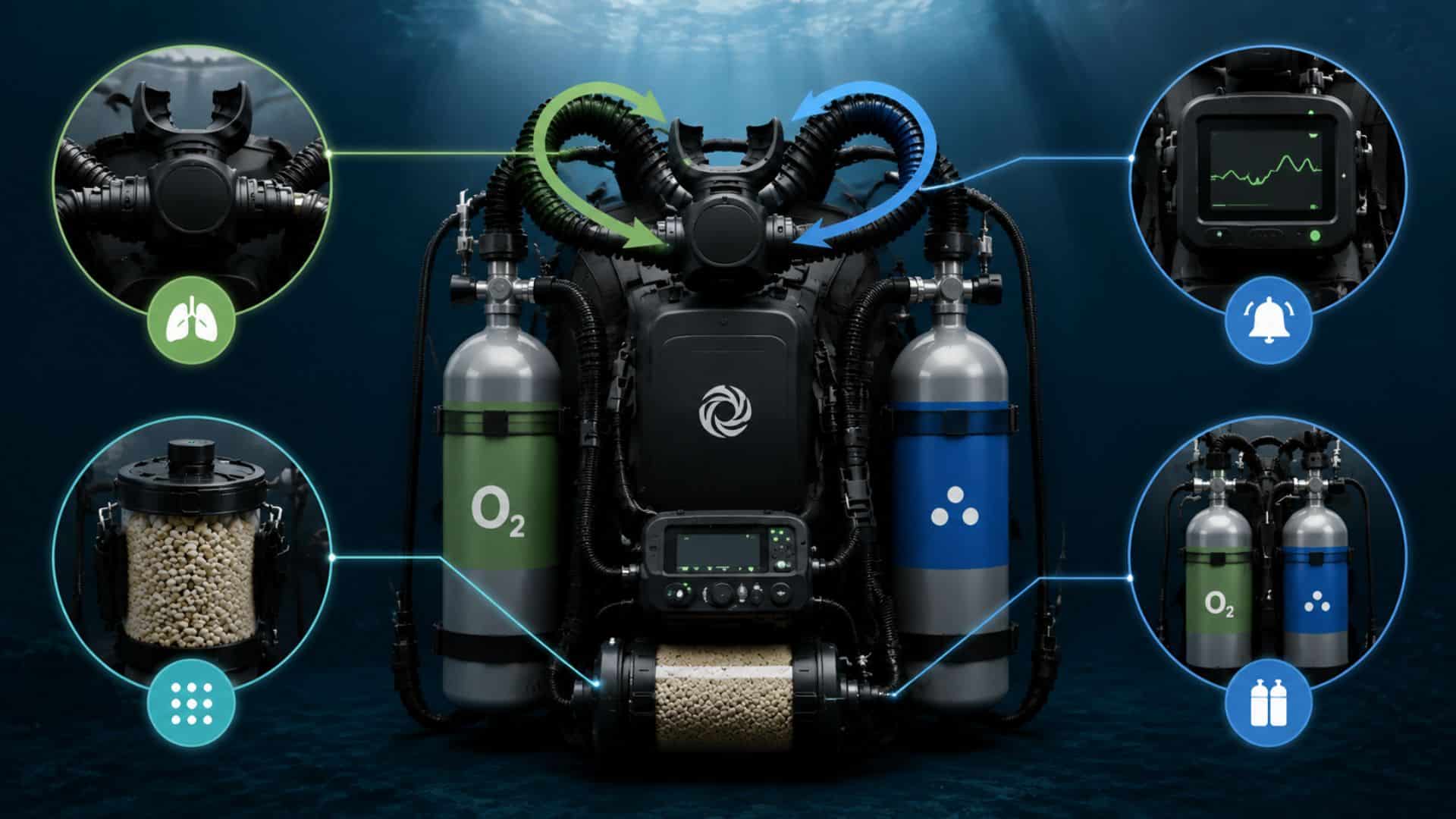
A rebreather consists of several components that work together as a single closed system. Each part performs a specific function, and all of them must operate correctly for a safe and effective rebreather dive.
Mouthpiece and Breathing Loop
The mouthpiece is where every breath begins and ends. Inhaled gas enters the loop, and exhaled gas returns through it for processing.
This circular path keeps gas moving continuously, preventing any release into the water and forming the foundation of the entire rebreather system’s operation underwater.
Scrubber Canister
The scrubber canister contains a granular chemical absorbent called Sofnolime that reacts with carbon dioxide in your exhaled breath, neutralizing it. This process happens passively with every breath cycle.
The absorbent has a set usage limit and breaks down over time, which is why checking and replacing scrubber material before each dive is a non-negotiable part of rebreather diving preparation.
Sensors and Monitoring Unit
Oxygen sensors inside the loop measure gas levels in real time throughout the dive. If oxygen drops too low or rises too high, the monitoring unit triggers a warning to alert the diver immediately.
These alerts provide the information you need to respond before conditions become dangerous, making the sensor system one of the most critical safety components on any rebreather.
Gas Cylinders
A rebreather carries two separate cylinders. One holds pure oxygen, which is added to the loop as oxygen levels drop during the dive.
The second holds a diluent gas, usually air or trimix, which helps maintain the right overall gas volume and pressure inside the breathing loop throughout the descent and dive.
How it Compares to Standard Scuba Equipment
Standard scuba and rebreather diving serve the same purpose but work in very different ways. Comparing the two side by side helps recreational divers understand what they are actually gaining or taking on before making any decisions about switching systems.
| Feature | Open Circuit Scuba | Rebreather |
|---|---|---|
| Gas Usage | High. exhaled gas fully released | Low. Gas recycled through the loop |
| Dive Duration | Limited by tank capacity | Extended per cylinder |
| Bubble Output | Constant with every exhale | Near silent, minimal to none |
| Wildlife Impact | Can disturb marine life | Far less disruptive |
| Breathing Gas Quality | Cold and dry from the cylinder | Warm and humid, it reduces fatigue and dehydration |
| Complexity | Beginner accessible | Requires training and monitoring |
| Cost | Lower entry point | Higher equipment and training costs |
Rebreather diving offers clear advantages in gas efficiency, dive time, and quietness underwater. One important difference to understand before training is buoyancy control. On open-circuit scuba, breathing in slightly lifts you and breathing out slightly sinks you.
On a rebreather, the gas volume in the loop stays constant, so breathing in or out does not change your buoyancy at all.
This requires a new approach to depth control that takes practice to master. These differences, combined with added cost and complexity, make standard scuba the more practical starting point for most recreational divers.
Safety Requirements and Training Needs
Rebreather diving requires mandatory certified training before any underwater use. The system is sensitive, and maintaining the right gas balance depends entirely on the diver’s ability to manage it.
Pre-dive setup checks, scrubber replacement, and post-dive cleaning are all part of the routine. Skipping any step, whether before or after a dive, significantly increases risk.
This same safety-first mindset for open-water activity applies to all serious water sports, not just rebreather diving.
| Common Beginner Mistakes
New rebreather divers often make a few repeated errors worth knowing before getting started:
|
Who Should Consider Using It and Who Should Avoid It
Rebreather diving is best suited for experienced divers who already hold advanced certification and are comfortable managing complex equipment underwater.
Casual recreational divers and first-time learners should avoid it until a solid foundation in scuba divingis firmly in place. Understanding where basic underwater activities sit on the experience scale helps set realistic expectations before pursuing rebreather training.
The system demands too much active involvement and technical awareness to be practical for anyone still building basic underwater skills. If you are serious about making the transition, the progression looks like this:
Basic scuba certification → Advanced open water training → Specialty rebreather qualification
Cost and Practical Investment Overview
Rebreather diving carries a significant upfront investment, with ongoing costs that add up depending on how frequently you dive. Professional-grade units run considerably higher than entry-level systems.
Here is a general breakdown of what to expect across the main cost areas:
| Cost Area | Estimated Range |
|---|---|
| Entry Level System | $3,000 to $8,000 |
| Professional Grade Unit | $8,000 to $20,000+ |
| Certified Training Course | $800 to $2,000 |
| Scrubber Material (per dive) | $5 to $15 |
| Routine Maintenance (annual) | $200 to $600 |
| Gas Refills (per dive) | $20 to $50 |
The cost of rebreather diving is justified for divers who frequently dive underwater and need extended dive times. For occasional recreational divers, standard scuba remains the more cost-effective choice.
Real World Use Cases in Underwater Activity
Rebreather diving is most valuable in professional, creative, and technical settings where standard scuba simply cannot match its performance or efficiency.
- Professional Underwater Work: Scientists and technical divers use rebreather systems for extended research and complex operations, including technical enclosed underwater environments, where longer uninterrupted bottom time is essential.
- Photography and Marine Observation: Near-silent operation keeps marine life undisturbed, giving underwater photographers a clear advantage when capturing natural behavior.
- Technical Deep Environment Use: Gas efficiency allows divers to stay down considerably longer than any open-circuit setup permits.
These use cases highlight where rebreather diving truly delivers, well beyond what standard scuba can offer.
| Key Points Beginners Should Remember
Rebreather diving has a real learning curve that cannot be skipped. Structured training, constant monitoring, and solid experience on standard scuba all come before making the switch. Only after building consistent skills and confidence in open-circuit diving does upgrading to a rebreather system make sense. |
Conclusion
Rebreather diving is a capable system, but it is not for everyone. The technology rewards divers who put in the time to learn it properly and use it regularly.
For beginners, the path starts with an open-circuit experience, not here. For experienced divers ready to extend bottom time, reduce disturbance, or take on technical work, a rebreather becomes a serious and worthwhile option.
The investment in training and equipment is real, but so are the results when the system is used by someone genuinely prepared for it.
Frequently Asked Questions
Is Rebreather Diving Safe for Beginners?
No. It requires advanced scuba experience and certified rebreather training before any underwater use.
How Long Can You Dive With a Rebreather?
Anywhere from 1 to 6 hours, depending on the unit, scrubber size, water temperature, depth, and diver workload. Most recreational dives stay within a 2 to 3-hour window.
What Does a Rebreather Cost on Average?
Entry-level units typically start around $3,000, with professional-grade systems reaching $15,000 or more when training costs are included.
Can a Rebreather Run Out of Oxygen Underwater?
Yes. Sensors continuously monitor levels, but the cylinder supply is finite and must be managed carefully throughout the dive.
Do You Still Need Scuba Certification for Rebreather Diving?
Yes. A standard scuba certification is the required foundation before enrolling in any rebreather training course.






One Response