

Few sports have a messier, more rebellious origin story than snowboarding.
What began as a father’s backyard experiment in the 1960s grew into one of the most watched winter sports on the planet, complete with Olympic medals, billion-dollar brands, and a culture entirely its own.
The history of snowboarding is not just about the sport itself; it is about the people who refused to let it die when ski resorts banned it, when critics dismissed it, and when the mainstream ignored it.
This is the full story, from its invention to the global force it is today.
When was Snowboarding Invented?
The year was 1965, and Sherman Poppen was not trying to invent a sport. He was trying to keep his kids entertained.
The Michigan-based engineer fastened two skis side by side and sent his daughter sliding down the backyard slope. The reaction was immediate; every child in the neighborhood wanted one.
He named it the Snurfer, licensed it to Brunswick Corporation, and watched it move from his backyard to store shelves across America.
But the Snurfer’s biggest contribution was not its sales figures. It was the image it put in people’s heads, standing sideways on a board, riding the snow the way surfers rode waves.
That image refused to go away, users across the globe became familiar with snowboarding, and it became an obsession worth building a sport around.
The Development of Snowboarding in the 1970s
The Snurfer had planted the idea. The 1970s were about two very different people deciding, independently, to do something about it.
Jake Burton Carpenter & Burton Snowboards
- The Snurfer lacked foot bindings, limiting rider control and performance
- Jake Burton Carpenter began experimenting with bindings in his Vermont garage in the mid-1970s
- Bindings allowed riders to carve turns, control speed, and push the board far beyond what the Snurfer could offer
- In 1977, he founded Burton Snowboards, which is one of the most preferred snowboard brands, starting with hand-built boards out of a small workshop
- It grew into the most recognized name in snowboarding history
Tom Sims & the Skateboarding Influence
- Tom Sims approached snowboarding as a skateboarder first
- His designs were wider, trick-focused, and carried the rebellious energy of skate culture
- Sims helped attract an entire generation of sideways riders onto the mountain
- Where Burton built performance, Sims built attitude, and snowboarding needed both
By the end of the 1970s, snowboarding had moved from a backyard toy to a sport with real pioneers, real products, and a culture of its own.
What are Snowboards Made of?
|
Snowboarding Didn’t Start on a Mountain: Here’s Where It Did
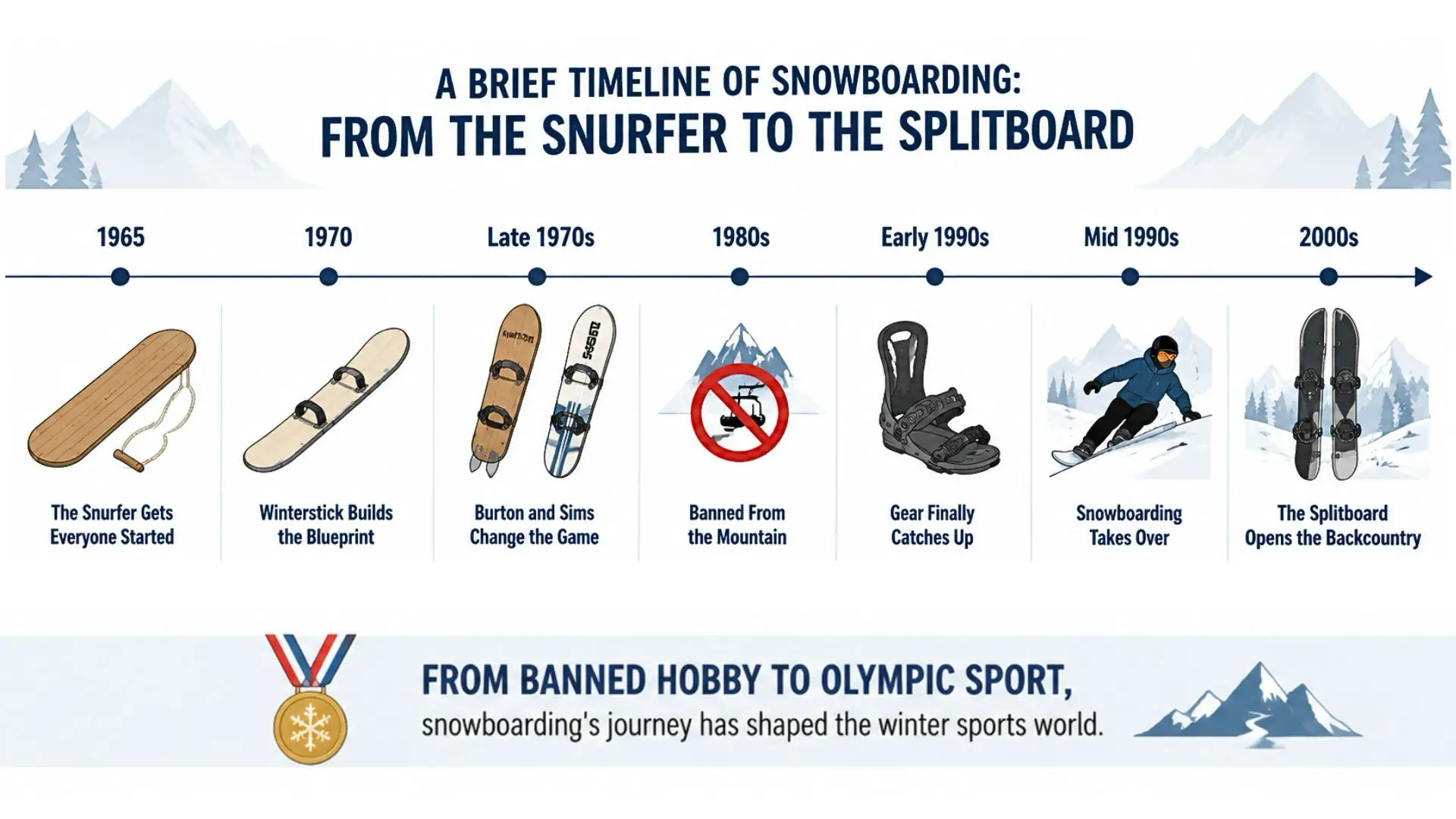
Snowboarding didn’t start at a resort. It started in someone’s backyard with a piece of wood, a rope, and a bad idea that turned out to be a great one. What followed over the next 40 years changed winter sports entirely.
1965: The Snurfer Gets Everyone Started
Sherman Poppen built a snowboard-shaped surfboard and called it the “Snurfer.” It went into commercial production, and between 1965 and 1975, over a million units were sold at $15 each.
1970: Winterstick Builds the Blueprint
East coast surfer Dimitrije Milovich began building boards based on the shortboard model, adding steel edges, laminated fiberglass, and nylon straps. His company, Winterstick, is widely considered the first dedicated snowboarding company, though it eventually went out of business.
Late 1970s: Burton and Sims Change the Game
Jake Burton Carpenter, then 23, kept tinkering with his Snurfer until he landed on a flexible wood-planked board with footstraps and fins. Around the same time, former skateboard champion Tom Sims began producing his own snowboards.
1980s: Banned From the Mountain
Most ski resorts refused to allow snowboarding on public runs. Early riders had to hike up at night to avoid detection or stay in the backcountry. Competitions picked up during this period, starting as races before shifting to freestyle events that drew on skateboarding culture.
Early 1990s: Gear Finally Catches Up
Ski-industry materials improved board glide, and Flite introduced the first high-back bindings. Board design expanded fast: rounded tails, hard boots, powder boards, twin-tips, carving boards, and asymmetrical shapes all emerged in quick succession.
Mid 1990s: Snowboarding Takes Over
Snowboarding became the fastest-growing winter sport on the planet, with more than 6 million participants. More than 80% of young people learning alpine sports chose snowboarding over skiing, forcing most resorts to finally open their doors to riders.
2000s: The Splitboard Opens the Backcountry
Voile’s splitboard design gave snowboarders a real alternative to snowshoes, making backcountry terrain far more accessible and expanding where and how people could ride.
Snowboarding went from a banned hobby to an Olympic sport in just a few decades.
Key Milestones and Growth of Snowboarding
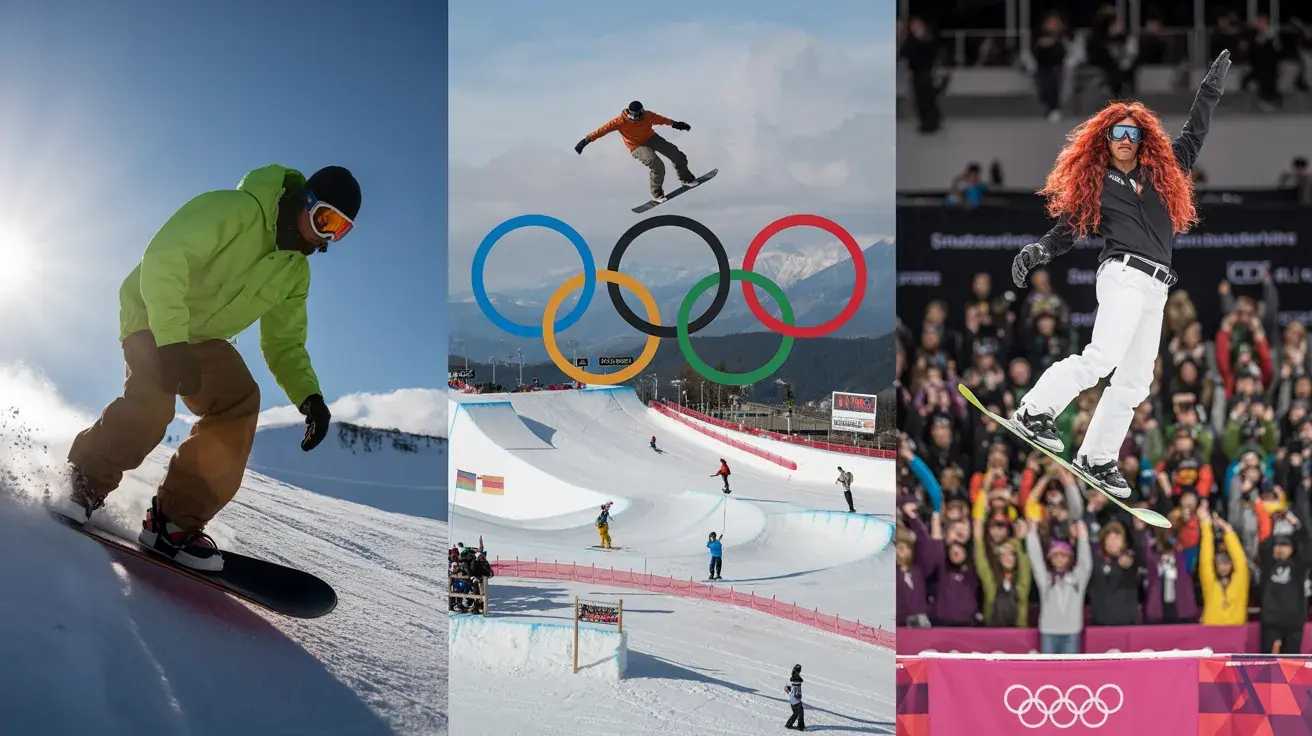
For most of the 1980s, snowboarding was not welcome on the mountain. Ski resorts across North America banned it, and riders had no choice but to build their culture around the edges of the winter sports world.
That changed as the following grew too large to dismiss: parks, halfpipes, and dedicated terrain gradually replaced the closed gates.
The 1998 Winter Olympics in Nagano gave snowboarding its biggest stage yet. For millions of viewers, it was their first real look at the sport, and it showed.
Participation surged, the X Games brought competitive energy to a global audience, and Shaun White became the face that carried snowboarding into the mainstream for good.
Why Snowboarding Became Popular?
In the 1980s, ski resorts actively banned snowboarders from their slopes, viewing them as reckless outsiders.
That resistance only made the sport more attractive to a younger generation looking for something raw, free, and entirely their own.
Where skiing had rules and tradition, snowboarding had creativity and self-expression. Riders brought their own music, their own clothing, and their own attitude to the mountain, and that identity spread fast.
The 1980s and 1990s MTV generation took to it naturally. Snowboarding videos circulated widely, dedicated magazines launched across the US and Europe, and the aesthetic, baggy clothing, gave it a visual identity that felt genuinely different from anything winter sports had offered before.
By the early 1990s, ski resorts began lifting their bans as snowboarders filled their slopes and spent money. Once the infrastructure caught up, mainstream audiences followed, and the sport never looked back.
Where Snowboarding Stands Today

Snowboarding today is a global sport with no signs of slowing down. The United States alone counts approximately 6.56 million active snowboarders, and the sport continues to grow across Europe, Asia, and beyond.
The global snowboard market reached approx USD 1.98 billion in 2024 and is projected to expand to USD 3.29 billion by 2033. Dataintelo Burton remains the most recognized brand in the industry, still leading the market nearly five decades after Jake Burton built his first board in a Vermont garage.
Newer names like Capita, Ride, and Arbor continue to push the sport forward in both performance and sustainability.
With the 2026 Winter Olympics in Milan-Cortina on the horizon and a new generation of riders rewriting what is possible on a board, the sport that was once banned from ski resorts shows no sign of losing its edge.
Conclusion: The Future of Snowboarding
Snowboarding has never moved in a straight line, and that is exactly what makes it worth following.
What Sherman Poppen built for his daughter in 1965 has grown into a global sport with millions of riders, billion-dollar brands, and a competitive scene that keeps redefining what is physically possible on a board.
The history of snowboarding is a story of people who refused to be turned away, from ski resorts, from mainstream sports, from the world stage.
That refusal built everything. And it is not finished yet. If you are also planning to get started, do let us know in the comments.
Frequently Asked Questions
Who is Considered the Father of Modern Snowboarding?
Jake Burton Carpenter is widely regarded as the father of modern snowboarding, having added foot bindings and founded Burton Snowboards in 1977.
When Did Snowboarding Become an Olympic Sport?
Snowboarding made its Olympic debut at the 1998 Winter Games in Nagano, Japan, with halfpipe and giant slalom as the first two disciplines. It was a landmark moment that brought the sport to a global audience for the first time.
Why were Snowboarders Banned from Ski Resorts?
Through the 1980s, ski resort owners viewed snowboarders as reckless and unpredictable, considering them a liability on groomed slopes. The bans gradually lifted as the sport’s popularity grew too large for resorts to ignore.
What was the First Commercially Sold Snowboard Called?
The first commercially sold snowboard was the Snurfer, invented by Sherman Poppen in 1965 and licensed to Brunswick Corporation shortly after.