
Ever wondered what the word “scuba” actually stands for? Most people instantly associate it with underwater diving, yet very few know the real meaning of the scuba acronym.
Interestingly, scuba isn’t just a random term; it’s a well-defined abbreviation that explains how divers breathe beneath the surface. Understanding this acronym not only satisfies curiosity but also helps you grasp how scuba diving works in real life.
In plain terms, SCUBA stands forSelf-Contained Underwater Breathing Apparatus, a wearable system that lets divers carry their own air supply and move freely below the surface without being connected to the boat or shore above.
Once you break it down, the meaning becomes easy to remember and directly connected to the diving experience itself.
SCUBA Acronym Meaning: A Letter-by-Letter Breakdown
SCUBA stands for Self-Contained Underwater Breathing Apparatus. Each word in this acronym has a specific meaning that together describes exactly how the equipment functions.
| Letter | Word | What It Means |
|---|---|---|
| S | Self | The diver is fully independent. No hoses, no cables, no connection to the surface, everything needed for the session is carried by the diver alone. |
| C | Contained | The entire air supply is sealed within a compact system strapped to the diver’s back, making it portable and self-sufficient. |
| U | Underwater | The apparatus is purpose-built for use beneath the surface, engineered to withstand water pressure at varying depths. |
| B | Breathing | Scuba exists for one reason: to deliver breathable air to the diver in an environment where humans cannot naturally breathe. |
| A | Apparatus | Not just one piece of equipment, it’s a complete system: tank, regulator, and mouthpiece all working together. |
When you put it all together, SCUBA is essentially a wearable, self-powered breathing system designed for underwater exploration. That’s exactly why the name stuck.
Who Coined the SCUBA Acronym
SCUBA did not emerge by accident. The term was officially coined by Dr. Christian J. Lambertsen in 1952, when he patented a modified version of his earlier underwater breathing apparatus developed for the U.S. military.
Before that, the device was called the Lambertsen Amphibious Respiratory Unit, or LARU, a much less memorable name. By introducing SCUBA, Lambertsen gave the invention a clear, lasting identity, and the term quickly spread beyond military circles.
Yet the device itself has an earlier origin. In 1942, French naval officer Jacques Cousteau and engineer Émile Gagnan created the Aqua-Lung, an open-circuit regulator widely seen as the forerunner of modern scuba gear.
Cousteau helped popularize diving, but Lambertsen supplied the name that endured worldwide.
What Does Scuba Actually Mean in Practice?
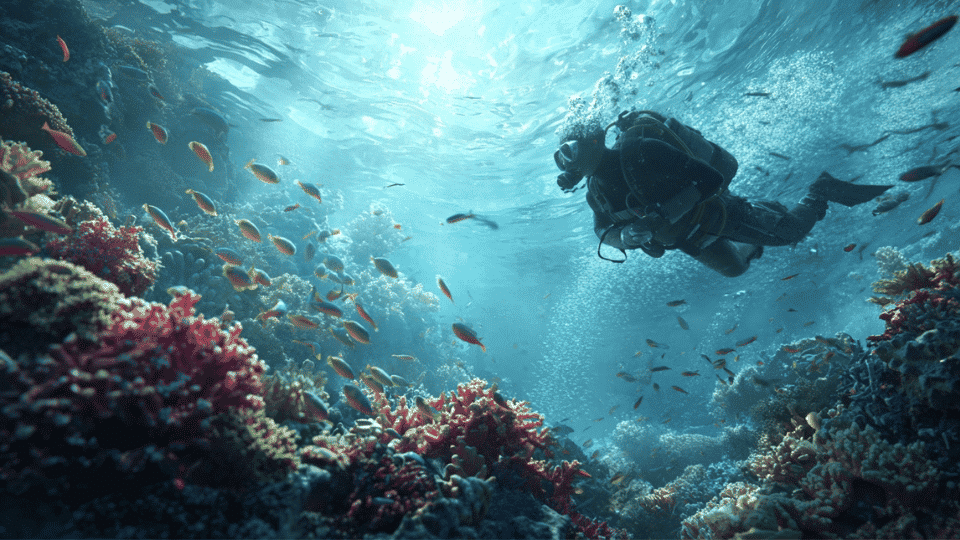
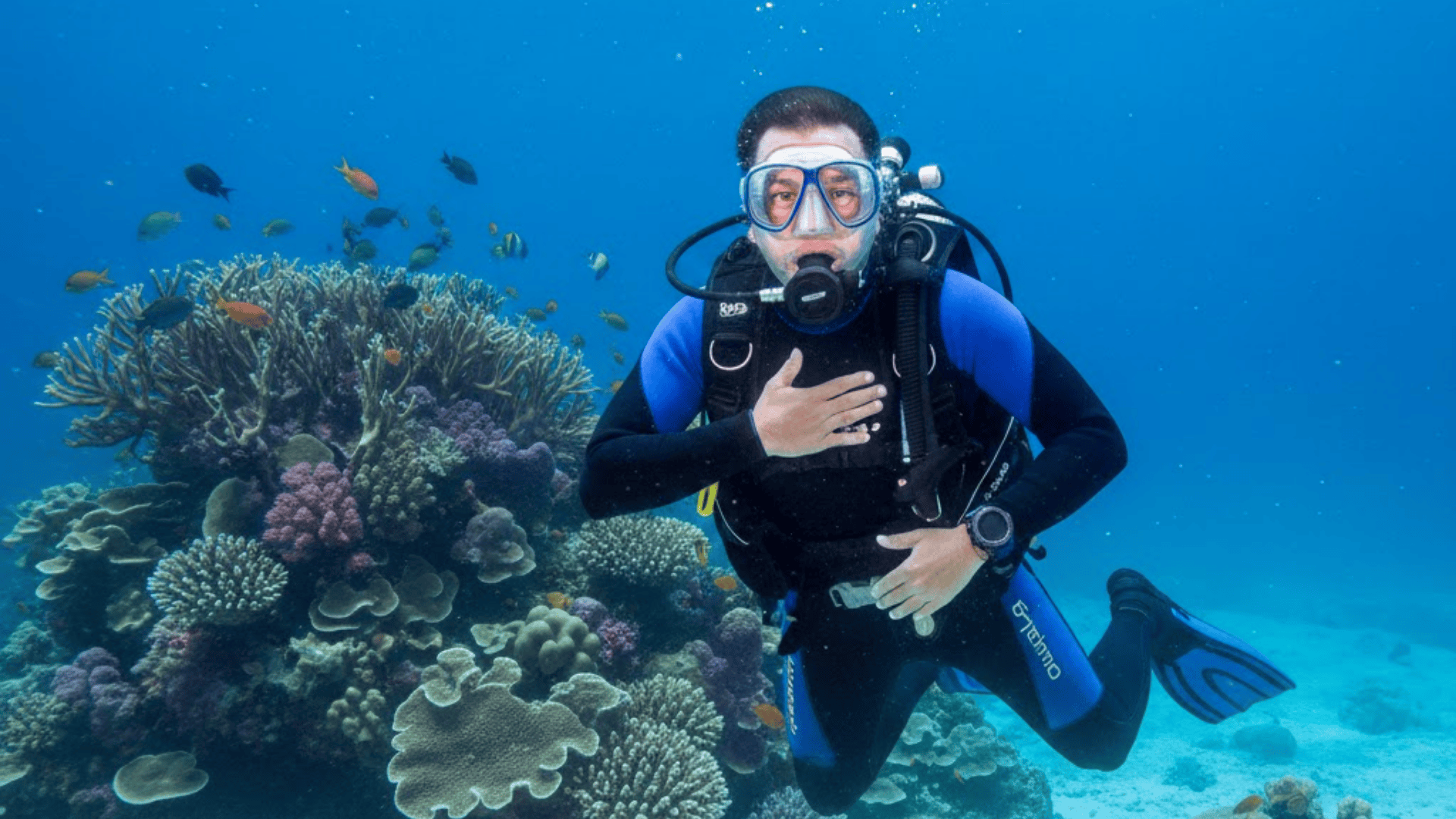
SCUBA is a diving system that allows divers to breathe underwater using air they carry, giving them the freedom to move and explore underwater environments.
This independence is what makes scuba diving unique. The equipment works together to deliver air at the right pressure, allowing you to breathe naturally while submerged.
It also helps control buoyancy, so divers can ascend, move downward, or stay at a stable depth with ease. Simply put, SCUBA isn’t just an acronym; it’s a complete system that enables safe and controlled underwater exploration.
What Does a SCUBA System Actually Do?
At its core, a scuba system solves three fundamental challenges that enable underwater exploration.
1. It Lets You Breathe Underwater: The human body cannot extract oxygen from water the way fish do. A scuba system bypasses this entirely by supplying compressed air from a tank through a regulator, delivering it at a safe, breathable pressure no matter how deep you go. Every breath you take underwater is made possible by this single function.
2. It Helps You Control Your Depth: Staying at a specific depth underwater is not natural for the human body. The scuba system works together with a buoyancy control device to help divers rise, descend, or hover in place with precision. This control is what allows divers to explore coral reefs, shipwrecks, and underwater landscapes without constantly fighting the current.
3. It Allows You to Move Freely Underwater: Because the entire system is carried by the diver, there are no hoses or tethers restricting movement. A diver can swim in any direction, at any depth within safe limits, and explore the underwater environment with the same freedom as walking on land.
These three functions are exactly what the acronym promises: a self-contained apparatus that handles breathing, depth, and movement simultaneously.
Scuba Diving vs. Free Diving: What’s the Difference?
A question that comes up often among beginners: if free divers can go deep on a single breath, why do you need all that gear?
Free diving, also called breath-hold diving, relies entirely on the diver’s lung capacity.
Competitive free divers can reach remarkable depths, but recreational free diving is generally limited to 10–20 meters and lasts only as long as the diver can hold their breath, typically under two minutes.
SCUBA removes both of those constraints. Because you carry your own air supply, you can stay submerged for 45–60 minutes and descend to 30–40 meters recreationally, with no breath-holding required. The tradeoff is the equipment weight and the training needed to use it safely.
Snorkeling sits below both: it’s surface-level, with no submersion beyond a few feet, using only a mask and tube. If you’re still deciding between snorkeling and scuba diving, understanding the cost, training requirements, and depth limits can help you choose
Why “Scuba” Is Now a Word (Not Just an Acronym)
Few acronyms make the rare leap from abbreviation to everyday word, but scuba is one of them. Linguists call this a lexicalized acronym: a term used so often that people no longer think of it as initials.
Words like laser, radar, and taser followed the same path. Scuba joined them as recreational diving expanded in the 1960s and 1970s, helped by Jacques Cousteau, who brought the underwater world into homes through television.
Over time, people stopped writing it as S.C.U.B.A. in capitals with periods. It became lowercase, conversational, and widely accepted.
Today, Merriam-Webster lists scuba as both a noun and an adjective, proving it now stands as a full ordinary word in English.
What Equipment Is Included in Scuba?
The scuba system consists of three primary components. Each one handles a specific function, and together they enable underwater breathing.
| Component | Function | Beginner Note |
|---|---|---|
| Tank (Cylinder) | Stores compressed air on the diver’s back. Filled with regular air (~3,000 PSI), not pure oxygen. | A standard aluminum 80 cu ft tank lasts 45–60 min at 10m, shorter as you go deeper. |
| Regulator | Connects to the tank and reduces high-pressure air to a safe, breathable level. Delivers air on demand when you inhale. | The regulator is what makes each breath feel natural, even at 20 meters down. |
| BCD (Buoyancy Control Device) | A wearable vest that holds the tank and controls depth by inflating or deflating an internal air bladder. | Mastering your BCD is the main focus of the first open-water dives during certification. |
Together, these three components form the complete “apparatus” that the scuba acronym refers to. Remove any one of them, and the system no longer works.
Common Scuba Acronyms You Should Know
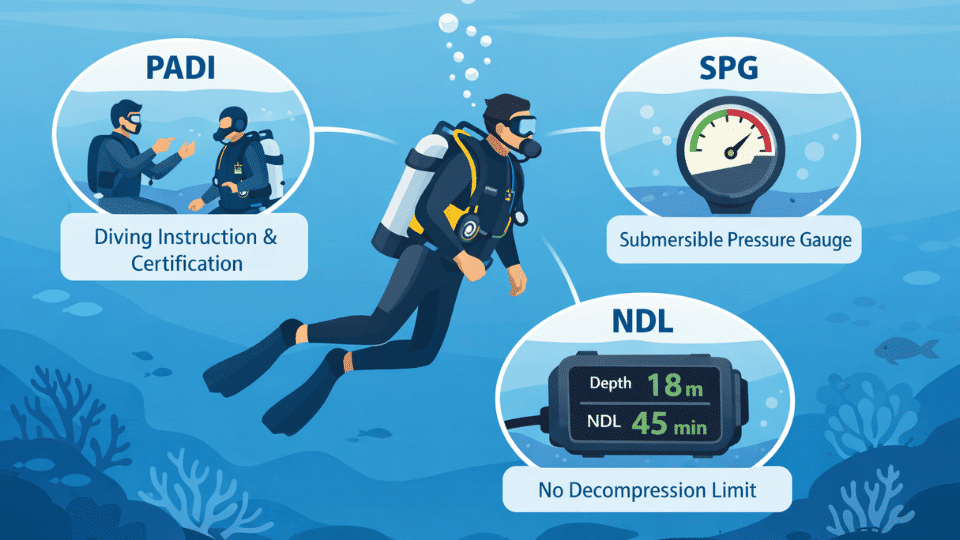
SCUBA is just the beginning. The diving world is full of abbreviations that come up regularly, from your first lesson all the way through to open water certification.
1. PADI (Professional Association of Diving Instructors)
PADI is the world’s largest scuba diving training organization. It sets the global standard for recreational diver education and offers certifications ranging from beginner Open Water to advanced professional levels.
Other major certifying bodies include SSI (Scuba Schools International) and NAUI (National Association of Underwater Instructors). All three produce internationally recognized certifications; PADI is simply the most widely distributed.
If you’re planning to get your certification, most beginners complete the Open Water course in 3-4 days, though the exact duration varies based on your schedule and learning pace.
2. SPG (Submersible Pressure Gauge)
The SPG monitors the amount of air remaining in the tank during an underwater session. It is one of the most critical instruments a diver checks regularly to ensure they surface with a safe reserve of air.
Most instructors teach the “rule of thirds”, use one third of your air going out, one third returning, and keep one third in reserve. On my first few open-water dives, I burned through air much faster than my instructor because I was tense. Relaxed breathing is a genuine skill that develops over your first 10–15 dives.
3. NDL (No Decompression Limit)
NDL refers to the maximum amount of time a diver can stay at a certain depth without needing to make decompression stops during ascent. Staying within this limit helps ensure a safe return to the surface and reduces the risk of decompression sickness.
Dive computers calculate your real-time NDL automatically throughout a dive. For context: at 18 meters, your NDL is roughly 56 minutes. At 30 meters, it drops to about 20 minutes. The deeper you go, the faster nitrogen builds up in your tissues, and the less bottom time you have.
Getting familiar with these acronyms early makes diving far less overwhelming. The more comfortable you are with the language, the more focused you can be on the experience itself.
Is SCUBA Diving Safe for Beginners?
Yes, with proper training, scuba diving has a strong safety record. According to Divers Alert Network (DAN), the risk of a serious diving incident for a trained recreational diver is very low, comparable to that of other outdoor sports such as cycling or hiking.
The biggest risk factors are skipping training, diving beyond your certification depth, and ascending too quickly. All three are preventable through a recognized certification course.
Most people in reasonably good health can learn to dive.
You don’t need to be a strong swimmer, though basic comfort in the water is required. The Open Water certification course through PADI or SSI takes 3–4 days and covers everything from equipment setup to emergency procedures.
If you’ve been hesitant because diving seems technical or intimidating, the acronym itself is reassuring: it’s a Self-Contained system.
The gear is doing most of the hard work. Your job is to breathe steadily and not panic. Learning the basic skills takes just a few days with proper instruction.
Final Thoughts
The scuba acronym’s meaning is more than just an interesting piece of trivia. It reflects the full purpose of the technology in only five letters: a self-contained system that allows divers to breathe underwater safely and independently.
This invention transformed the underwater world from a place humans could only visit briefly into one accessible for recreation, training, research, and exploration.
From its early military and professional uses to its widespread place in modern diving culture, scuba has become a term recognized around the world.
For those interested in learning to dive or just exploring its meaning, knowing what scuba stands for adds a deeper appreciation of the sport and the equipment behind every dive.
Frequently Asked Questions
How Long Does a Scuba Tank Last Underwater?
A standard tank lasts 45 to 60 minutes at recreational depths. Breathing rate and depth both affect consumption, as deeper sessions use air significantly faster.
Do You Need a Certification to Go Scuba Diving?
Yes. A recognized certification from PADI or NAUI is required. Most beginner courses take three to four days and cover both theory and open-water sessions.
What Is the Difference Between Scuba Diving and Snorkeling?
Snorkeling is surface-level using a mask and tube. Scuba diving uses a full breathing apparatus, allowing divers to descend to much greater depths for longer periods.
How Deep Can a Recreational Scuba Diver Go?
The recommended limit for recreational divers is 40 meters (130 feet). Going beyond that requires specialized technical diving training and equipment.