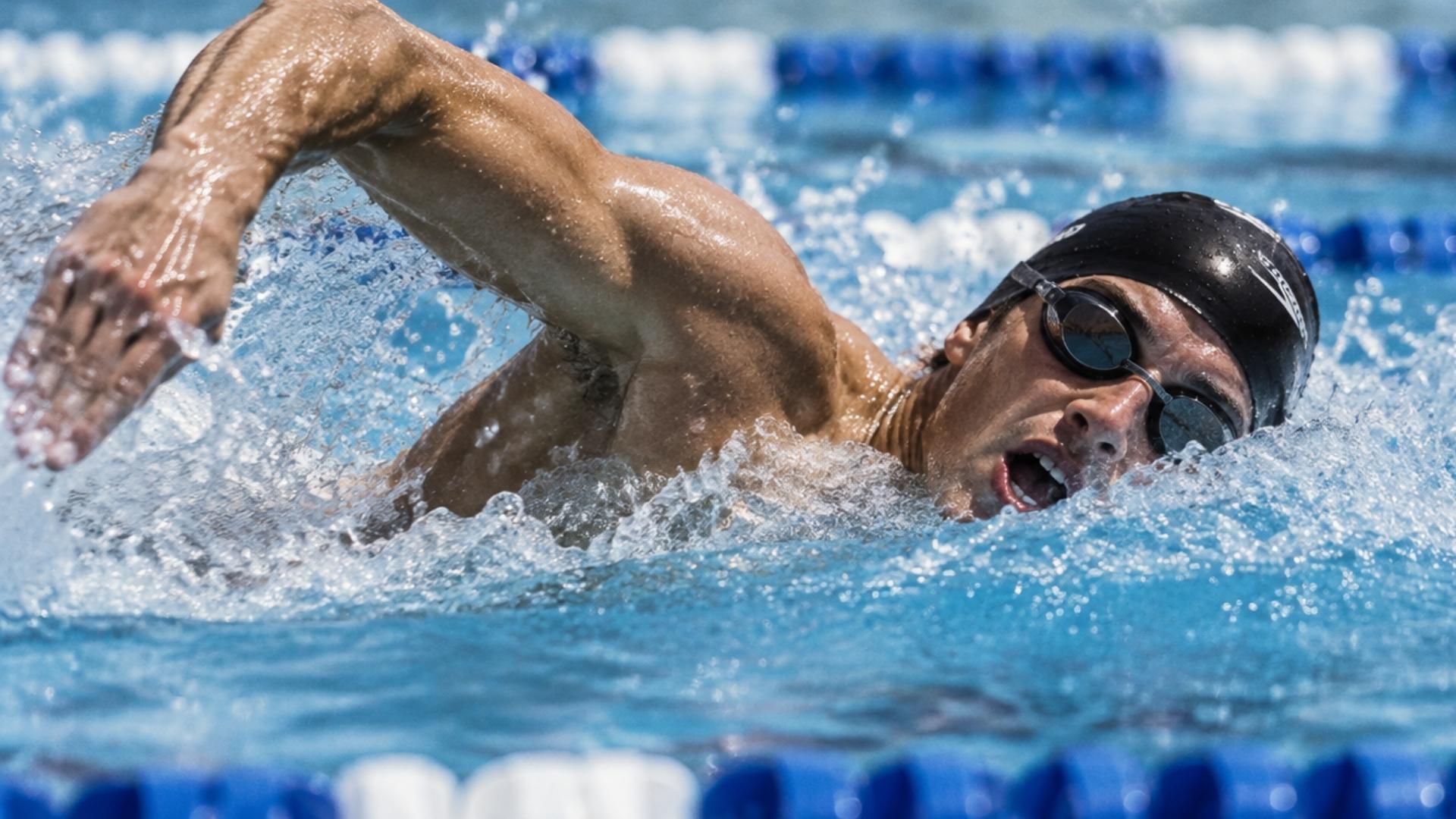
Freestyle swimming is fast, efficient, and probably the first stroke I think of when I want to cover more distance in the pool.
But getting it right takes more than moving my arms and kicking hard. I have found that the smallest details in how I enter the water, turn to breathe, rotate my body, or time my kick can completely change how a lap feels.
When those movements fall into rhythm, I use less energy, hold my speed longer, and feel much more in control of every stroke.
What Is Freestyle Swimming?
Freestyle swimming, also called front crawl, is the fastest and most efficient way to move through water, making it the go-to stroke for lap swimming, fitness, and long-distance events.
Swimmers alternate overhead arm strokes while rotating their body from side to side, paired with a steady flutter kick.
The stroke earns its name because freestyle events allow any swimming style, and nearly every swimmer chooses front crawl for its speed.
I learned it as a kid at a community pool, and it remains my default for both fitness swims and open water sessions.
Is Freestyle the Same Thing as Front Crawl?
Technically, no, though most swimmers use the two terms interchangeably. Freestyle refers to the event category, where the rules allow any stroke a swimmer wants to use.
Front crawl is the stroke most people choose in a freestyle event because it is faster than backstroke, butterfly, or breaststroke.
I use the two terms the same way most swimmers do, since in practice freestyle means front crawl unless someone specifically tells you otherwise.
Freestyle Swimming Benefits
Freestyle is not just the fastest stroke in the pool. It also delivers a full-body workout with lower injury risk than most land-based cardio. That combination is a big part of why I have stuck with it for over a decade.
- Full-body conditioning: Freestyle works your shoulders, back, core, and legs in one continuous motion, building strength without separate equipment.
- Low impact on joints: Water supports your body weight, so freestyle puts far less stress on knees and hips compared to running or field sports.
- Strong cardiovascular benefit: The Centers for Disease Control and Prevention (CDC) notes that water-based exercise offers real health benefits for people managing diabetes, heart disease, and arthritis.
- Efficient calorie burn: A swimmer weighing around 150 pounds can burn roughly 250 to 500 calories in a half hour of freestyle laps, depending on pace and effort.
- Better lung control: Rhythmic breathing during freestyle trains your lungs to work more efficiently. I noticed the carryover myself in my air consumption during scuba trips in the Caribbean.
- Mental reset: Research summarized by the CDC points to swimming’s mood-boosting effect. I still find a freestyle set clears my head faster than almost any other workout.
The Fundamentals of Freestyle Swimming Technique
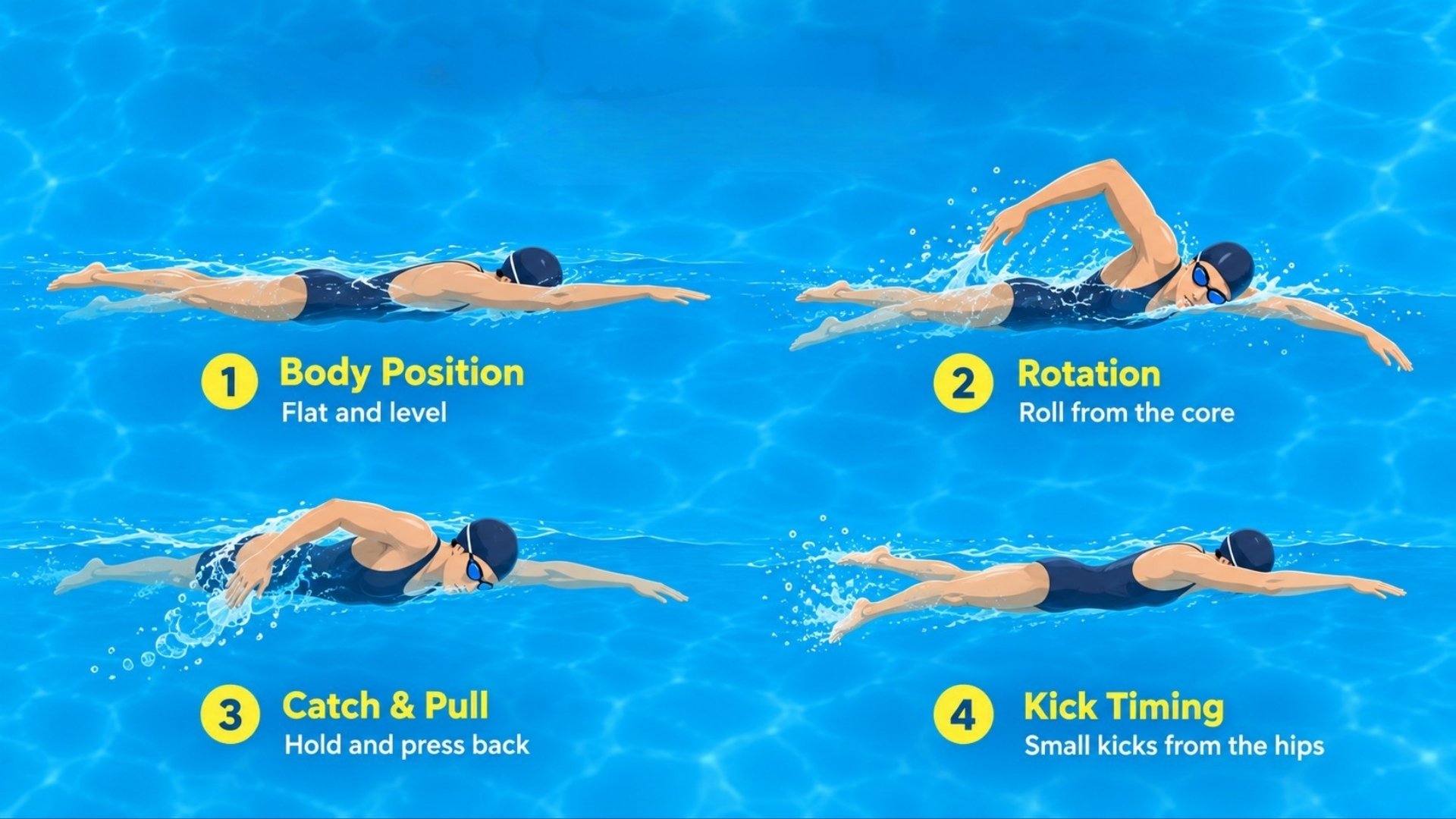
Every efficient freestyle stroke rests on four pillars working together, and neglecting even one forces the rest of your body to compensate. Here is how I think about each one when I swim.
Body Position
Your body should sit flat and horizontal near the surface, like a torpedo cutting through the water rather than an anchor dragging through it.
According to U.S. Masters Swimming, maintaining this straight line with minimal effort is the single most important skill in freestyle. When my hips sink, my whole stroke slows down, no matter how hard I pull.
Rotation
Your torso should rotate along its long axis with each stroke. Without it, your shoulder joint lacks the mobility to recover your arm over the water.
I aim for about 30 to 45 degrees of rotation to each side, since the right amount depends on your body and stroke style. Keeping my spine straight helps that rotation assist my pull instead of twisting my stroke off course.
The Catch and Pull
The catch happens the moment your hand enters the water and begins pressing backward, and a strong catch sets up everything that follows.
I focus on keeping my elbow higher than my hand early in the pull, a position often called early vertical forearm. It lets my forearm act like a paddle instead of slicing through with no grip.
This differs from a high-elbow recovery, which means keeping your elbow lifted as your arm swings forward above the water. Both matter, but they solve different problems.
Kick Timing
Your kick should come from the hips, not the knees, with a compact, steady rhythm that supports rotation rather than replacing it.
I keep my ankles loose and my kick small, since a big splashy kick burns energy fast without adding much forward push.
Do Sprinters and Distance Swimmers Use the Same Freestyle Technique?
Not exactly. The four fundamentals stay the same, but how you apply them shifts depending on what you are training for.
Distance and open water swimmers tend to favor a slower stroke rate, often somewhere in the 60 to 70 strokes per minute range, with a longer stroke and more generous rotation to conserve energy over time.
Sprinters lean toward a faster turnover, sometimes 80 strokes per minute or more, with slightly less rotation and a quicker recovery to maximize speed over a short distance.
I swim differently depending on whether I am training for an open water event or doing short, fast sets in the pool, and neither style is wrong. The right fit depends on your event, your body, and what feels sustainable for you.
Freestyle Swimming vs. Other Strokes
Freestyle is not the only way to move through the water, and knowing how it stacks up against the other strokes explains why most swimmers choose it by default. Speed, effort, and difficulty to learn all shift depending on which stroke you pick.
|
Stroke |
Speed |
Difficulty to Learn |
|---|---|---|
|
Freestyle |
Fastest |
Easiest |
|
Backstroke |
Fast |
Moderate |
|
Butterfly |
Moderate |
Hardest |
|
Breaststroke |
Slowest |
Moderate |
Freestyle keeps drag low while still generating strong propulsion, which is why it wins on speed. Backstroke uses similar mechanics but on your back, easing breathing while making sighting harder. Breaststroke lags behind because both arm and leg recovery happen underwater.
How to Breathe During Freestyle Without Losing Your Stroke
Breathing wrecks more freestyle strokes than any other single factor, mostly because swimmers lift their head instead of rotating to breathe. These habits fixed my own breathing pattern years ago and still guide every session I swim.
- Rotate, don’t lift: Turn your head with your body’s natural rotation rather than craning it upward, which keeps your hips from dropping.
- Exhale underwater: Breathe out steadily through your nose or mouth while your face is submerged, so you are only inhaling when you turn to breathe.
- Pick a breathing pattern: Bilateral breathing every three strokes builds balance on both sides, while breathing every two strokes suits faster sprint efforts.
- Keep one eye in the water: A small head turn that leaves one eye near the surface is enough air to keep your stroke from stalling.
- Practice on land first: I still run through breathing timing at the pool wall before a hard set. It locks the rhythm in before fatigue sets in.
Once your breathing pattern feels automatic instead of forced, the rest of your stroke stops fighting itself. Your rotation and kick fall back into rhythm on their own.
Why Does Freestyle Feel So Tiring?
Freestyle exhausts new swimmers faster than almost any other stroke, and the reason usually has nothing to do with fitness level.
Poor body position forces your legs to work overtime just to keep your hips from sinking, burning energy that should be going toward forward speed.
Breathing technique plays an equally large role in how tired freestyle feels during a set. Holding your breath too long builds up carbon dioxide.
That buildup triggers a panicked, out-of-breath sensation well before your muscles actually run out of oxygen. I felt this constantly early on, and fixing my exhale pattern did more for my endurance than any amount of extra lap swimming.
Which Part of Your Freestyle Technique Needs Work?
Different symptoms in the water point to different fixes, and matching your specific issue to the right fundamental saves you from guessing at random drills. Use this table to spot your pattern.
|
What You Feel in the Water |
Likely Cause |
Fundamental to Fix |
|---|---|---|
|
Legs feel heavy and keep sinking |
Head lifted too high, poor horizontal alignment |
Body Position |
|
Shoulders feel tight during arm recovery |
Flat body with little to no rotation |
Rotation |
|
Stroke feels like it slips through water |
Dropped elbow, weak early catch |
Catch and Pull |
|
Legs tire out within a few laps |
Kicking from the knees with a large splash |
Kick Timing |
|
Gasping or panicked feeling during a lap |
Holding breath instead of exhaling underwater |
Breathing |
Once you find the row that matches how your stroke feels, focus your next few sessions entirely on that one fundamental. Trying to fix everything at once usually fixes nothing.
Freestyle Swimming Drills That Actually Fix Technique
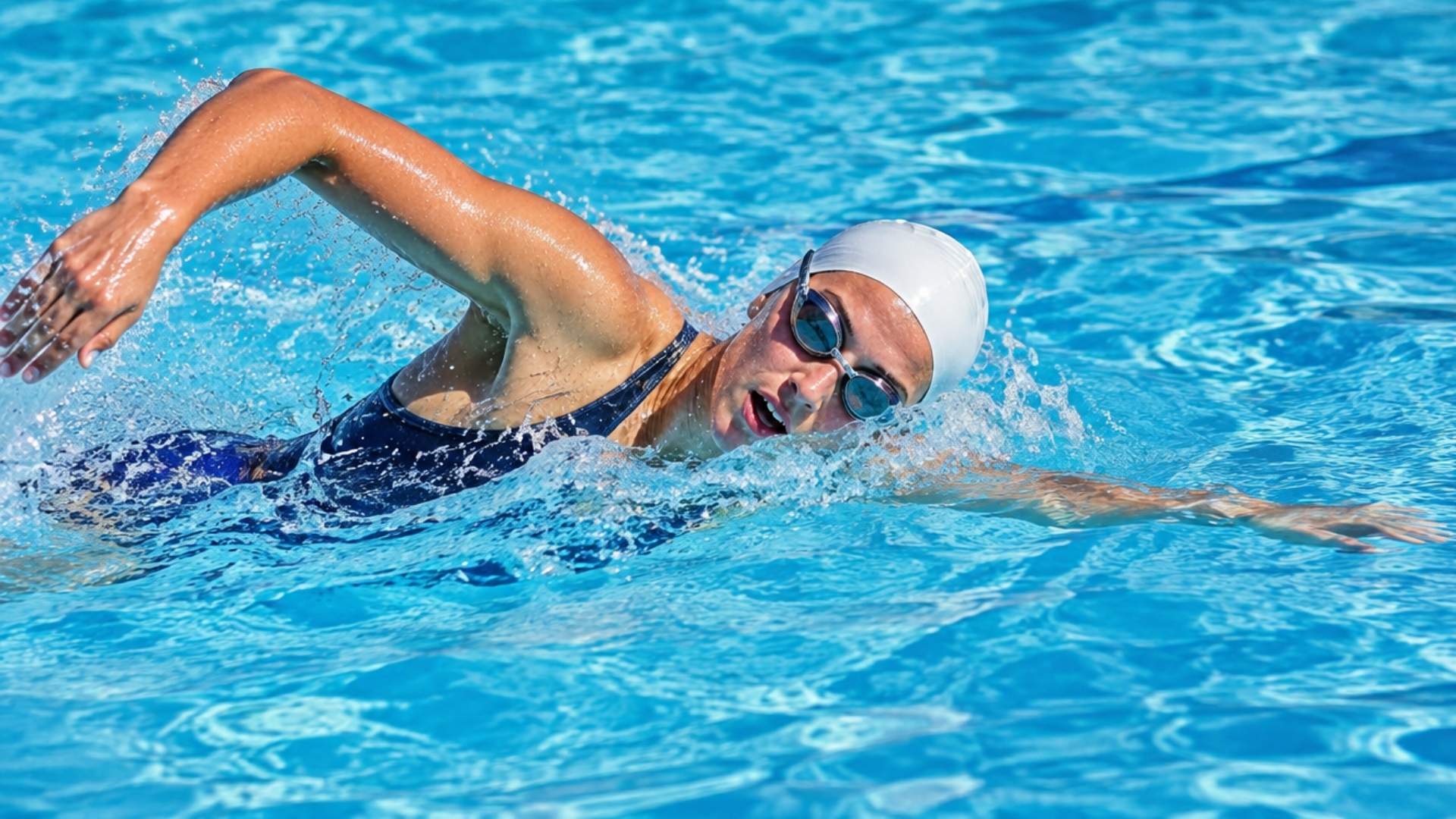
Drills isolate one part of the stroke so your body can learn the correct movement without the rest of the stroke getting in the way. These six are the ones I return to most, whether I am shaking off rust or fine-tuning before an open water swim.
A well-fitted pair also makes these drills easier to execute cleanly, since leaking or fogging goggles break your focus mid-set. The right fit differs for beginners and competitive swimmers.
Catch Up Drill
Swim freestyle while keeping one arm extended forward until the other hand catches up to meet it before starting the next stroke.
This drill slows your timing down enough to feel exactly where your catch begins, and I use it as a warm-up before nearly every session.
Fist Drill
Swim your normal freestyle stroke with both hands clenched into fists instead of open palms. Without your palm to rely on, your forearm has to do the work of catching water, which builds the early vertical forearm position naturally.
Single Arm Drill
Swim using only one arm while the other stays extended in front, switching sides every few lengths. This isolates your pull mechanics on each side and quickly reveals if one arm is doing more work than the other. It is a habit I picked up years ago without noticing.
Zipper Drill
As your recovering arm swings forward, let your thumb brush lightly along your side seam as if zipping up a jacket. This keeps your elbow high during recovery and prevents a wide, wasted arm swing that adds drag.
Scull Drill
Extend your arms forward and sweep your hands side to side in small motions, feeling the water press against your palms without pulling through. This builds a sensitive feel for the water that translates directly into a stronger catch.
Six Kick Switch Drill
Kick six times on your side with one arm extended before rotating and switching to the other side for six more kicks. I rely on this one to rebuild rotation and kick timing together after any stretch away from the pool.
Common Freestyle Mistakes and How to Fix Them
Most freestyle mistakes trace back to the same handful of habits, and I have made every one of these myself at some point over the years. Use this table to match your mistake with a direct fix.
|
Mistake |
Why It Slows You Down |
Fix |
|---|---|---|
|
Crossing the centerline on hand entry |
Creates a side-to-side snaking motion instead of straight forward travel |
Enter the water in line with your shoulder, not toward the center |
|
Lifting the head to breathe |
Drops the hips and increases drag across the whole body |
Rotate to breathe instead of lifting straight up |
|
Dropping the elbow during the pull |
Reduces the surface area catching water, weakening propulsion |
Practice the fist drill to build early vertical forearm |
|
Overkicking from the knees |
Wastes energy and adds drag without adding real speed |
Keep kicks short, driven from the hips, with pointed toes |
|
Gliding too long between strokes |
Kills momentum and stroke rhythm, especially over distance |
Shorten the glide phase and keep your stroke rate consistent |
Correcting even one of these habits tends to improve the others too, since freestyle mechanics are closely linked from your head position down to your toes.
How to Swim Freestyle Faster
Speed in freestyle comes from reducing drag and improving propulsion, not from swimming harder on a poor technique base. These are the changes that made the biggest difference in my own times.
- Fix your body position first: A flat, horizontal body position cuts drag more than any strength gain ever will.
- Accelerate through the pull: U.S. Masters Swimming points out that pulling with increasing speed through the stroke, rather than at one constant pace, creates more propulsion, especially in short, sprint-focused efforts.
- Shorten your kick amplitude: A smaller, faster kick displaces less water and keeps your legs from tiring early.
- Count your strokes per length: Fewer strokes to cross the same distance usually means a more efficient pull and better body position. I track this number every few weeks to see if my technique work is actually paying off.
- Train your turns: A clean flip turn or push-off can save real time over a set without changing your stroke at all.
- Add resistance training: Light drag tools like a parachute or swim socks force better body position and a higher elbow catch when used at low effort.
- Swim with intent, not just laps: I get more out of a focused, technique-first thousand yards than an unfocused mile. My times reflect that every season.
Do Flip Turns and Streamline Actually Matter for Speed?
Yes, more than most recreational swimmers realize. A clean flip turn and a tight streamline off the wall can save real time in a set, especially if you are swimming in a shorter pool where you hit the wall often.
Streamline is the position you hold off the wall after a push-off or dive: arms extended, hands stacked, head tucked between your shoulders, and body as straight as possible.
It is one of the fastest positions you will move through in any swim, since you are gliding without any drag from your stroke or breath.
I used to treat turns as a throwaway moment between lengths. Once I started timing myself off the wall to the flags, I found tightening my streamline and pushing off harder shaved real seconds off a set, without changing a single thing about my actual stroke.
Final Thoughts on Mastering Freestyle Swimming
Strong technique comes from steady practice, not trying to fix everything at once.
Use drills to improve weak areas, pay attention to stroke count and effort, and build speed only when your form stays controlled.
With time, freestyle swimming becomes smoother, more consistent, and easier to maintain over longer distances. Try the drills that match your biggest weakness, and let me know in the comments which change made the biggest difference.
Frequently Asked Questions
How Long Does It Take to Improve Freestyle Technique?
Many swimmers notice improvement within four to six weeks of consistent, drill-focused practice. Developing lasting muscle memory can take several months.
Is Freestyle Harder Than Other Swimming Strokes to Learn?
Freestyle is often easier to learn at a basic level than breaststroke or butterfly because its arm and leg movements are continuous. Refining the technique takes more practice, especially for rotation and the catch.
Do I Need Fins or a Snorkel to Practice Freestyle Drills?
No. However, fins and a swim snorkel can help isolate parts of your stroke and let you focus on technique without worrying as much about balance or breathing.
How Many Times a Week Should I Swim Freestyle to See Progress?
Three sessions a week can be enough to build technique and endurance. As your swimming volume increases, include lighter or drill-focused sessions to reduce shoulder strain.
Can Freestyle Technique Work Transfer to Open Water Swimming?
Yes. Freestyle technique transfers well to open water, but conditions such as waves, sighting, and the lack of lane lines require additional practice.