
Two teams, one ball, and constant swimming, passing, and shooting make water polo one of the fastest games played in a pool.
Learning the water polo rules turns a blur of splashes into a game you can follow from the first whistle.
The sport got its start in Britain and was part of the first modern Olympic Games in 1900, and it has kept much of that same fast, physical character ever since.
Players swim, pass, shoot, and defend all at once while treading water, and they can never touch the bottom of the pool.
That combination of skills is what makes water polo rules stricter, and the game itself tougher, than most people expect on their first watch.
This page covers how water polo is scored, how fouls are called, what the positions mean, and the key terms you will hear a referee or commentator use during a match.
What is Water Polo and How is it Played?
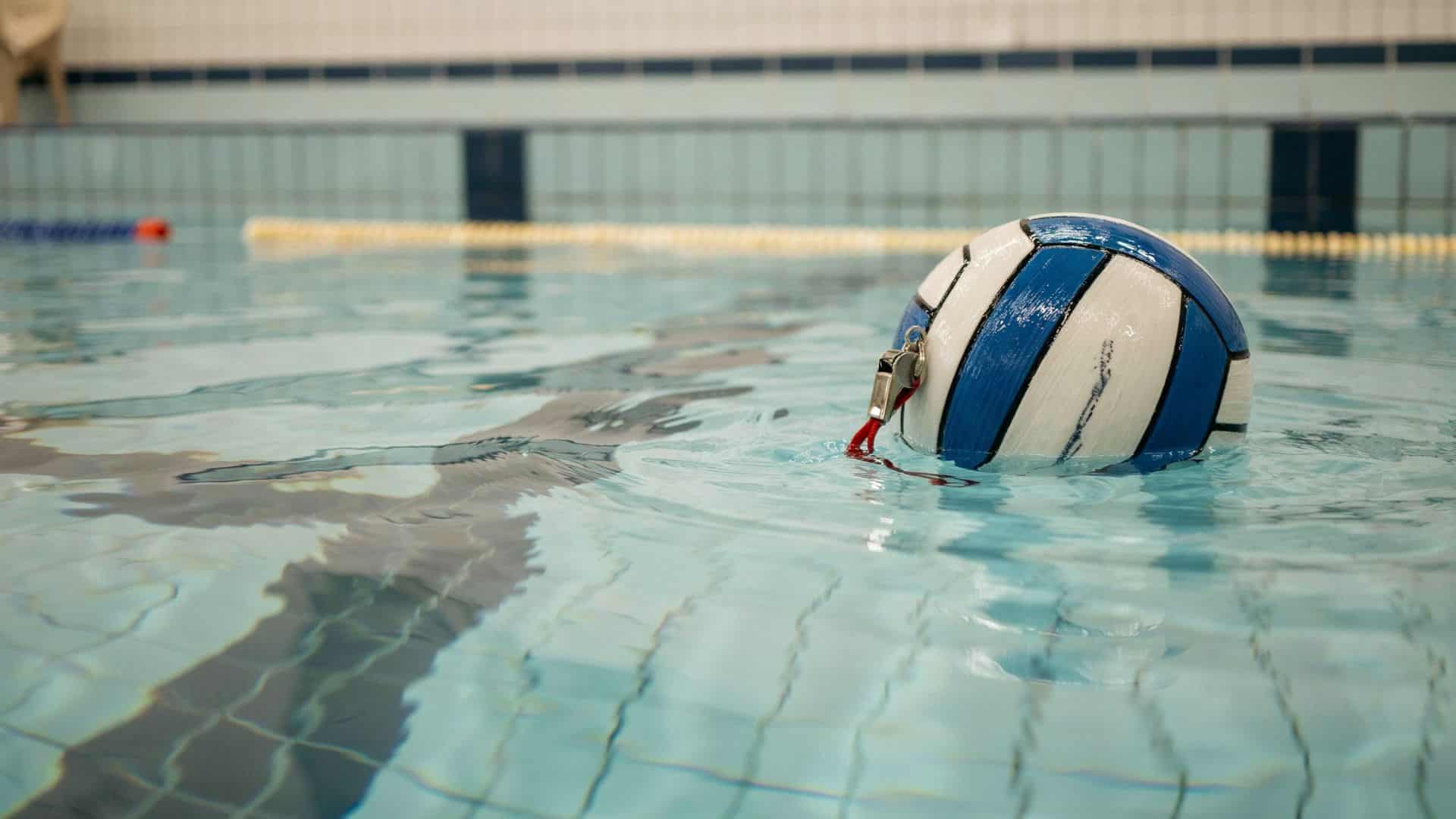
Water polo is a team sport played in a swimming pool, where the goal is to score more points than the opposing team within four timed quarters.
To score, a player has to move the ball from one end of the pool to the other and get it into the opponent’s goal, all while treading water and never touching the pool floor.
Each team has seven players in the pool at one time: six field players and one goalkeeper.
Water Polo Field of Play and Match Format
Before the fouls and scoring rules make sense, it helps to know how the pool itself is set up and how a match is timed.
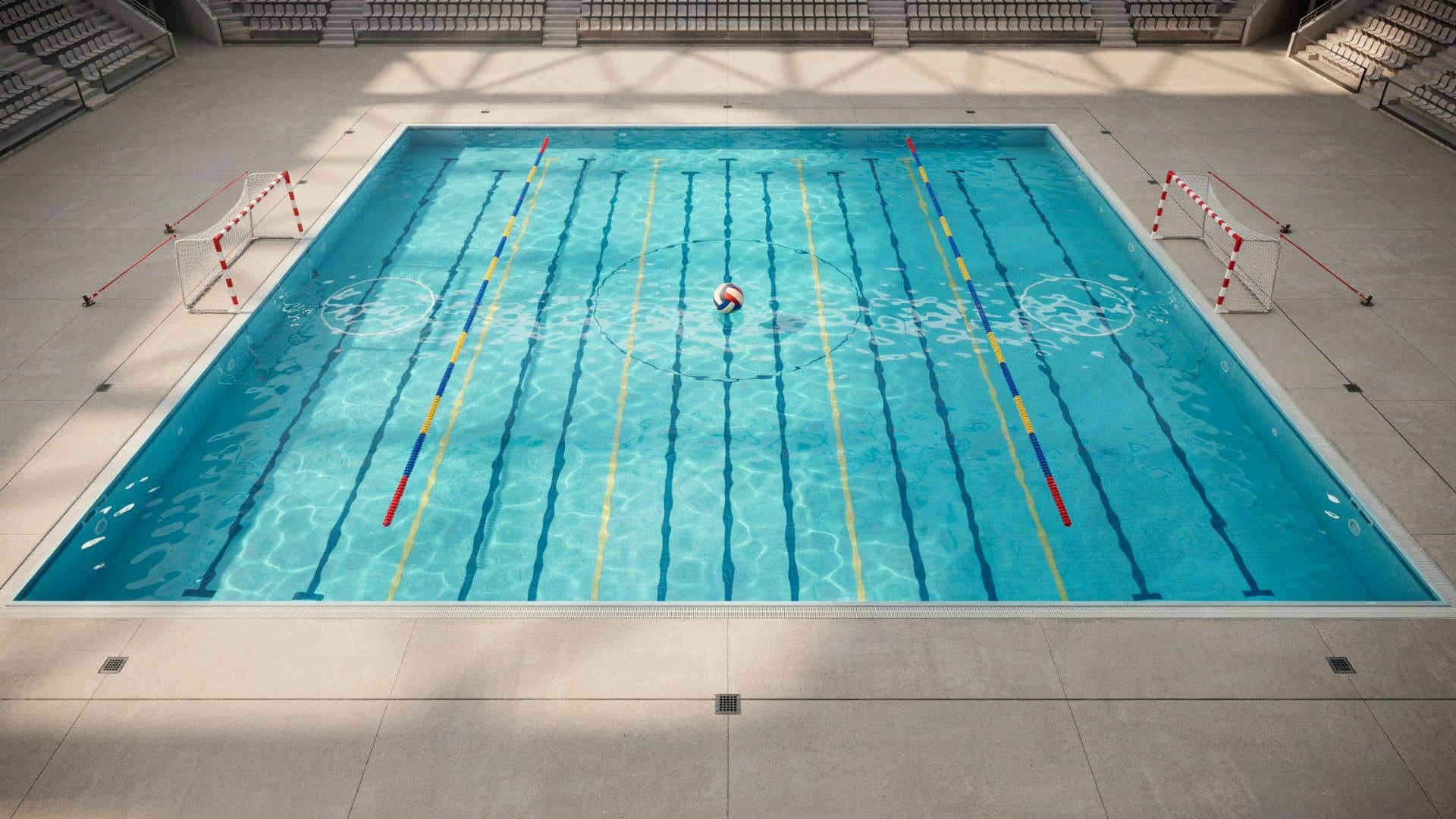
- Field of play: Men’s pools are usually 30m long, while women’s pools are usually 25m long, with both commonly 20m wide.
- Pool depth: Official pools have a minimum depth of 1.8m, deep enough that every player, aside from the goalkeeper, has to tread water the entire game.
- Pool markings: The goal line is marked in white, the 2-meter line in red, the 5-meter line in yellow, and the center line in white, each marking a different zone of play.
- Goal placement and size: Goals sit at each end of the pool and measure about 3m wide by 90cm tall. A goal only counts when the ball fully crosses the goal line and passes under the crossbar.
- Match duration: A full match is played across four quarters, each lasting 8 minutes of actual playing time, with the clock stopping whenever the ball is out of play.
- Breaks between play: Teams get roughly a 2-minute break between quarters, plus a longer break at halftime.
- Cap colors: The home or higher-seeded team usually wears white or light-colored caps, while the visiting team wears blue or dark caps. Both goalkeepers wear red caps so referees and spectators can spot them instantly
Basic Water Polo Rules Every Beginner Should Know
Water polo can look confusing the first time you watch it, but the rules are easier to follow once you know the basics. Here are the main rules that shape almost everything you see in a match.
1. Players cannot touch the bottom of the pool during play, since the water is deep enough that everyone has to tread water throughout the game.
2. Only the goalkeeper is allowed to use both hands on the ball, while every other player must play it with one hand at a time. The goalkeeper also cannot cross the center line during play, even though every other player can move the full length of the pool.
3. Teams have a 30-second shot clock and must attempt a shot on goal before it runs out, or possession turns over to the other team.
4. Players cannot hold, pull, or block opponents in ways that stop them from moving freely, since this leads to fouls and possible exclusion.
5. Substitutions happen after a goal, during a timeout, and between quarters through the bench, and during live play only through the designated re-entry area at the corner of the pool.
6. A player who racks up three personal fouls, whether from major fouls or penalty fouls, is disqualified from the rest of that game and a substitute takes their place.
The Offside Rule in Water Polo (The 2-Meter Rule)
Water polo has its own version of an offside rule, and it is one of the most common sources of confusion for new fans.
An attacking player is not allowed to be inside the 2-meter zone in front of the opponent’s goal unless the ball is already inside that zone or the player has possession of it.
If an attacker enters that 2-meter area early, without the ball, the referee stops play and awards an ordinary foul to the defending team.
The rule exists to stop attackers from camping directly in front of the goal, which keeps the game moving and prevents an unfair scoring advantage near the crease.
How Scoring Works in Water Polo
Scoring in water polo follows one of the simpler rules of the game. A goal only counts when the ball fully crosses the goal line and enters the net, so a shot that hits the line but does not cross it completely does not count.
Every goal is worth one point, no matter which player scores or from where. Most goals come from close-range shots, counterattacks, or penalty throws awarded after a foul.
The team with more points when the game ends wins.
If the score is still level after regulation, most levels of play move to a shootout: five players from each team take alternating shots from the 5-meter line, and if the score remains tied after all five have gone, the shootout continues one shot at a time until one team misses and the other scores.
Minor Fouls That Should Be Avoided
Minor fouls, officially called ordinary fouls, happen often during a match and usually cost a team possession rather than a player.
1. Holding the Ball Underwater
This happens when a player pushes the ball below the surface so the other team cannot reach it or play it. It is one of the most common calls in a game.
The referee gives the ball to the other team through a free throw.
2. Touching the Ball With Both Hands
Every field player except the goalkeeper has to play the ball with one hand at a time. Touching or holding it with both hands at once is an ordinary foul, and possession switches to the opposing team.
3. Pushing Off the Bottom of the Pool
Since players cannot touch the pool floor during play, pushing off the bottom to gain height or speed is also called an ordinary foul. This rule keeps the physical demand of treading water consistent for every player on both teams.
4. Wasting Time
A wasting time foul happens when a player deliberately delays play instead of moving the game forward, such as throwing the ball to an empty part of the pool just to run down the shot clock.
Taking too long to put the ball back into play after a free throw, or knocking the ball out of the field of play on purpose, are also treated as ordinary fouls under this same idea of delaying the game.
The referee stops this by giving the ball to the other team.
5. Penalties for Minor Fouls
A minor foul does not remove a player from the game. It simply gives the ball to the other team through a free throw.
If the foul happens outside the 5-meter line, the fouled player can take a direct shot at the goal right away.
Major Fouls That Should Be Avoided
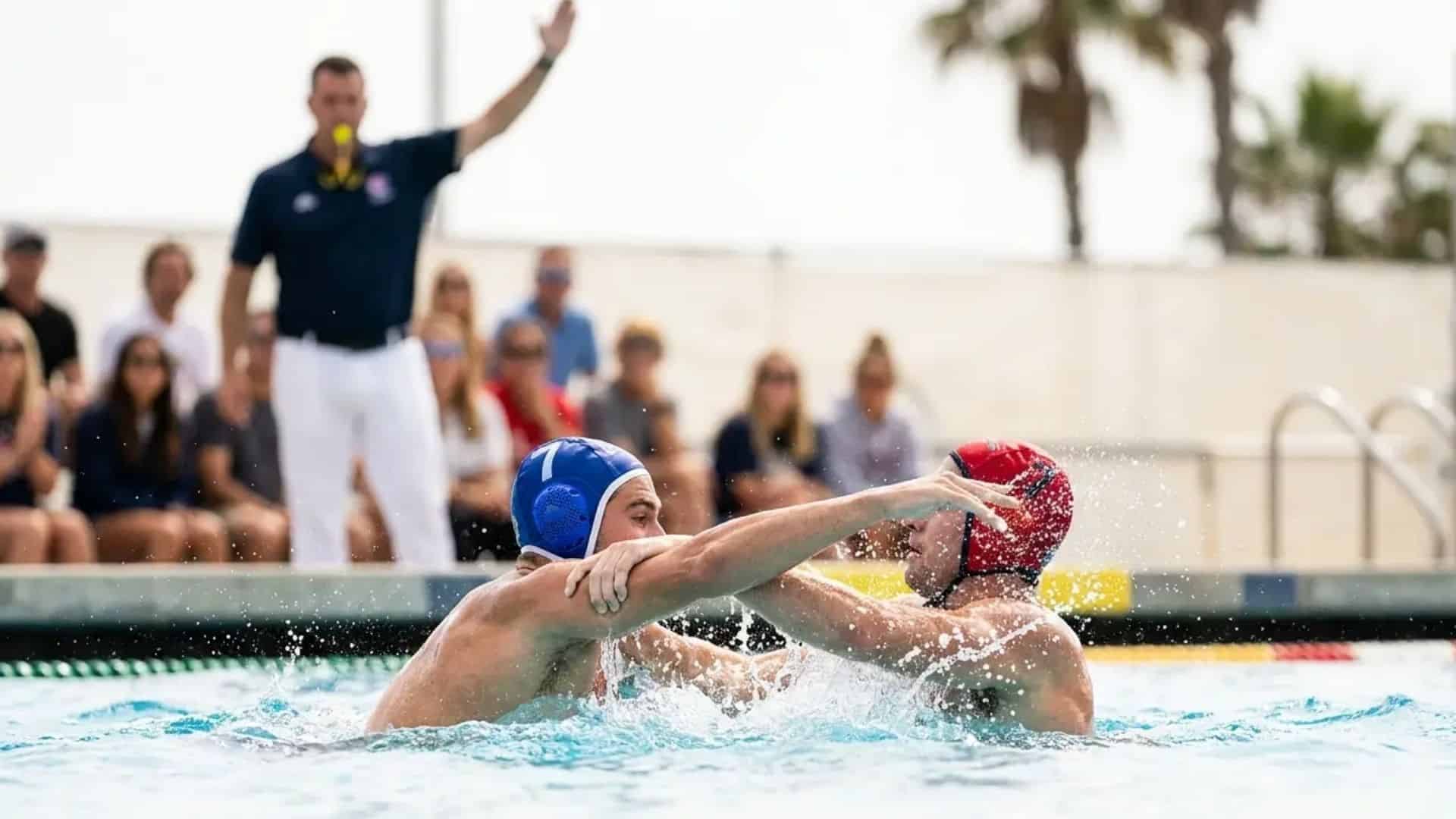
Major fouls are considered far more serious than ordinary fouls because they interrupt an opponent’s movement or take away a scoring opportunity.
In most cases, these fouls result in the offending player being sent out of the pool temporarily, giving the opposing team a short-term advantage.
1. Holding or Pulling an Opponent
This is the most common major foul in water polo. It happens when a player holds, pulls, or sinks an opponent who does not have the ball.
The player who commits this foul is excluded from the pool for 20 seconds, and their team has to play with one less player during that time.
2. Dangerous Contact and Brutality
This covers actions like kicking, striking, or any contact that could hurt another player.
It is treated as more serious than simple holding. Depending on how bad the contact is, the player can be excluded for 20 seconds, or in extreme cases, removed for the rest of the game.
If the contact shows clear intent to injure another player, it becomes a brutality foul, the most serious foul in water polo. The offending player is removed from that game and at least the next one, their team plays one player short for four minutes, and the other team is awarded a penalty throw.
3. Blocking a Scoring Chance Illegally
This happens when a defender fouls an attacker inside the 5-meter line in a way that stops a likely goal.
Since this takes away a clear scoring chance, it is punished more heavily than a normal foul.
The referee awards a penalty throw to the attacking team, giving that player a direct shot at the goal with only the goalkeeper standing in the way.
4. Penalties for Major Fouls
Major fouls come with tougher consequences than minor ones. A player can be excluded from the pool for 20 seconds, and their team plays short-handed during that time.
If the foul is more serious, exclusion can come with a substitute allowed back in after 4 minutes, or in the case of brutality, the player is removed from that game and the next one, with a penalty throw given to the other team.
In official rulebooks, major fouls are usually called exclusion fouls because the player leaves the pool temporarily.
Once a player has been charged with three personal fouls in a single game, whether major or penalty fouls, they are disqualified for the rest of that match and a teammate substitutes in for them.
5. Bench Conduct Fouls: Yellow and Red Cards
Fouls in water polo are not limited to players in the water. If a coach or other team personnel on the bench behaves inappropriately, the referee can issue a yellow card as a warning.
A red card is more serious. It removes that person from the pool deck for the rest of the game, and sometimes the next one, with no further contact allowed with the team during that time.
Water Polo Rules For Players and Positions
Each water polo squad consists of players in the water playing certain roles within a fixed formation. This is a short summary of the formation of a team.
| Category | Details |
|---|---|
| Players in the pool | 7 per team (6 field players + 1 goalkeeper) |
| Squad size | Usually 13 players total, with substitutes on the bench |
| Substitutions | Allowed after a goal, during a time-out, between periods, or through the re-entry area during play |
| Goalkeeper | Defends the goal, the only player allowed to use both hands on the ball, and not allowed to swim past the center line |
| Field players | Attack and defend, play the ball with one hand only |
| Center forward | Attacking position near the opponent’s goal, often draws fouls |
| Defenders | Mark opponents and protect the 5-meter area |
| Wing | Offensive player positioned along the side of the pool, often used to set up scoring chances |
| Point | Offensive player positioned near the 5-meter line, farthest from the goal |
| Hole D | Defender assigned to guard the center forward directly in front of the goal |
| Utility player | Player without one fixed role, moving between offense and defense as needed |
Having this knowledge about positions will make it easy to keep track of each player during the game.
A Quick Glossary of Water Polo Terms
New water polo rules and terms tend to come up together, so keeping a short list of definitions nearby makes the rest of the game much easier to follow.
Ordinary foul: A minor rule break that results in a free throw to the other team, such as holding the ball underwater or touching it with both hands.
Exclusion foul: A major foul that sends a player out of the pool for 20 seconds while their team plays a player short.
Penalty throw: A direct shot from the 5-meter line, defended only by the goalkeeper, awarded after certain fouls inside the 5-meter area.
Free throw: A throw awarded after an ordinary foul, taken from the spot of the foul.
Sprint or swim-off: The race between one player from each team to reach the ball at the start of each quarter.
Counterattack: A fast offensive push after a team gains possession, aimed at scoring before the defense sets up.
Hole set: The offensive player positioned at the 2-meter line directly in front of the opponent’s goal, also called the center forward
Tips for Understanding Water Polo Rules Better
A few simple habits can make the game much easier to follow, especially the first few times you watch or play.
- Watch the 2-meter and 5-meter lines, since most fouls and penalty calls happen around them.
- Keep an eye on the shot clock, as it explains why teams sometimes rush a shot late in a possession.
- Follow the goalkeeper’s movements, since their positioning often tells you where an attack is headed.
- Pay attention to player exclusions, as they create short power-play situations similar to other team sports.
- Learn the referee’s hand signals early on, since they explain most stoppages without needing commentary.
The objective of water polo is to have your team put the ball into the opponent’s goal, while keeping the opposing team from doing the same in yours.
For the full official rulebook, the USA Water Polo governing body publishes current playing rules for every level of the sport.
Final Thoughts
Water polo requires patience, but only if you know what to look out for.
Scoring more than your opponents is the primary objective, but fouls, positioning, and the 2-meter rule define most of the action.
Being aware of where a foul occurs, either inside or outside the 5-meter line, provides a lot of insight into why the official awarded a particular penalty.
For those unfamiliar with water polo, watching a match and spotting these rules in real time is still the fastest way to make them stick.
Watch one this weekend and try to identify a minor foul, a major foul, and a 2-meter violation before it ends.
Frequently Asked Questions
What Equipment is Needed for Water Polo?
The equipment needed in water polo includes the water polo ball, caps with numbers on them, goals, and swimming gear suitable for playing in the water.
Can You Swim Underwater in Water Polo?
Players in water polo can swim underwater momentarily, but they should not use underwater actions to beat other players unfairly.
Do You Play Water Polo in Saltwater or Freshwater?
A game of water polo can be played in either saltwater or freshwater pools. However, most games are played in freshwater pools.
How Do Players Remain at the Surface When Playing Water Polo?
Players use a kicking action called the eggbeater kick that helps them stay upright and vertical in the water.
What Is the 2-Meter Rule in Water Polo?
The 2-meter rule is water polo’s version of an offside rule. An attacking player cannot be inside the 2-meter zone near the opponent’s goal unless they have the ball or the ball is already inside that zone.
How Many Fouls Can a Water Polo Player Get Before They’re Out?
A player is disqualified from the rest of the game after their third personal foul, whether that comes from major fouls or penalty fouls, and a substitute takes their place in the water.
What Happens If a Water Polo Game Is Tied?
Most levels of play settle a tie with a shootout. Five players from each team take alternating shots from the 5-meter line, and if the score is still even after that, the shootout continues one shot at a time until one team misses and the other scores.