Most divers finish a job and head straight back to the surface within an hour. Saturation divers follow a completely different rulebook.
They live inside a pressurized chamber for weeks at a time, only leaving through a sealed bell that drops them straight to the seafloor.
It sounds more like a plot from a submarine film than an actual job, yet this method has kept offshore oil rigs, pipelines, and underwater structures functioning for decades.
| The short version: A saturation diver is a commercial diver who stays under pressure continuously for a whole project, usually up to 28 days, living in a chamber on a support vessel and commuting to the seafloor in a diving bell. Most work happens between roughly 65 and 1,000 feet. Decompression happens once, at the end, and takes days. Experienced divers average around $110,000 a year, with offshore day rates that can push the top end past $200,000. |
What Does “Saturation Diver” Actually Mean?
A saturation diver is someone whose body tissues have absorbed all the inert gas they can hold at a specific depth, a state called equilibrium.
Once that saturation point is reached, more time at depth adds no extra decompression risk, since no additional gas is being absorbed. Different tissues fill at different speeds, but most reach saturation within about 24 hours, according to the Divers Alert Network.
This principle comes straight from Henry’s Law, and it’s the reason saturation diving stands apart from scuba or standard commercial diving.
Recreational divers work in the opposite direction, deliberately keeping their time at depth short enough to avoid saturation so they can ascend without mandatory stops.
Saturation Diving vs. Standard Commercial Diving
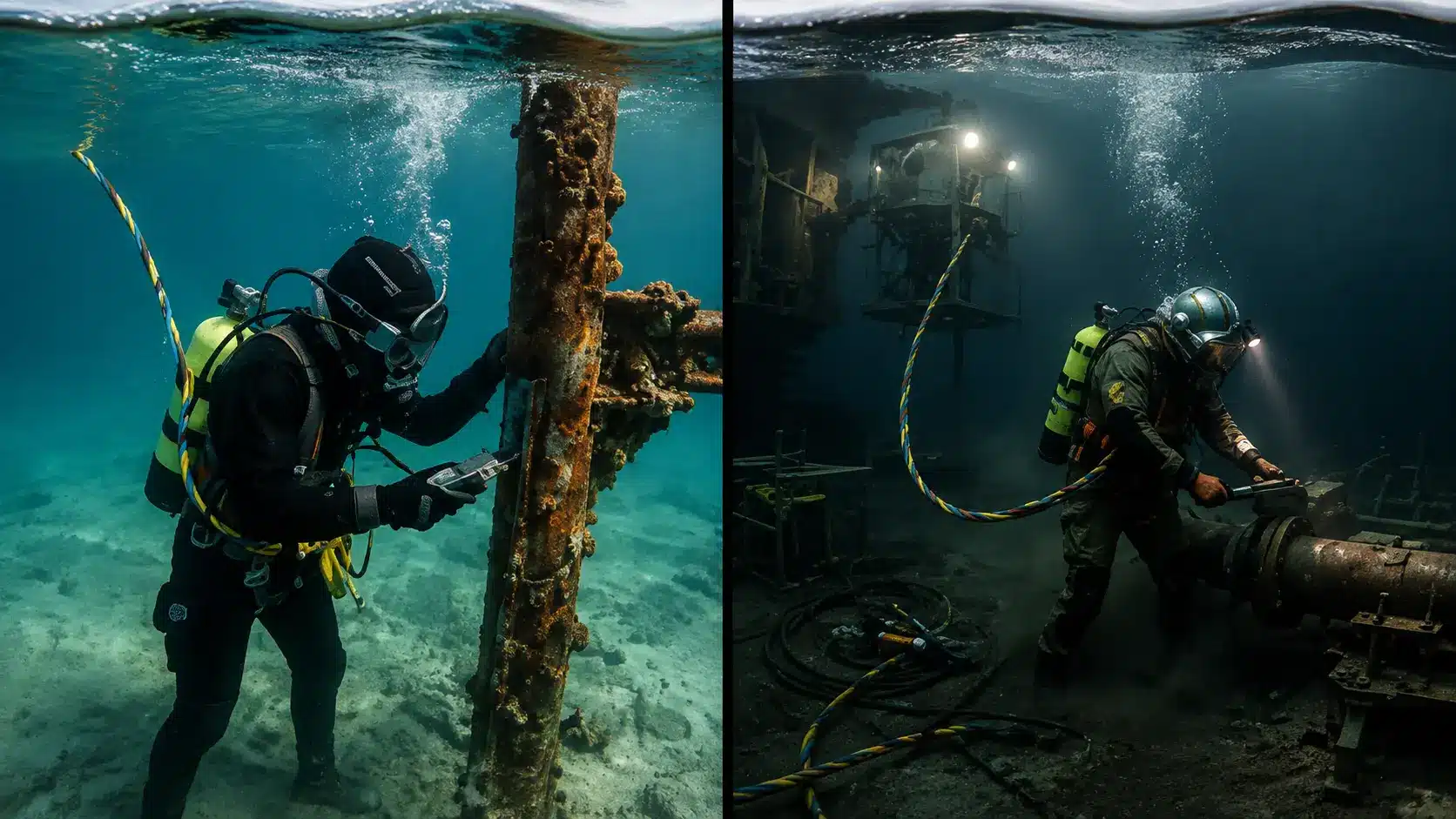
Standard commercial diving covers shorter, shallower jobs where surfacing and decompressing the same day makes sense.
Typical work includes harbor inspections, hull maintenance, and repairs on structures in shallower water. These jobs don’t need the cost or setup of a full saturation system.
Saturation diving takes over for deep, long-duration offshore projects where repeated decompression would burn through too much working time.
Offshore oil platforms, subsea pipelines, and deepwater construction jobs depend on saturation systems to keep skilled divers on site for weeks at a stretch.
Knowing what saturation means explains the term itself, but not why anyone would choose to work this way. That answer lies in the economics of offshore work.
Why Does Saturation Diving Exist?
This method wasn’t designed for comfort. It solves an expensive, time-consuming problem in offshore work.
- Decompressing from deep water carries a real decompression sickness risk, and takes roughly one day for every 100 feet of depth, plus an extra day.
- Repeating that process after each individual dive would burn through working hours fast
- Keeping divers under pressure for an entire project means decompression happens just once, at the end
- Offshore oil, gas, and pipeline operators needed a way to get skilled hands to the seafloor without losing weeks to repeated decompression
- Remotely operated vehicles still can’t match the judgment and precision a trained diver brings to tight, unpredictable underwater tasks
The technique itself isn’t new. The U.S. Navy tested the concept through its SEALAB program in the 1960s, and commercial diving contractors adapted it soon after for offshore oil and gas work, where it remains standard practice today, as detailed in OSHA’s commercial diving overview.
How Does Saturation Diving Work?
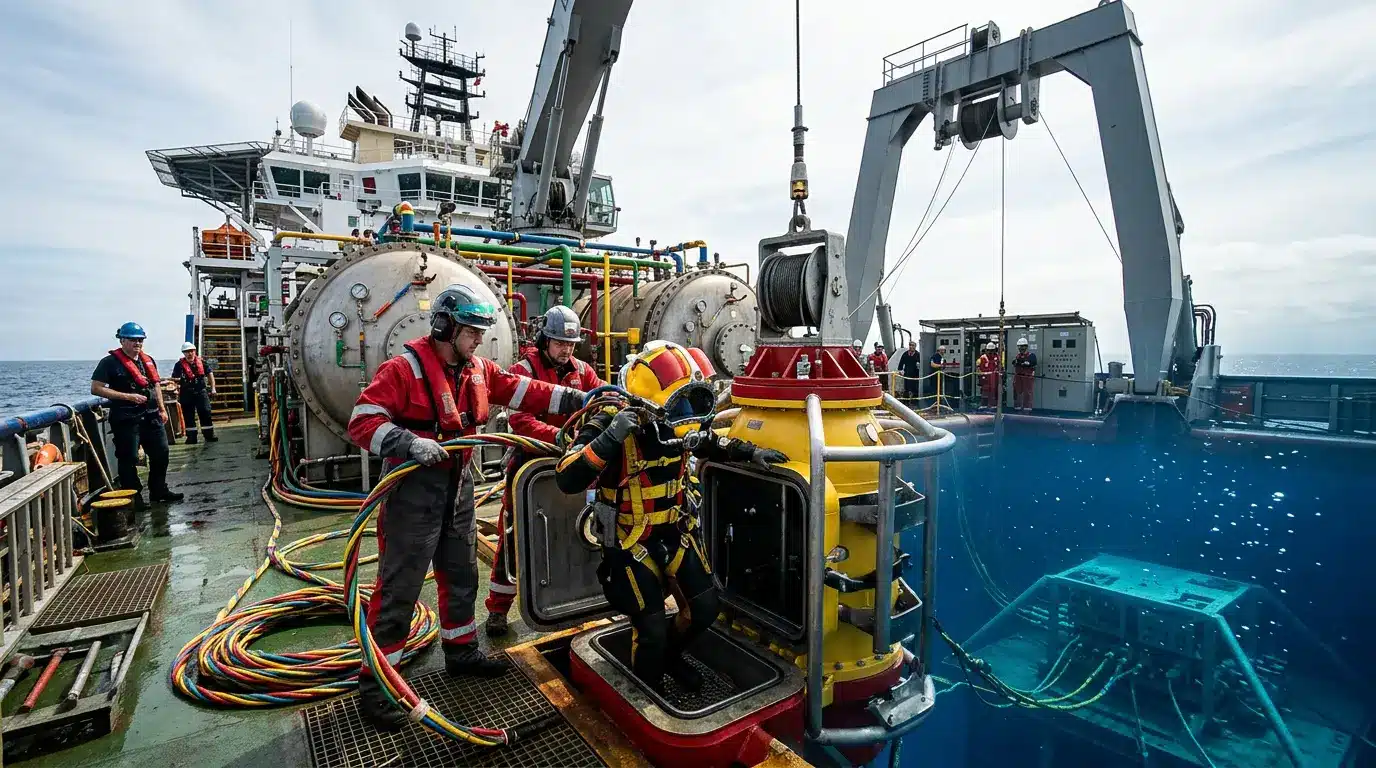
The process follows a tightly controlled routine built around pressure at every stage. Each part of the sequence exists to keep the body stable from the moment divers board until the job is done.
1. Boarding the Dive Support Vessel
Every job starts aboard a dive support vessel above the work site. Divers move directly into the hyperbaric chamber that becomes their home for the job.
The chamber is self-contained and built for pressure control. Every step from here depends on getting that control right.
2. Pressurizing the Chamber (Blowdown)
Once divers are settled, the chamber pressurizes to match the worksite’s depth. This stage is called blowdown and is done gradually so the body adjusts safely.
Inert gas fills body tissues until full saturation is reached. After that point, no extra depth exposure adds more decompression risk.
3. Transferring Into the Diving Bell
Once saturated, divers move under pressure into a diving bell through a sealed hatch. The transfer holds pressure constant so decompression never begins early, and the bell works as a mobile extension of the chamber, carrying that pressure down to the seafloor.
4. Descending to the Seafloor
The bell lowers slowly to the seafloor near the worksite. Once positioned, the hatch opens, letting divers exit directly into open water.
From here, the actual work begins, covering tasks like welding, inspection, or repair. The bell stays close by as a safe return point throughout the shift.
5. Working the Shift and Returning to Rest
A typical day splits into eight hours of diving, called a bell run, and sixteen hours of rest. Once the shift finishes, divers return through the bell and back into the pressurized chamber.
Rest happens fully under pressure, with no surfacing between shifts. Meals, sleep, and recovery all take place inside the same sealed environment.
6. Repeating the Routine Daily
This same cycle of work, rest, and pressure repeats every day until the project is complete. Divers rotate through shifts without ever leaving the pressurized system.
The routine can continue for weeks depending on the size of the job, though international standards cap a single stint at 28 days measured seal to seal, meaning the clock starts when divers enter the chamber and stops when they leave.
Decompression counts against that total, so a deeper job buys fewer working days. A dive to 650 feet leaves roughly 19 days of actual work after a day to descend and eight days to decompress.
7. Final Decompression
Once the job wraps up, the entire team begins one long, final decompression. This is the only time pressure gets reduced during the whole project.
The process is slow and monitored, often taking several days to complete safely. Only after this final stage do divers return to normal surface pressure.
Life Inside the ChamberBetween shifts, divers eat, sleep, and pass time in a space about the size of a small camper van. Meals arrive through an airlock and the temperature is held between 85 and 93 degrees Fahrenheit, since helium strips body heat with every breath. In the water, divers wear hot-water suits fed by hoses from the surface. Helium plus the added air density distorts speech so badly that crews rely on voice descramblers to understand each other. |
None of this would be possible on ordinary air, which makes the breathing gas itself worth a closer look.
What Gas Do Saturation Divers Breathe?
Standard air stops working long before divers reach typical saturation depths.
Past a certain point, closed-circuit breathing systems and specialized gas mixes become the only safe option, so the choice of what divers breathe becomes just as important as the equipment they use.
| Gas Mix | Common Use | Why It Matters for Saturation Diving |
|---|---|---|
| Compressed air | Recreational and shallow diving | Causes nitrogen narcosis and oxygen toxicity at depth, with cognitive effects starting around 100 feet |
| Heliox (helium + oxygen) | Saturation diving | Prevents narcosis, though helium pulls body heat away quickly and can trigger tremors below 500 feet |
| Heliox with trace nitrogen (trimix) | Deep saturation dives | A small amount of nitrogen is added because its narcotic effect at depth helps suppress HPNS tremors |
| Hydreliox (hydrogen + helium + oxygen) | Experimental record dives | Used by COMEX past 500 metres, where even trimix reaches its limits |
How Deep Can Saturation Divers Go?
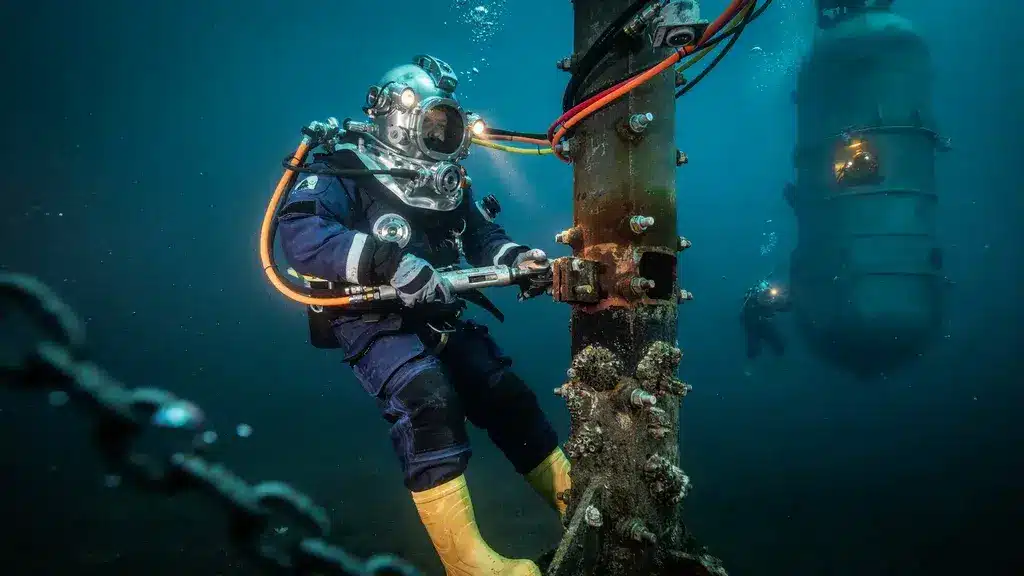
Depth is where saturation diving separates itself from most extreme depth conditions in the diving world. Most commercial saturation work takes place between roughly 65 and 1,000 feet below the surface, according to the Divers Alert Network.
Two records mark the outer edge, and they are worth separating. The deepest working dive in open water belongs to a COMEX team on the Hydra 8 program in 1988, who connected a pipeline at 534 meters, or 1,752 feet, in the Mediterranean off Marseille while breathing a hydrogen-based mix. That number still stands.
The deeper figure came from a chamber. In November 1992, French diver Théo Mavrostomos spent two hours at a pressure equal to 701 metres, or 2,300 feet, during COMEX’s Hydra 10 dive. The whole sequence took 43 days: 13 days of compression, a short stretch at depth, then 23 days coming back up.
Actual offshore jobs rarely push that far, but the fact that the human body can be conditioned to function at those pressures at all says a lot about why this career sits near the top of the world’s most extreme professions.
For comparison, the deepest free dive records are set on a single breath in minutes, while a sat diver spends weeks earning the same depth.
How Much Does a Saturation Diver Make?
Pay is the reason most people search for this job in the first place, and the honest answer has a wide spread. Glassdoor puts the US average near $110,000 a year, with a typical range of roughly $84,000 to $147,000 and top reported earners close to $188,000.
Offshore work is usually priced by the day rather than by salary. Day rates on peak-season offshore projects run $1,300 to $1,500 and up before depth bonuses, and a diver who strings together enough project days in a strong year can clear $200,000, according to Ocean Corp’s wage breakdown.
Be careful with generalist salary sites. Several list saturation diving under $60,000 because their scrapers pull in shore-based and entry-level commercial diving jobs under the same label. The day-rate figures from diving contractors are the more reliable read.
What Are the Risks of Saturation Diving?
This job consistently ranks among the most hazardous in the world, and that reputation isn’t exaggerated.
- Decompression sickness if pressure changes happen too fast
- High-pressure nervous syndrome, which brings tremors and loss of coordination and becomes a factor on heliox below roughly 500 feet
- Equipment failure during transfer between chamber and bell
- Long stretches of isolation from family and daily life
- Physical strain from pressure changes on joints and disrupted sleep cycles
- Repeated deep exposure over a career, which has been linked to bone and joint damage in long-serving divers
How Do You Become a Saturation Diver?
Nobody starts here directly. Saturation diving sits at the top of a long ladder of commercial diving experience.
- Complete a commercial diving program covering underwater welding, hyperbaric systems, and dive physiology
- Log several years of standard commercial or offshore diving experience
- Earn a Diver Medic Technician certification, since medical emergencies can’t wait for help from the surface
- Complete specialized training in closed-bell and saturation systems
- Get certified through recognized bodies such as IMCA or ADCI
- Apply through diving contractors, often relying on industry connections to get hired
The bottleneck is the second step, not the training. Contractors want logged hours across a range of depths before they will put someone in a chamber, which is why the path from diving school to a first saturation job usually takes years rather than months.
Saturation Diving Safety Tips
Every stage of saturation diving depends on strict pressure control, gas management, and constant monitoring.
- Complete Medical Clearance: Complete a full medical exam within 24 hours before entering saturation
- 24 Hour Life Support Monitoring: Keep a life support supervisor monitoring pressure, gas levels, and diver health around the clock
- Maintain Emergency Gas Reserves: Maintain enough reserve gas to complete a full emergency decompression
- Prepare Evacuation Systems: Keep a hyperbaric evacuation and rescue system ready throughout the operation
- Meet Energy Requirements: Consume about 44 to 52 kilocalories per kilogram of body weight each day
- Report Warning Signs Early: Report early signs of decompression stress or high-pressure nervous syndrome immediately
These safety practices align with standards followed by IMCA, ADCI, and professional offshore diving contractors worldwide.
Frequently Asked Questions
How Much Money Does A Saturation Diver Make?
Glassdoor puts the US average around $110,000 a year, with top reported earners near $188,000. Offshore day rates of $1,300 to $1,500 plus depth bonuses can push a busy year past $200,000.
How Do Saturation Divers Use The Bathroom?
Chambers include built-in sanitation systems, since divers can’t leave the pressurized environment for basic needs.
Is It Hard To Get A Job As A Saturation Diver?
Entry is competitive and slow, since most contractors hire through referrals rather than open applications.
How Long Does A Saturation Diving Job Last?
Most saturation stints run anywhere from a few days to several weeks, with many contractors limiting a single rotation to around 28 days before swapping in a fresh team.
How Deep Do Saturation Divers Go?
Commercial work usually falls between 65 and 1,000 feet. The deepest open-water saturation dive on record reached 534 metres, or 1,752 feet, off Marseille in 1988.
Is Saturation Diving Worth It?
Saturation diving isn’t a novelty career or a stunt performed for attention.
It’s a precisely engineered answer to a problem offshore industries couldn’t solve any other way: getting skilled people to the seafloor without losing weeks to decompression every single time.
Between the physics of saturation, the gas mixes divers breathe, and the risks built into every shift, the job makes sense once each piece is understood.
After twelve years around the water, including scuba hours in the Caribbean, the part that stays with me is the scale of the gap. A recreational diver plans a safety stop in minutes and treats it as non-negotiable.
A saturation diver plans one in days. Same physics, completely different order of magnitude, and a good reminder of how much respect decompression deserves at any depth.
It remains one of the most demanding professions still carried out by humans instead of machines, built around one fact: the body adapts to pressure, but only with enough time to do it safely.
If the career itself appeals to you, the realistic first move is a commercial diving program and several years of logged offshore hours before saturation work opens up. If you are here out of curiosity, our guide to deep sea diving basics covers the shallower end of the same physics.