I used to think getting out of breath while swimming meant I needed better stamina.
But after spending more time in the pool, I learned the bigger issue was usually my breathing pattern.
I was holding my breath underwater, lifting my head too much, and rushing every inhale.
The key is simple: breathe out steadily underwater, turn your body with your stroke, and take a quick breath when your mouth reaches the surface.
With the right timing, swimming feels smoother and far less exhausting.
How to Breathe While Swimming Freestyle Step by Step
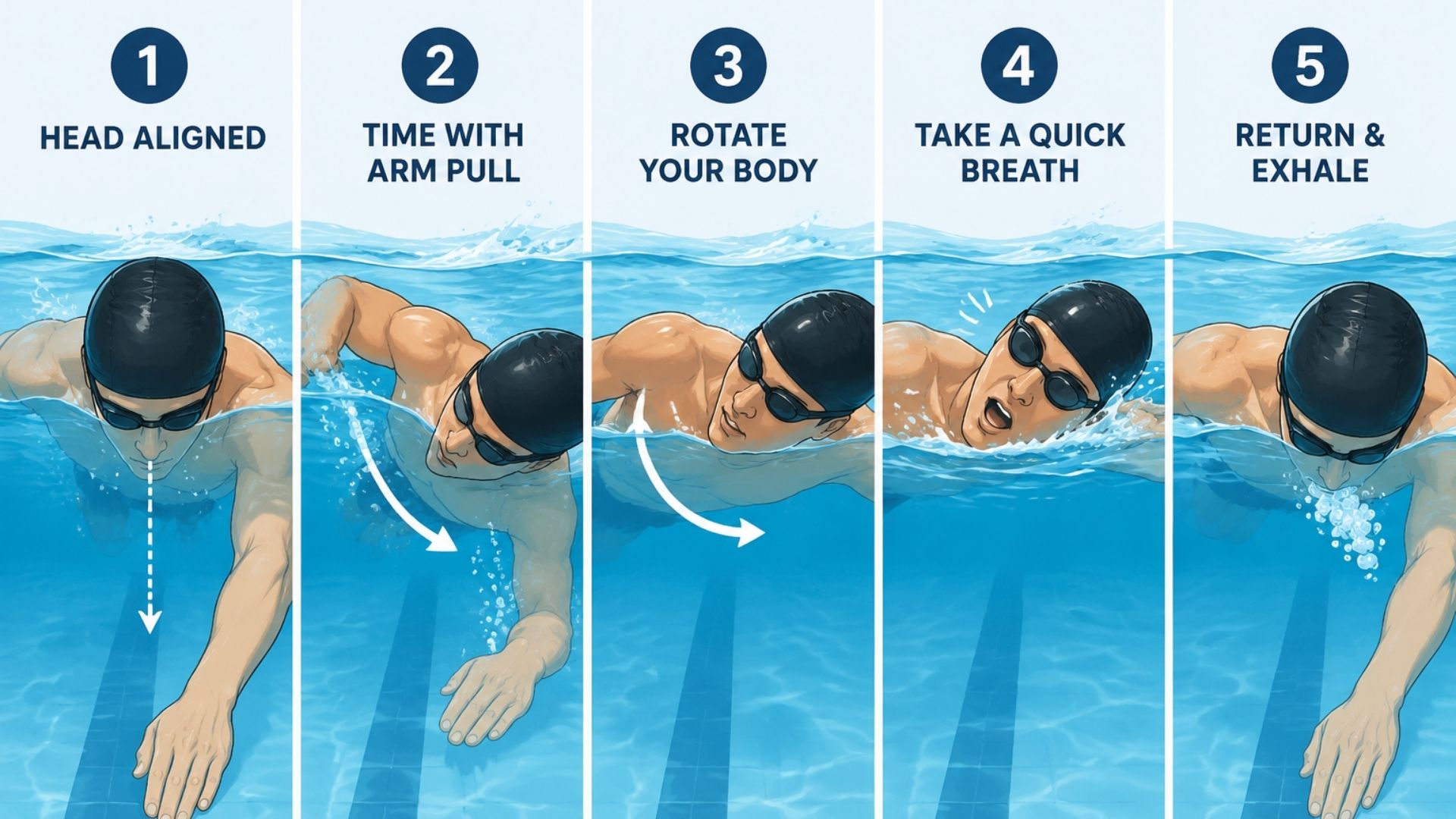
Freestyle breathing comes down to five repeatable steps that link your arm stroke to your air supply. Once your body learns the pattern, it stops feeling like a separate task.
Step 1: Keep Your Head Aligned Before You Breathe
Start with your head in a neutral position, eyes looking down and slightly forward at the bottom of the pool. Keep your neck in line with your spine the entire time.
I remind myself of this every single lap because a lifted head is usually the first mistake that throws off everything else.
Step 2: Time the Breath With Your Arm Pull
As one arm begins pulling back through the water, that is your cue to prepare for a breath on that same side.
The pull creates a small window of time where rotation feels natural instead of forced. Rushing this step is what causes most beginners to gasp instead of inhale smoothly.
Step 3: Rotate Your Body, Not Just Your Neck
Let your hips and shoulders roll together so your head turns as a result of body rotation, not a separate neck twist.
I picture my head resting on a pillow made of water and just rolling with my shoulder. This single adjustment fixed more of my early breathing issues than anything else I tried.
Step 4: Take a Quick, Low Breath
Turn just far enough for your mouth to clear the surface, ideally with one goggle still touching the water.
Inhale quickly through your mouth rather than gulping air, since a fast, small breath keeps your rhythm intact. You should never feel like you are lifting your whole face out to breathe.
Step 5: Return Your Face and Exhale Fully Underwater
Roll your head back down before your recovering arm enters the water, and begin exhaling right away, mostly through your nose.
Empty your lungs steadily through the rest of the stroke cycle so you are ready to inhale again the moment you rotate.
A full exhale here is the single biggest thing that fixes both a panicked, gasping feeling and water sneaking in through your nose.
When Should You Breathe During Freestyle?
Timing confuses more new swimmers than the head turn itself does.
The sequence is simple: Pull → rotate → breathe → return → stroke.
As your arm pulls through, your body naturally rotates onto its side, and that rotation is your window to breathe, not a separate movement layered on top of the stroke.
Once your face clears the surface and you take that quick inhale, roll your head back down right as your recovering arm reaches forward, then keep exhaling until your next scheduled breath.
Most recreational swimmers breathe every two strokes on one side. Bilateral breathers alternate sides every three strokes instead, which helps in open water when waves or glare hit from one direction.
Why You Might Feel Out of Breath Even With Good Technique
Feeling breathless is not always a technique problem. A lot of it comes down to carbon dioxide, not oxygen, and the fix is usually smaller than swimmers expect.
- Your urge to breathe is triggered by rising carbon dioxide, not falling oxygen. Holding your breath underwater lets that carbon dioxide build up fast, even if your form looks fine.
This is a well-documented part of how breathing control works, and understanding it is one reason coached breathing drills, like those recommended by U.S. Masters Swimming, focus so heavily on rhythmic exhale timing. - A held breath creates that panicked, rushed feeling. It is not a sign you need more fitness; it is a sign you stopped exhaling too early.
- Releasing air the entire time your face is down prevents the buildup. There should be a steady stream of bubbles from the moment you rotate down to the moment you rotate back up.
This showed up clearly in my own swimming. My form was not the issue on longer sets; I was holding air a half second too long between breaths. Once I exhaled the whole time I was submerged, the breathless feeling mostly disappeared, even at the same pace I had been swimming before.
If you notice yourself gasping on schedule but still feeling winded, check your exhale before you check anything else in your stroke.
Does Breathing Change for Other Swimming Strokes?
Each competitive stroke handles breathing differently because your body position and head movement change with the stroke itself. The timing that works for freestyle will not transfer directly.
Backstroke Breathing
Since your face stays out of the water the entire time in backstroke, you can technically breathe whenever you want.
I still keep a rhythm going, inhaling on one arm stroke and exhaling on the next. Random breathing tends to lead to hyperventilating during longer sets.
Breaststroke Breathing
In breaststroke, you lift your head to breathe during the outsweep of your arms, right as your chest rises naturally with the stroke.
Your head lifts naturally as your chest and shoulders rise with the stroke’s undulation, so you are not straining your neck the way you might in other strokes.
Your face should be back in the water by the time your arms finish their insweep. This stroke gives you the most consistent access to air of any competitive style.
Butterfly Breathing
Butterfly breathing happens during arm recovery, when your chin lifts forward, not up, to grab a quick breath before your face drops back underwater.
Most swimmers inhale every other stroke cycle to avoid disrupting the wave-like rhythm the stroke depends on. This is the stroke where I see the most tension in new swimmers, mostly from lifting the head too high.
How Often Should You Breathe While Swimming?
Breathing frequency depends on your stroke, your pace, and how hard you are working. No single number works for every swimmer in every situation.
|
Stroke or Situation |
Typical Breathing Pattern |
Best For |
|---|---|---|
|
Freestyle, unilateral |
Every 2 strokes, same side |
Sprinting and short distances |
|
Freestyle, bilateral |
Every 3 strokes, alternating sides |
Endurance and open water swims |
|
Backstroke |
Every 1 to 2 arm strokes |
Steady, controlled pacing |
|
Breaststroke |
Every stroke cycle |
Recreational and beginner swimmers |
|
Butterfly |
Every 1 to 3 stroke cycles |
Race pace and drill work |
I lean on bilateral breathing for most open water swims because it keeps my stroke balanced when waves or glare hit from one side.
On shorter, faster efforts in the pool, I switch to breathing every two strokes, so I get more oxygen without slowing down.
Nose Breathing or Mouth Breathing: Which Should You Use?
Inhale through your mouth since it pulls in more air, faster, during your short window above the surface. Exhale mostly through your nose, since a steady nasal exhale is easier to control and keeps water from sneaking in when you rotate back down.
Some swimmers exhale through both at once, which works fine too. What matters is that the exhale stays slow and continuous, not held and dumped all at once.
How to Stop Swallowing Water When You Breathe
Swallowing water usually traces back to the same root cause as feeling out of breath: an incomplete exhale and poor timing. A few adjustments can fix most of the discomfort within a few sessions of focused practice.
- Exhale fully before you rotate: If your lungs are still half full when you turn to breathe, there is no room left to inhale cleanly, and water sneaks in through the gap.
- Keep your breath low and quick: A large, gasping inhale pulls in splash and spray along with air, especially in open water or a choppy pool lane.
- Blow bubbles steadily through your nose: This creates gentle outward pressure that helps keep water from entering your nose during rotation or when a wave passes over your face.
- Avoid lifting your head too high: Lifting straight up instead of rotating to the side often causes your mouth to catch a wave or your own bow wake.
- Time your breath with your stroke, not against it: Breathing out of sync with your arm pull forces a rushed, poorly timed inhale that is far more likely to bring water with it.
I dealt with this constantly during my first open water swims along a choppy coastline. Slowing down my exhale timing solved most of it within a couple of weeks.
Breathing Drills for Beginner Swimmers
These drills isolate breathing mechanics from the rest of the stroke. That makes it easier to build muscle memory before adding full swimming speed back in.
1. Getting Comfortable With Your Face in the Water
If putting your face underwater still feels uneasy, start here before anything else. Stand in shallow water, take a breath, and lower your face in for a few seconds at a time, breathing out slowly through your nose the whole time.
Repeat until submerging feels ordinary, not tense. Every other drill on this list builds on that basic comfort, so it is worth not skipping even if it feels too simple.
2. Bubble Blowing at the Wall
Hold onto the pool edge, submerge your face, and exhale steadily through your nose and mouth until your lungs are empty.
Lift your head just enough to inhale, then repeat. This teaches the exhale underwater, inhale at the surface pattern that everything else builds on.
3. Side Kick Breathing Drill
Kick on your side with one arm extended forward and the other resting along your body. Rotate your head gently to breathe without lifting it.
This drill builds comfort with rotation in a slower, more controlled setting than full stroke swimming.
4. Catch Up Drill
Swim freestyle but wait for your recovering arm to touch your extended hand before starting the next pull. This slows your stroke rate down and gives you extra time to focus purely on your breathing timing.
5. 3-3-3 Breathing Drill
Take three strokes breathing to one side, then switch and take three strokes breathing to the other. This trains bilateral breathing and keeps your rotation even on both sides of your body.
6. Snorkel Drill
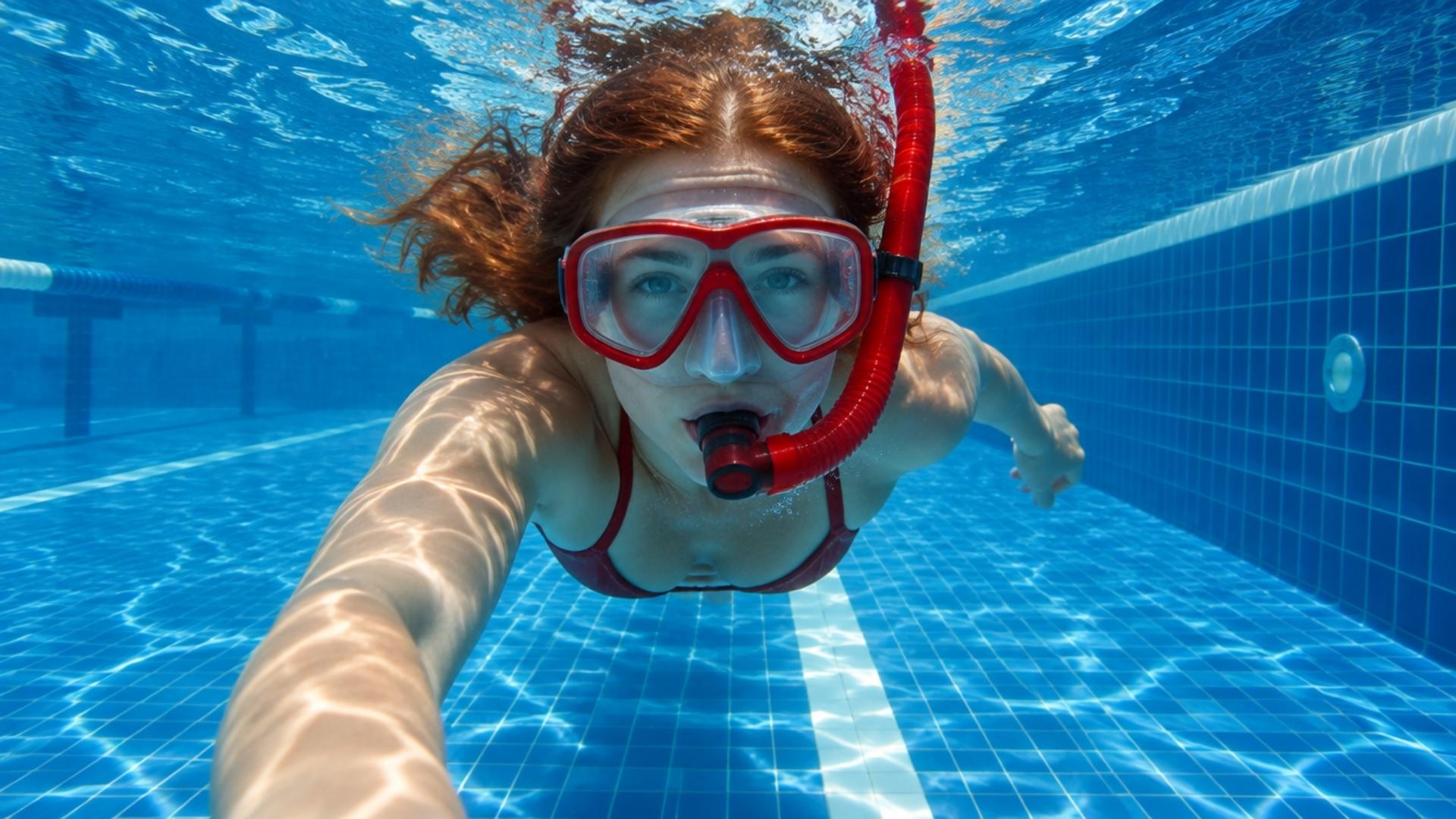
A front-mounted snorkel takes breathing out of the equation completely for a set or two. With no need to turn your head at all, you can focus entirely on keeping your neck neutral and your eyes looking down. I go back to this drill whenever my head position starts drifting after time away from the pool.
How to Practice Swimming Breathing Without Getting Overwhelmed
Learning to breathe well in the water rarely happens in one session. A simple progression keeps it manageable instead of frustrating.
- Start with bubble blowing at the wall. Practice until exhaling underwater feels automatic, not something you have to think through.
- Move to the side kick drill next. This lets you practice head rotation without also managing your arms or full-body coordination.
- Add the catch-up drill during short pool lengths. Focus only on timing your breath with your arm pull, nothing else.
- Bring in full freestyle strokes over short distances, like 25-yard lengths, before trying to hold a breathing pattern over longer sets.
- Return to these same drills whenever your technique slips, especially after time away from the pool.
I still cycle through this same progression myself after a break from swimming, and it works just as well for a rusty swimmer as it does for a total beginner.
If you are building toward longer sessions, pair this with a plan for getting started with open water swimming so you can apply steady breathing outside a controlled pool.
Final Thoughts on Breathing While Swimming
Good breathing can change the way swimming feels. Once your breath matches your stroke, you waste less energy and move through the water with more confidence.
Focus on steady practice, not perfection, and let the rhythm improve over time.
Learning to breathe while swimming gets easier with every session. Keep practicing the techniques that feel natural, and share your own swimming tips or struggles in the comments.
Frequently Asked Questions
Can I Learn to Breathe on Both Sides Even if I Have a Dominant Side?
Yes. Practicing bilateral breathing during easy swims a few times a week can build comfort on your weaker side and help maintain a more balanced stroke.
Does Wearing Goggles Affect How I Should Breathe?
No. Goggles do not change breathing mechanics, but a poor seal can cause distractions or interruptions during rotation, affecting your timing.
Why Does My Breathing Get Worse When I Swim Faster?
Faster swimming increases oxygen demand, so you may need to breathe more frequently. Many swimmers switch to breathing every two strokes during harder intervals.
Is It Normal to Feel Anxious About Breathing in Open Water?
Yes, especially with waves, wind, or limited visibility. Practicing in calm, shallow water can help you adjust gradually and build confidence.
How Many Seconds Should You Hold Your Breath While Swimming?
You generally should not hold your breath. Exhale while your face is underwater, usually for about one to two seconds per stroke cycle, rather than holding air until you turn to breathe.
Does Swimming Breathing Work Differently if You Have Asthma or Reduced Lung Capacity?
Talk with your doctor before starting a swim program if you have asthma or reduced lung capacity, since they can advise on pacing and warm-up routines specific to your condition. General strategies like breathing more frequently and warming up gradually can help once you have medical clearance.