Most boat owners know what they paid. Fewer know what their boat could sell for right now. That gap shows up the moment you think about selling, trading, or refinancing.
A boat’s value depends on its brand, year, condition, engine hours, upgrades, and overall demand in the market.
You can get a much clearer estimate using free online tools, recent sold prices, and current listings, which give you a solid starting point before you make any decision.
Here is how to check your boat’s current value, what changes it, and how to price it right when it is time to sell.
| The fast answer: Run your make, model, and year through the Boat Trader Price Checker for a range based on live listings, then cross-check it against J.D. Power’s marine values (formerly NADA Guides) for a dealer-side figure. Both are free. Expect a used boat to hold around 80 percent of its original price at the five-year mark, and 50 to 70 percent of that original price by year ten. |
Note: Boat values shift with market conditions, so treat every number here as a starting range and confirm with a tool or dealer before making a financial decision.
How Can I Find Out How Much My Boat Is Worth?
Finding your boat’s value becomes easier when you compare multiple sources instead of relying on a single estimate. Each method gives a different level of accuracy depending on your boat type, condition, and selling goals.
- Online Boat Value Calculator: Provides a quick estimate using recent sales data and industry pricing databases. It works well for a basic starting point but may miss upgrades or repairs.
- Similar Boat Listings: Comparing boats with matching size, age, and condition helps private sellers understand current market demand and realistic prices. Look for sold prices rather than asking prices, since asking prices run high.
- Dealer Trade-In Estimate: Useful for upgrades or quick sales, but the value is often lower due to dealer costs and resale margins.
- Professional Marine Survey: Offers the most accurate valuation through an in-person inspection, especially for high-value boats. A survey confirms condition, not market price, so it works best alongside a valuation tool rather than instead of one.
A full list of boat value calculators is found on the Boat-Alert History Report website and you can even try the free tool on HIN Decoder.
For a more reliable price, combine online estimates, market comparisons, and expert opinions before listing your boat.
Which Free Tools Give the Most Accurate Boat Value?
| Tool | Data Source | Best For |
|---|---|---|
| Boat Trader Price Checker | Live and sold listings across the US, updated daily | Private sellers wanting a current asking-price range with geographic filtering |
| J.D. Power marine values | Broker and dealer transaction history, not private-party sales | Understanding what a dealer will likely offer you |
| ABOS Marine Blue Book (Price Digests) | Specification-based valuation | Boats where model year alone gives a misleading figure |
The two main tools disagree by design. J.D. Power draws on broker and dealer sales, so its numbers skew toward what the trade pays. Boat Trader reads live listings, so it tracks closer to what private sellers are asking.
Running both gives you the floor and the ceiling of your realistic range, which is more useful than either number alone.
If you have searched this before and found NADA Guides, that is the same data. NADA’s marine values are now published under the J.D. Power name.
What Information Do I Need to Estimate My Boat’s Value?
Before estimating your boat’s value, collect key details that help create a more accurate price.
Keep your title or documentation ready, as the U.S. Coast Guard’s National Vessel Documentation Center notes that buyers and appraisers use it to verify ownership before finalizing a value.
Include your boat’s type, size, location, and model year, since demand and pricing can vary by region and category. Boats hold value better in warm-weather states where the season runs year-round than in northern markets with a short season.
Engine hours, maintenance records, service history, and overall condition also influence the final estimate. Details about the hull, interior, electronics, and upgrades, such as updated navigation equipment, can further affect value.
How Fast Do Boats Lose Value?
Depreciation is the reason your boat is not worth what you paid, and knowing the curve tells you roughly where your number should land before you run any tool.
According to BoatUS, most boats follow an S-curve rather than a straight line:
| Age | Typical Value Lost | What Is Happening |
|---|---|---|
| Year 1 | 10 to 15 percent | The “off-the-lot” drop, the steepest single year of ownership |
| By year 5 | About 20 percent | Depreciation slows considerably after the first year |
| By year 10 | 30 to 50 percent | Still gradual, with condition mattering more than age |
| Teens and 20s | Accelerates again | Dated equipment and higher upkeep costs weigh on price |
| Eventually | Bottoms out at 10 to 30 percent of original value | The floor, below which a maintained boat rarely falls |
Published depreciation estimates vary a great deal. Some brokers cite 20 to 30 percent in year one, others model 15 percent compounding annually.
The figures above follow BoatUS because its curve matches how the used market actually behaves, but treat any depreciation table as a guide rather than a calculation.
Two practical takeaways. First, buying a two or three year old boat lets someone else absorb the steepest part of the curve. Second, if your boat is between five and fifteen years old, its condition and service history will move the price more than its model year will.
Factors Determining a Boat’s Resale Value
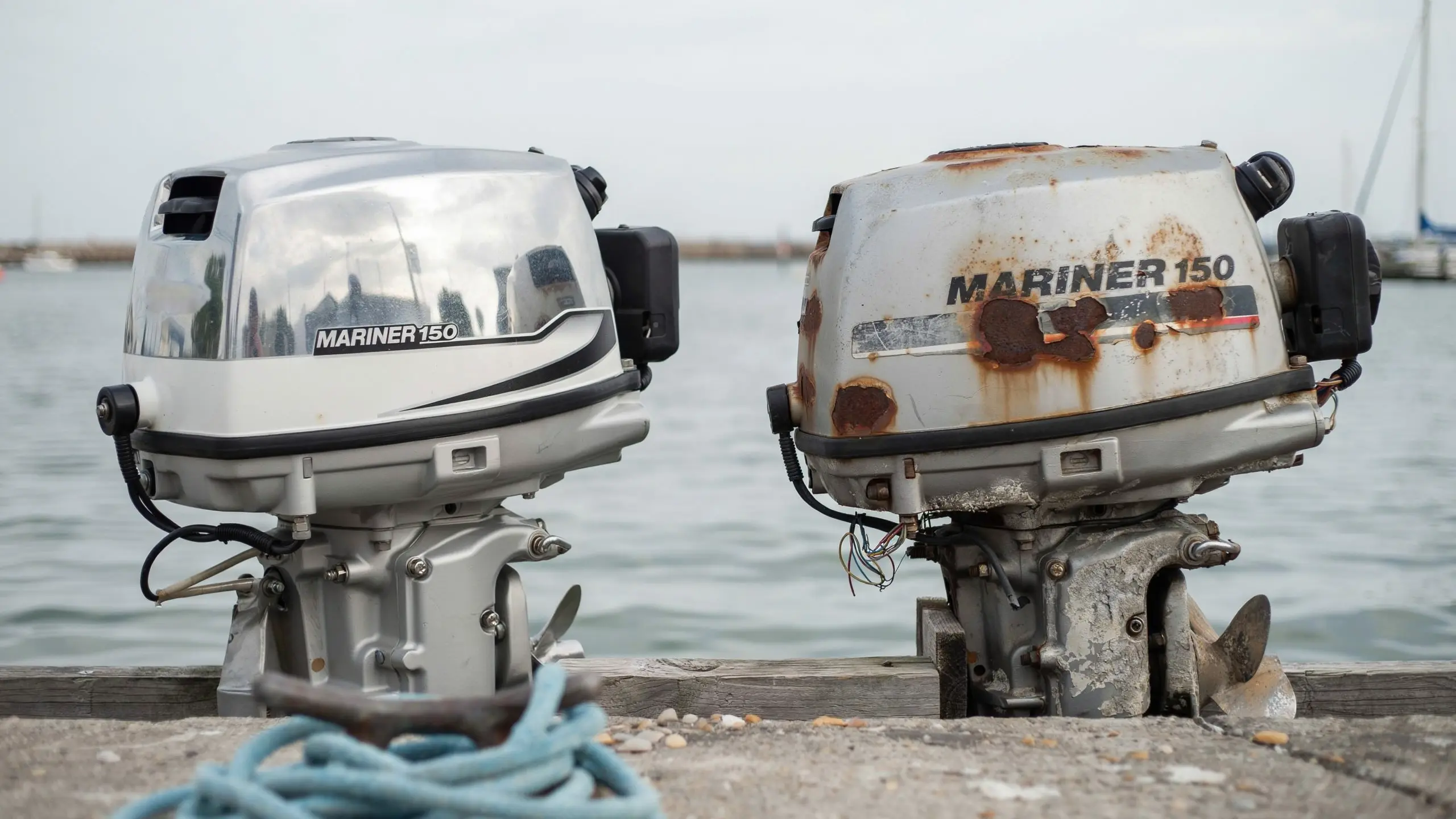
Several factors influence how much your boat is worth. Some details can increase buyer interest and raise the price, while others may reduce its appeal.
Things that can increase your boat’s value:
- Popular brand and model with a strong reputation
- Location, season, and local demand that match buyer interest (spring brings the highest trade-in offers, since dealers need inventory for peak season)
- Low engine hours showing less wear and longer service life
- Updated electronics, navigation, and sound systems
- Recent upgrades, equipment, and useful accessories
- Quality additions like trailers, covers, and safety gear
- Clean appearance and proper upkeep
Things that can lower your boat’s value:
- Hull damage, cracks, or visible repairs
- Poor maintenance history or skipped servicing
- Outdated equipment and worn interiors
- Missing maintenance records
- Engine or mechanical problems
- Late-season timing, when dealers face holding costs through winter
How Much Are Different Types of Boats Worth?
Boat type has a big effect on price, so most buyers search by category instead of brand alone, especially when comparing different types of boats for a lake against saltwater options.
| Boat Type | Typical Used Value Range | Main Factors |
|---|---|---|
| Pontoon boats | $8,000 to $40,000 | Size, motor, condition |
| Fishing boats | $8,000 to $50,000 | Engine, equipment |
| Wake boats | $15,000 to $100,000 | Ballast system, upgrades |
| Cruisers | $25,000 to $150,000 | Size, maintenance |
| Sailboats | $8,000 to $60,000 | Rigging, age |
Typical used market ranges vary by year, brand, condition, and region, so treat these as a starting point rather than a fixed price.
Depreciation also differs by category: personal watercraft and jet boats lose value fastest, pontoons and fishing boats sit in the middle, and sailboats depreciate slowest because there is less technology to date.
What Is the Used Boat Market Doing Right Now?
Market conditions move your number as much as your boat’s condition does, and 2026 is not a straightforward year.
Used boat prices have stayed resilient while new boat prices have climbed under tariff pressure, which pushes buyers toward the used market and supports resale values.
At the same time boats are taking longer to sell: dealers report that one-year-old boats need roughly 75 more days on the market than they did in 2023.
The practical effect is that model year alone is a poor guide to price right now. Near-new used boats are being compared directly against discounted new ones, so a two-year-old boat may be worth less relative to a fresh model than the depreciation curve suggests. Run a current tool rather than relying on what a similar boat fetched two seasons ago.
How Do I Get the Best Offer on My Boat?

Getting a strong offer depends on how well you prepare your boat and how accurately you price it according to the current market.
- Complete maintenance and repairs: Fix mechanical issues and small problems before listing to avoid concerns during inspections.
- Improve your boat’s appearance: Clean the interior and exterior, remove clutter, and take clear photos that show its condition.
- Compare current market listings: Check similar boats for sale to understand realistic pricing based on demand. Use sold prices where you can find them, since asking prices are inflated.
- Consider timing and demand: Seasonal trends and local buyer interest can influence how quickly your boat sells.
- Set a realistic asking price: Leave some room for negotiation while avoiding a price that is too high or too low.
- Negotiate the trade separately: If you are trading in, agree the new boat’s price first, then discuss your trade value. Dealers can inflate a trade figure while raising the purchase price to match.
Adjust your number based on how fast similar boats are moving. Leave room for negotiation, since most buyers expect to talk the price down slightly.
Private Sale or Dealer Trade-In?
Dealers typically offer 70 to 85 percent of a boat’s retail market value. On a boat worth $30,000 retail, that means offers in the $21,000 to $25,500 range.
The gap is not arbitrary: dealers commonly spend $2,000 to $5,000 reconditioning a trade before it goes back on the lot, and they carry the resale risk while it sits there.
A private sale almost always nets more money and costs you time, showings, and paperwork. A trade-in costs you money and saves you all three.
In many states a trade-in also reduces the sales tax on your next boat, since you pay tax only on the difference, though the rules vary and some states offer no credit at all. Washington’s Department of Revenue publishes a clear example of how one state handles it; check your own state’s rules before assuming the same applies.
Pricing Your Boat With Confidence
Checking your boat’s value does not have to be complicated once you know where to look. Start with the Boat Trader Price Checker for a live-market range, cross-check it against J.D. Power for the dealer-side figure, then compare both against similar boats actually selling in your region.
Gather your maintenance records before you start, since they speed up every step and directly support the number you are asking for.
If your boat is high value, heavily upgraded, or tied to insurance, financing, an estate, or a legal dispute, a professional appraisal is worth the cost. It gives you a documented number that holds up if anyone questions the price later.
For everyone else, two free tools and an afternoon of comparison will get you close enough to price with confidence. Run the numbers before you talk to a dealer, not after.
Frequently Asked Questions
How Do I Check My Boat’s Value for Free?
Most online boat value calculators are free to use. Enter your boat’s make, model, year, and condition, and the tool compares it against recent sales data. The Boat Trader Price Checker and J.D. Power’s marine values are both free and cover most makes.
Does Boat Value Decrease Every Year?
Generally, yes. Boats depreciate fastest in the first year, losing 10 to 15 percent, then slow to a gentler rate through the first decade. Depreciation picks up again once a boat reaches its teens, before flattening out near the bottom of its range.
What Makes a Boat Hold Its Value?
A recognized brand, low engine hours, and a clean maintenance history. Freshwater use and covered storage help too, and sailboats hold value better than powerboats because there is less technology to become dated.
How Much Is a 10-Year-Old Boat Worth?
Roughly 50 to 70 percent of its original price, based on the BoatUS depreciation curve, though condition and brand shift that a long way in both directions. A well-maintained ten-year-old boat from a strong brand can beat a poorly kept five-year-old one.
Do I Need a Marine Survey to Sell My Boat?
Not for a routine private sale. A survey becomes worth the cost when the boat is high value or heavily upgraded, or when the number has to satisfy an insurer, a lender, an estate, or a legal dispute. A survey documents condition; it does not tell you the market price on its own.