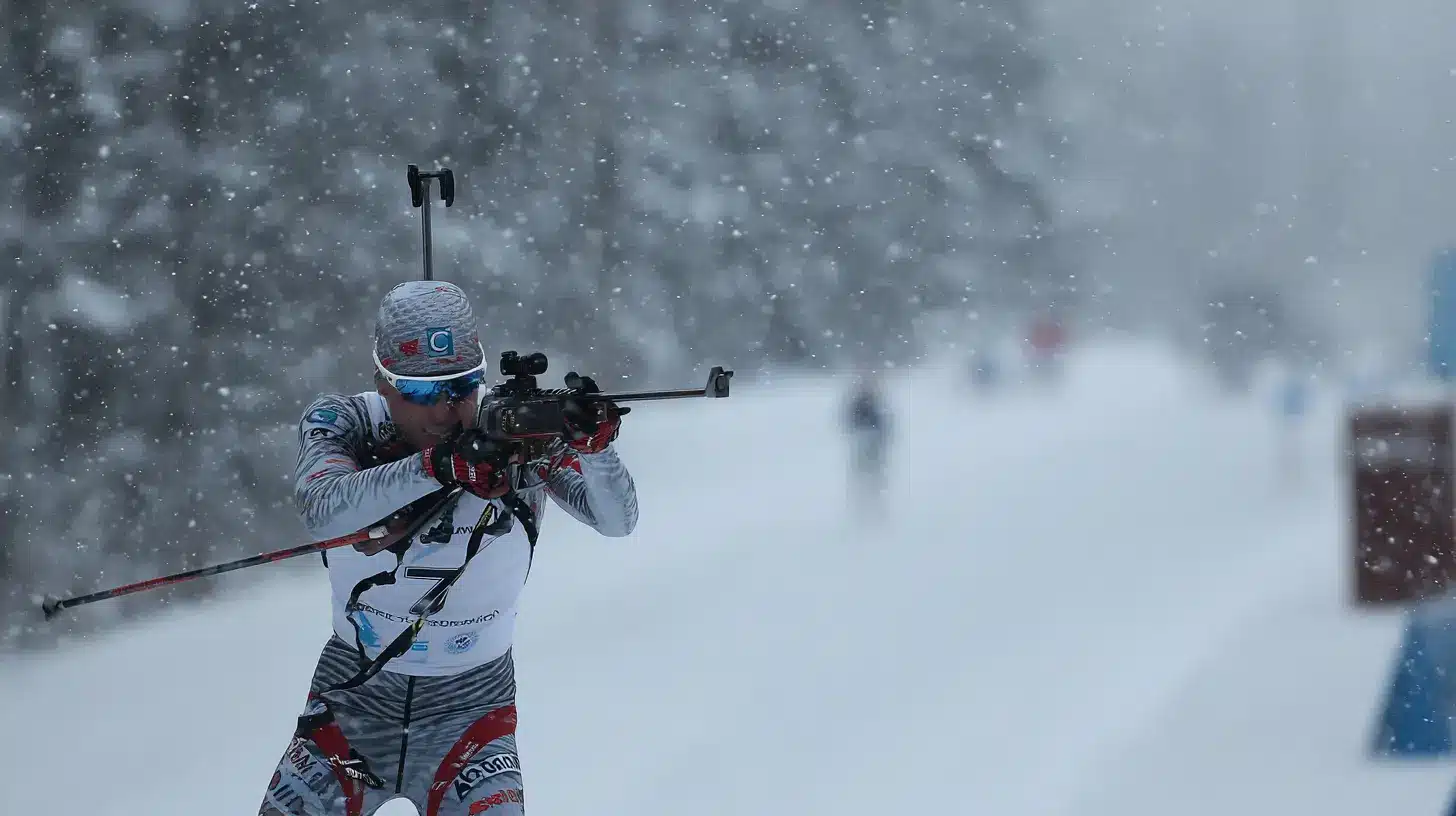
Most winter sports demand either speed or precision. Biathlon demands both, at the same time, in freezing temperatures, with a rifle on your back.
Athletes ski several kilometers at full effort, then must stop, steady their breath, and hit targets. Prone targets are just 45 mm across, roughly the size of a golf ball.
Standing targets are larger at 115 mm, but athletes must hit them while still recovering from the physical demand of skiing. One missed shot can cost a race.
This is winter biathlon, the Olympic sport whose name comes from the Greek words for “two” and “contest”, a discipline that has tested human limits since the 18th century.
It looks unusual at first glance, but spend five minutes watching a race, and it becomes nearly impossible to look away.
| Feature | Biathlon |
|---|---|
| Sport Type | Winter Olympic Sport |
| Combines | Skiing + Rifle Shooting |
| Main Challenge | Speed and Accuracy |
| Olympic Debut | 1960 |
What is Biathlon and Why is It Unique?
The International Olympic Committee states that biathlon is a Winter Olympic sport that combines cross-country skiing with rifle shooting. Competitors ski a set course, stopping at a designated shooting range to fire at five targets per stage before continuing.
Speed matters, but a single missed shot triggers a penalty, either a 150-meter penalty loop or a one-minute time addition, that can undo minutes of hard skiing.
What separates biathlon from every other Winter Olympic sport is this contradiction: the faster an athlete skis, the harder it becomes to shoot accurately.
A sprinting skier’s heart rate can hit 180 beats per minute. At the shooting range, they have seconds to bring that down enough to hold a rifle steady. It is a sport that rewards raw physical ability and mental control equally.
The history of Biathlon: From Scandinavian Military Training to the Olympic Stage
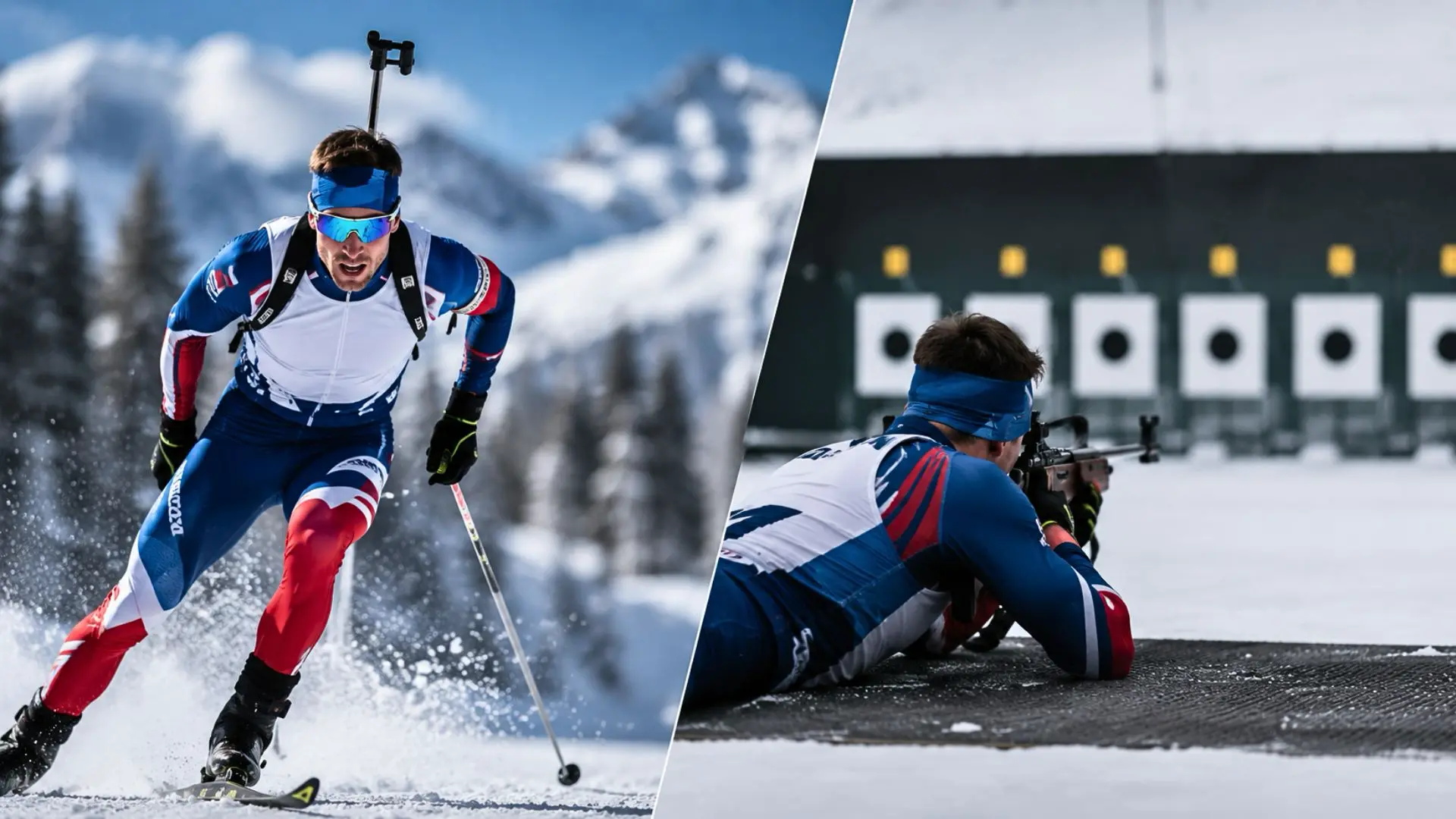
Biathlon’s roots run deeper than most Olympic sports. In Scandinavia, skiing while carrying weapons was a practical skill long before it became competitive.
Norwegian and Swedish border soldiers trained on skis for centuries, using rifles to patrol and protect their territories through long, difficult winters.
The first recorded ski-shooting competition took place in 1767, organized by Norwegian border troops near the Norway-Sweden border.
Competitors skied down a hillside and fired at targets, laying the groundwork for what would become a global Olympic discipline.
By the 19th century, military exercises mixing skiing with marksmanship had spread across Scandinavia. In 1861, the world’s first dedicated biathlon club, the Trysil Rifle and Ski Club, was established in Norway.
Hunting on skis was also a traditional rural practice, with communities depending on it for survival through the harshest months of the year.
How the Sport Expanded Worldwide
The International Biathlon Union (IBU) was established in 1993, taking over governance of the sport from the Union Internationale de Pentathlon Moderne et Biathlon. Based in Anif, near Salzburg, Austria, the IBU now runs the annual Biathlon World Cup circuit and the World Championships.
|
A Quick Timeline 1767: First recorded biathlon competition held by Norwegian-Swedish border troops |
How Does Biathlon Work? Biathlon Rules Explained
A biathlon race combines two simple elements, skiing and shooting, but the way they interact is what makes the sport so demanding. Here is how a race unfolds:
- Athletes set off on a cross-country ski loop, covering anywhere from 6km to 20km depending on the event format.
- At set intervals, competitors stop at a purpose-built shooting range positioned on the course.
Each athlete fires five shots at a row of five circular targets 50 meters away. - The shooting position changes; some stages are fired lying down (prone), while others are fired standing upright.
- Every missed target results in either a 150-meter penalty loop skied immediately or a one-minute time addition, depending on the event format.
The catch? Heart rates are through the roof at the shooting range. Athletes must slow their breathing within seconds of arriving, take aim, and fire before the body fully recovers from the physical effort of skiing.
Basic Rules of Biathlon
|
Equipment Used in Biathlon
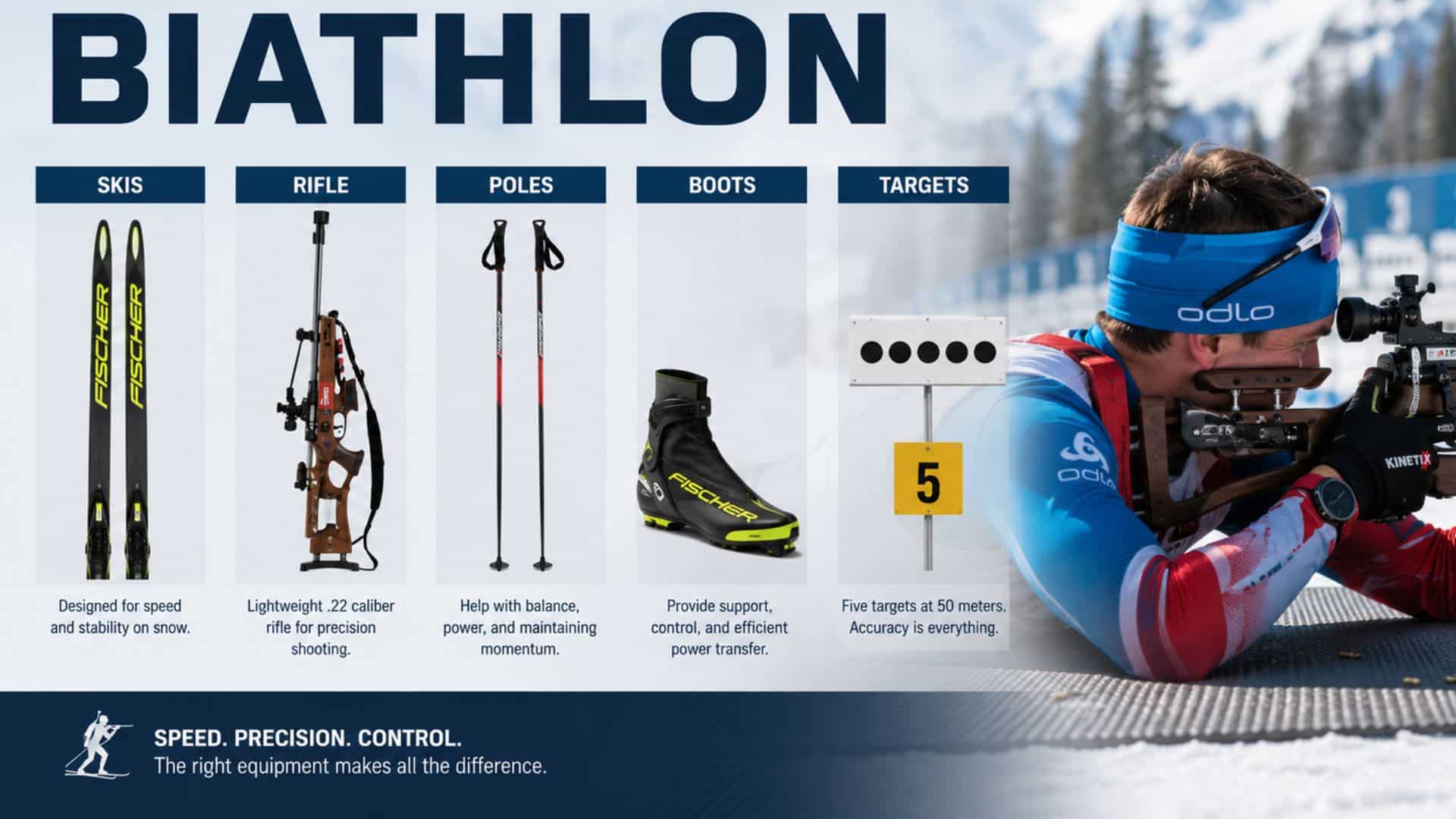
Biathlon combines fast-paced skiing with focused shooting, so every piece of equipment plays an important role in performance and control.
| Equipment | Purpose |
|---|---|
| Skis | Speed across the snow |
| Rifle | Precision shooting |
| Poles | Balance and forward movement |
| Boots | Ski control and support |
| Targets | Accuracy scoring |
Together, these tools help biathlon athletes stay balanced, move efficiently, and shoot accurately under pressure.
Every Biathlon Event at the Winter Olympics
Biathlon currently features 11 events at the Winter Olympics, five for men, five for women, and one mixed relay. Each format tests a different mix of speed, accuracy, and race tactics.
| Event | Distance (Men / Women) | Shooting Stages | What Sets It Apart |
|---|---|---|---|
| Individual | 20km / 15km | 4 | One-minute time penalty per miss |
| Sprint | 10km / 7.5km | 2 | Fastest qualifying format |
| Pursuit | 12.5km / 10km | 4 | Start order based on sprint results |
| Mass Start | 15km / 12.5km | 4 | All 30 athletes start together |
| Relay | 4×7.5km / 4×6km | 2 per leg | Team race; each athlete has 8 shots (5 + 3 spares) to hit 5 targets |
Individual Event
The oldest Olympic format and the most unforgiving. Men ski 20km, women ski 15km, across four shooting stages, two prone and two standing. Each missed shot adds one minute to the finishing time. A fast skier who misses four shots can lose to a slower competitor who hits every target cleanly.
Sprint Event
The shortest and most direct format: 10km for men, 7.5km for women, with two shooting stages. Missed shots send athletes around a 150-meter penalty loop. Sprint results also determine the starting order for the pursuit event, making every second here count twice.
Pursuit Event
The pursuit picks up where the sprint ends. Athletes start at intervals matching their sprint time gaps, so the sprint leader goes first. With four shooting stages and penalty loops for misses, positions can shift dramatically across the course. The first athlete across the finish line wins outright.
Mass Start Event
Thirty athletes start simultaneously, 15km for men, 12.5km for women , making this the closest thing in biathlon to a direct head-to-head race. Athletes who miss at the range must ski the penalty loop and rejoin the course, often falling well behind those who shoot cleanly.
Relay Event
Four-person teams race legs of 7.5 km (men) or 6 km (women) each. Unlike individual events, relay athletes carry spare rounds: each skier has eight bullets (five in the magazine plus three manual spares) to knock down five targets. Any targets still standing after all eight shots trigger a penalty loop. The first team across the finish line wins.
Greatest Biathletes in Olympic History
No sport in the Winter Olympics has produced legends quite like biathlon. A few names stand above the rest:
| Athlete | Country | Olympic Medals | Why They Matter |
|---|---|---|---|
| Ole Einar Bjørndalen | Norway | 13 total, 8 gold | Widely considered the greatest biathlete ever; the most decorated male Winter Olympian in history |
| Martin Fourcade | France | 7 total, 5 gold | Dominated the 2010s; five consecutive World Cup titles |
| Johannes Thingnes Bø | Norway | 9 total, 5 gold | 21 World Championship titles; retired after 2026 Games |
| Myriam Bédard | Canada | 2 gold | The only non-European to win an Olympic biathlon title (Lillehammer 1994) |
At the 2026 Winter Olympics in Milan, France’s Julia Simon claimed three gold medals, and France dominated the biathlon overall, winning all three relay gold medals for the first time in history. Norway remains the greatest all-time biathlon nation, with 67 Olympic medals and 25 golds.
What Sets Biathlon Apart From Cross-Country Skiing
Many first-time viewers assume biathlon is simply cross-country skiing with an added twist. The gap between the two sports is wider than it appears.
| Features | Biathlon | Cross-Country Skiing |
|---|---|---|
| Rifle shooting included | Yes | No |
| Penalties for misses | Yes, loops or time | Not applicable |
| Skills required | Speed and accuracy | Endurance only |
| Shooting stages per race | 2–4 | None |
| Equipment carried | Skis and a rifle | Skis only |
Also, check these amazing skiing spots to make the experience truly memorable.
Conclusion
Biathlon is the Olympic sport that combines skiing and shooting, refusing to let athletes be great at just one thing.
Every race demands endurance across kilometers of snow and accuracy on targets smaller than a fist. Its history runs from 18th-century Norwegian border drills to packed Olympic arenas, and its 11-event Olympic program gives competitors multiple formats to prove they belong at the highest level.
Among Winter Olympic sports, very few ask this much of the human body and mind at the same time.
That is what makes biathlon so unlike anything else on the Winter Olympic calendar, and what keeps viewers watching long after the race begins.
Frequently Asked Questions
Which Country Dominates Biathlon?
Norway has historically led the sport, holding the most Olympic biathlon medals of any nation. Germany, France, and Russia have also produced multiple Olympic champions, though Norwegian athletes have consistently set the standard.
Is Biathlon Harder Than Cross-Country Skiing?
Both sports are physically exhausting, but biathlon adds a layer of mental and technical difficulty that cross-country skiing does not require. Shooting accurately at a 45mm target seconds after skiing at full effort, while managing breathing, body temperature, and race pressure.
When did Biathlon Become an Olympic Sport?
Biathlon made its official Olympic debut at the 1960 Winter Games in Squaw Valley, California. A related discipline, Military Patrol, had appeared at earlier Winter Olympics as a demonstration event starting in 1924.
How Many Biathlon Events are in the Winter Olympics?
There are currently 11 biathlon events at the Winter Olympics: five men’s, five women’s, and one mixed relay.