
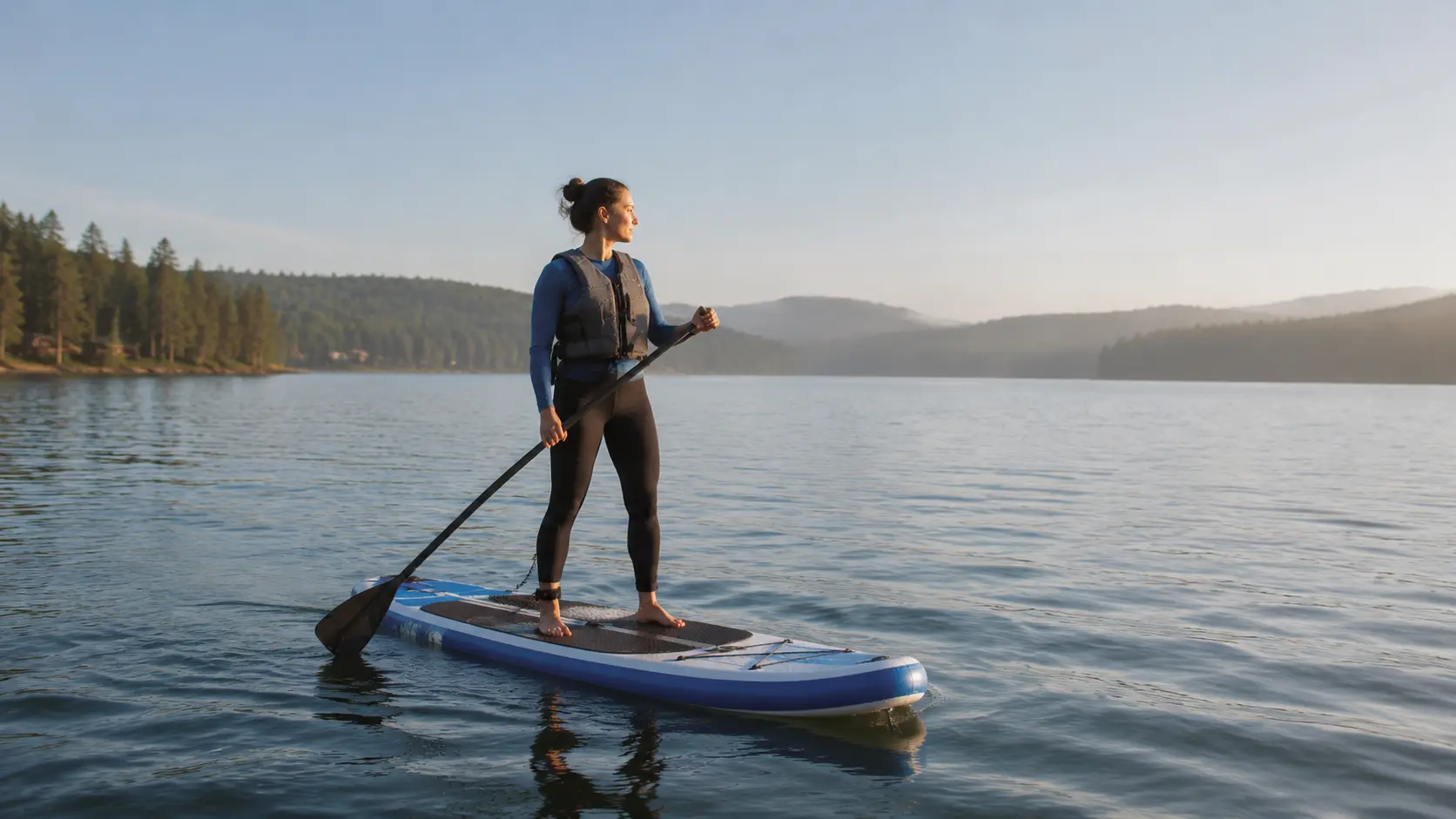
Paddleboarding looks tricky from the shore, but learning to paddleboard is easier than most beginners expect.
Most people find their balance within the first ten minutes, and by the end of your first session, you’ll wonder why you waited so long to try it.
What makes the difference between a shaky first attempt and a great one comes down to a few basics.
Pick a board that fits your size and skill level, learn to hold your paddle properly, and understand the basics of safety before paddling out. Get those right, and everything else falls into place.
By the time you finish reading this, you’ll know exactly what gear to grab and how to step onto the water with confidence.
Beginner Paddle Boarding Gear You Need First
Before you hit the water, a few basics make all the difference. These things really matter for your first time out on the water.
-
Choosing the right board: Go wide for stability over speed, pick an inflatable board for easier transport and safety, and stay within the ideal length range for your height so control feels natural, not forced. Choose a good SUP board brand for utmost comfort.
-
Picking the correct paddle: Choose an adjustable paddle for height flexibility, follow the correct sizing rule for your height, and opt for lightweight materials for easier control and less arm fatigue.
Water Safety Basics Before You Get on the Board
Basic safety gear keeps you protected from the moment you step onto the water. A personal flotation device (PFD) is essential and should always be worn while paddle boarding.
Getting this part right made all the difference for me when I started. I still remember how much smoother my early sessions became once I got these basics down.
- Check wind speed and water conditions before launching: A quick forecast check can save you from fighting choppy water.
- Start only in calm lakes, bays, or slow-moving water: These spots are more forgiving as you build confidence.
- Avoid strong currents, boat traffic, and deep open water at first: Give yourself room to learn without extra hazards.
- Always paddle within a safe distance from shore: Getting back stays easy even if you tire or the wind picks up.
- Understand how weather changes affect balance and control: Wind and waves can shift quickly, so know what to expect.
How to Get on and Start Paddle Boarding
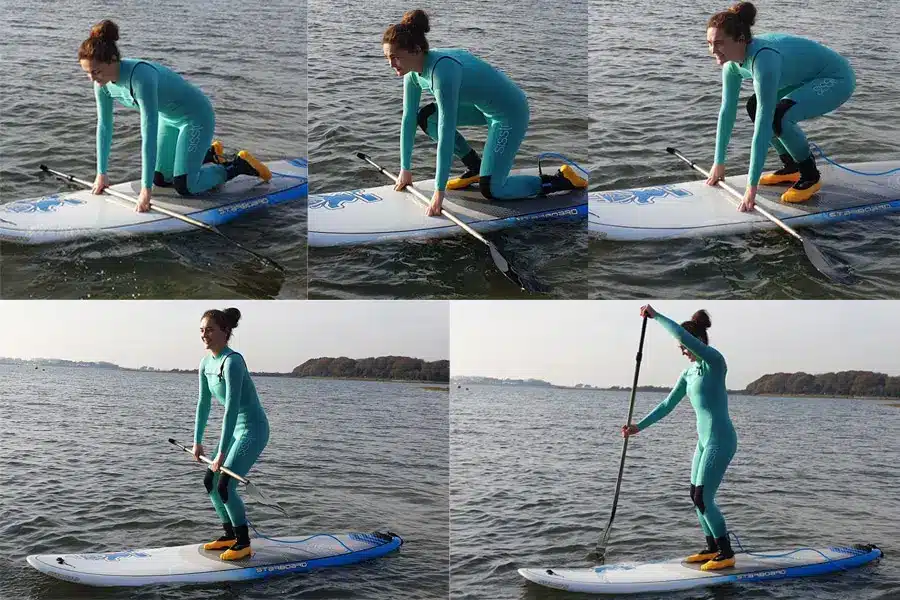
Once you’ve got your board safely in the water, getting on and standing up is the next milestone. Follow these five steps in order, and you’ll be up and paddling with confidence.
Step 1: Position Your Board in Calm Water
Place your board facing straight into light wind or current so it stays steady while you get on. Make sure the fins are clear of shallow ground to avoid any damage or drag.
Step 2: Get on Safely in Kneeling Position
Enter the board from the side rather than the tail for better balance. Kneel in the center handle area, since this is the most stable spot, and take a moment to steady yourself before attempting to move.
Step 3: Find Balance Before Standing Up
Keep your eyes forward rather than down at your feet, and hold the paddle across the board for extra support. Give the board a moment to settle before you shift your weight.
Step 4: Stand up Slowly and Carefully
Stand up on the board by rising one foot at a time into a shoulder-width stance, keeping your knees slightly bent for balance. Engage your core and try to stay relaxed as you find your footing.
Step 5: Begin Basic Paddle Movement
Alternate paddling sides every few strokes to keep moving in a straight line. Use short, controlled strokes rather than deep pulls, and keep the paddle as vertical as possible for the most efficient movement.
Getting on and off safely: Know how to fall safely away from the board, and how to get back on from deep or shallow water. Stay calm if you lose your balance. Always wear your leash, since it stops the board from drifting away and becoming a hazard.
How to Get Back on a Paddle Board After Falling
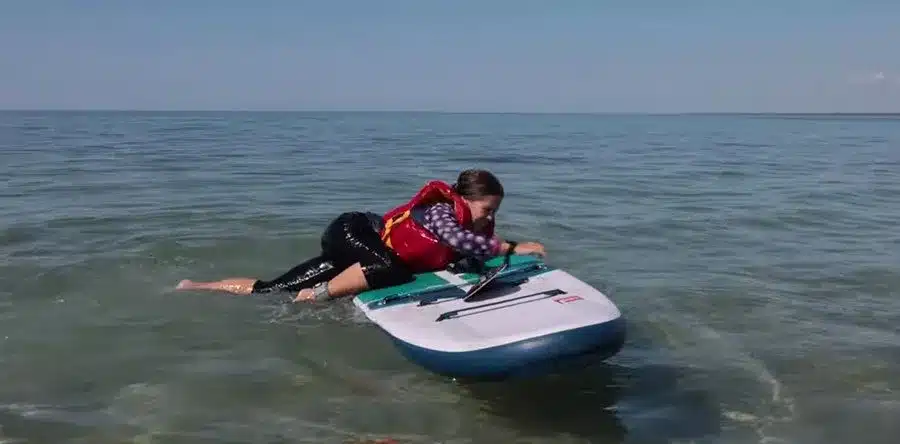
Falling in is part of the learning curve, but getting back on efficiently keeps you safe and saves your energy. Follow these steps to get back on the board.
Step 1: Swim to the Side of the Board, Not the Tail
Approach from the side rather than the tail, since this gives you a more stable point to climb from and avoids tangling with the fins.
Step 2: Position Yourself at the Center Handle
Line up with the carry handle in the middle of the board. This is the most balanced spot, making it easier to pull yourself up without tipping the board.
Step 3: Kick Your Legs up First, Then Pull Your Chest Onto the Board
Use a strong kick to bring your legs toward the surface, then use your arms to pull your chest onto the board in one smooth motion.
Step 4: Rebalance on Your Knees Before Standing
Once you’re on the board, pause in a kneeling position to regain your balance before standing back up.
Beginner SUP Board Types and What to Choose
Picking the right board type shapes how quickly you build confidence on the water. Each category serves a different purpose, so knowing the differences upfront saves you from an awkward first session.
| Board Type | Best For | Width | Key Traits |
|---|---|---|---|
| All-Around | Most beginners | 32–33” | Balanced stability and versatility; works across lakes, bays, and calm rivers |
| Extra-Wide / Stability | SUP yoga, dogs, kids, larger paddlers | 34″+ | Flattest, widest deck for maximum confidence and minimal wobble |
| Touring | Progressing beginners covering distance | Narrower, longer | Better glide and tracking, but less stable; usually a second board |
| Inflatable (iSUP) | Nearly all beginners | Varies | Easier to store and transport, more forgiving on falls |
| Hard Board | Advanced or performance-focused paddlers | Varies | Slightly better performance, but less forgiving and harder to store |
| Note: For most first-timers, wide all-around inflatable beginner-friendly boards offer the best mix of stability and versatility, typically 10-12 ft long and 32-34 in wide. Larger paddlers or those carrying gear should size up. |
Recommended Beginner Boards
A good beginner board should feel stable, easy to handle, and comfortable while you learn the basics. These recommended boards are designed to help new paddlers get started smoothly.
- Retrospec Weekender Plus (11’6” x 34”) – Versatile iSUP/kayak hybrid, very stable, includes kayak conversion kit.
- NRS Jukdo 108 – All-around favorite with a lowered standing height for extra stability.
- Sea Gods Diatom 10’6” – Widest, most stable option, great for beginners and yoga.
- BOTE WULF Aero 10’4” – Budget-friendly, easy to maneuver, full EVA deck pad.
- NIXY Venice – Top pick for calm-water cruising and SUP yoga stability.
Basic Paddle Boarding Techniques You Need
Before you can carve smooth turns or glide with confidence, you need a solid grip on the basics. These three techniques form the foundation of every paddle boarding session, no matter how advanced you get later.
| Technique | Key Points |
|---|---|
| Forward Stroke | Hand positioning on the paddle, stroke depth, and rhythm |
| Turning the Board | Sweep stroke technique, small vs wide turns |
| Stopping and Controlling Speed | Dragging paddle technique, backward stroke basics |
| Reverse Stroke | Paddle grip and pull direction, used for backing up or fine control |
| Draw Stroke | Sideways movement, achieved by placing the blade parallel to the board and pulling it in, is useful for adjusting position without turning. |
| Stance and Posture | Feet parallel and hip-width apart, knees slightly bent, eyes on the horizon rather than your feet |
Proper Paddle Boarding Stance and Balance
Your stance is the foundation of every good paddle boarding session. Get this right, and staying balanced becomes second nature.
- Foot Position and Body Alignment: Keep your feet shoulder-width apart, soften your knees, and engage your core to stay steady. I still check my stance every time I get on the water; it makes a real difference.
- Correct Posture While Standing: Stand tall with a straight back and eyes forward, not down at your feet. Keeping your weight evenly distributed helps you stay balanced the whole time.
- Paddle Sizing: Your paddle should reach 6 to 10 inches above your head when standing straight. Getting this right keeps your posture correct and your strokes efficient.
- Hand-Switching Mechanics: Switch your top and bottom hand each time you change paddling sides, keeping your top hand directly above the blade for control.
Conclusion
Paddle boarding really is as beginner-friendly as it looks once you get the basics down. A stable board, the right paddle grip, and a calm stretch of water can turn a shaky first try into a session you’ll want to repeat all summer.
I still remember how nervous I felt standing up for the first time, and how quickly that nervousness turned into fun.
Give yourself permission to wobble, fall, and climb back on. That’s part of the process, not a sign you’re doing it wrong.
Start small, pick calm conditions, and keep your gear simple. The confidence builds faster than you’d expect.
Frequently Asked Questions
Is Kayaking or Paddleboarding Easier?
Kayaking is generally easier for beginners because sitting provides greater stability. Paddle boarding takes a bit more balance but gets easier fast with practice.
Do Paddle Boards Flip Easily?
Not really. Wide, stable boards rarely flip during calm paddling. Falls happen more from losing balance than the board actually flipping over.
Do You Need a Life Jacket for Paddle Boarding?
Yes, in most cases. Once you paddle outside a designated swimming or surfing area, the U.S Coast Guard classifies your board as a vessel, so you need a wearable PFD on board, and children below 12 must always wear one.




One Response
https://intercom.help/bigmen/en/articles/16621336-mostbet-verificacao-da-oferta-2027-bro125-250-giros-gratis