
Skateboarding burns up to 450 calories an hour, keeps your heart rate in the cardio zone, and works your legs, core, and ankles all at once, and most people who do it don’t think of it as exercise at all. That’s the point.
Is skateboarding good exercise? Yes, and the science confirms it.
This post covers the physical and mental benefits of skateboarding, how many calories you actually burn, how it stacks up against other workouts, and the honest downsides you should know before counting it as your main form of fitness.
What Makes Skateboarding a Legitimate Workout
Your legs push you forward. Your ankles adjust every second to keep you upright. Your core fires constantly, keeping your balance while you move.
It’s not the same as lifting weights or running laps, but your body is working harder than it looks. You burn roughly 150 to 250 calories per 30 minutes at a casual pace.
Add tricks and your calorie burn jumps even higher. Your heart rate stays up the whole time you’re skating. And because you’re focused on not falling, you barely notice the effort until you stop and realize you’re tired.
How Many Calories Does Skateboarding Burn?
You’ll burn different amounts depending on how hard you’re skating. Casual skating burns about 150 to 200 calories in 30 minutes. That’s just cruising around, nothing too intense.
Moderate skating, where you’re doing some tricks and moving at a steady pace, burns 250 to 300 calories. And when you’re going hard at the skate park, trying new tricks and falling, you can hit 350 to 450 calories in half an hour.
Your weight plays a role, too. Heavier riders burn more doing the same moves. The constant movement keeps your body working the whole time.
Calorie Comparison with Other Exercises
You might wonder how skateboarding stacks up against other workouts. Turns out, it holds its own pretty well. Check out how the calories compare for 30 minutes of activity:
| Exercise | Calories Burned (30 min) |
|---|---|
| Skateboarding (moderate) | 250-300 |
| Running (6 mph) | 300-350 |
| Cycling (moderate) | 200-250 |
| Swimming | 250-300 |
| Walking (3.5 mph) | 120-150 |
| Basketball | 240-290 |
| Jump rope | 300-400 |
Skateboarding sits right in the middle of the most popular exercises. You’re burning more than walking or light cycling, but slightly less than running or jumping rope.
Physical Health Benefits of Skateboarding
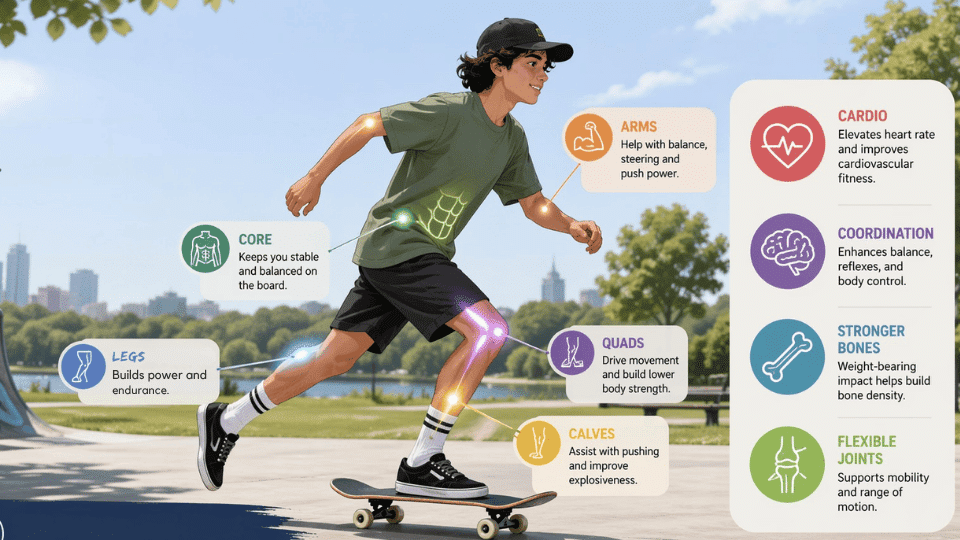
Skateboarding does more for your body than just burning calories. You’re building strength, improving your heart health, and training your body in ways that other exercises don’t quite match.
1. Full-Body Muscle Engagement
Your legs do most of the obvious work, but your whole body is involved. Your quads and calves push you forward and absorb landings. Your core stays tight to keep you balanced.
Even your arms and shoulders work when you’re turning or catching yourself from a fall. Your ankles get a serious workout too, constantly adjusting to keep the board steady under your feet.
2. Cardiovascular Fitness
Your heart rate stays elevated the entire time you’re skating. You’re not standing still between tricks as you might rest between weightlifting sets. The constant movement keeps your blood pumping and your lungs working.
Over time, this builds your endurance and strengthens your heart. You’ll notice you can skate longer without getting winded as your cardio improves.
3. Balance and Coordination
Every second on a skateboard tests your balance. You’re adjusting your weight, shifting your feet, and reading the ground beneath you. Your brain and muscles learn to work together faster.
This kind of coordination training also helps in other areas of life. You’ll find yourself steadier on your feet in general, with better reaction times when you need to catch yourself.
4. Bone Health and Density
The impact from jumping and landing creates stress on your bones, and that’s actually good for them. Your body responds by making your bones denser and stronger.
This is especially important when you’re younger because you’re building bone mass that lasts. But even adults benefit from the bone-strengthening effects of impact activities like skateboarding.
5. Flexibility and Mobility
Skateboarding forces your body through a wide range of motion. Your hips, ankles, and knees are constantly bending and extending. You’re twisting, crouching, and reaching in ways you don’t do sitting at a desk.
This keeps your joints mobile and your muscles flexible. The more you skate, the easier it becomes to move in different directions without feeling stiff or tight.
Those benefits add up over time. You’re not just having fun on your board, you’re actually training your body in multiple ways at once. And because it doesn’t feel like traditional exercise, you’re more likely to keep doing it.
Mental Health Benefits of Skateboarding
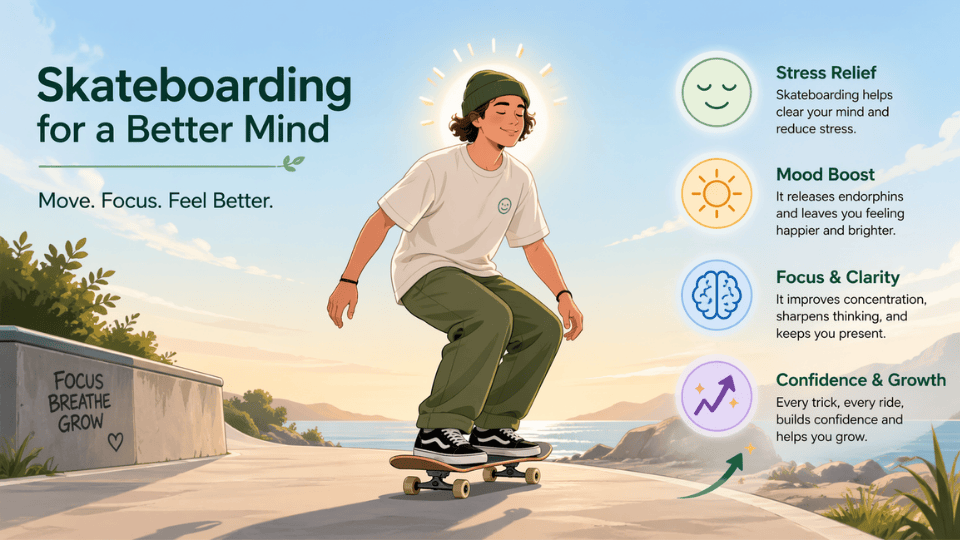
Your mind gets a workout along with your body when you skate. The mental side of skateboarding often gets overlooked, but it’s just as real as the physical benefits.
6. Stress Relief and Mood Enhancement
When you’re skating, your brain stops overthinking everything else. You’re focused on the moment, on landing the trick or just staying upright. This kind of focus gives your mind a break from daily worries.
Your body also releases endorphins when you move, which naturally lift your mood. After a session, you’ll usually feel lighter and more relaxed than when you started.
7. Anxiety and Depression Reduction
Skateboarding gives you something to look forward to and work on. When you’re dealing with anxiety or low moods, having that outlet matters.
The physical activity helps regulate your nervous system, calming those racing thoughts. You’re also outside, getting sunlight and fresh air, both of which help with mental health.
8. Cognitive Function and Focus
Your brain is making split-second decisions the whole time you’re on your board. You’re calculating speed, distance, and balance without even thinking about it consciously.
This kind of mental training sharpens your reaction time and decision-making skills. You learn to read situations quickly and adjust on the fly, which carries over into other parts of your life.
9. Confidence and Personal Growth
Every trick you land builds your confidence a little more. You’re proving to yourself that you can learn hard things through practice. Falling and getting back up builds resilience in a way that’s hard to find elsewhere.
You start seeing yourself as someone who can tackle challenges, and that mindset shifts how you approach problems off the board, too.
The mental benefits stick with you even when you’re not skating. You’re training your brain to stay present, handle setbacks, and keep pushing forward. That’s worth as much as any physical workout.
What the Research Says About Skateboarding as Exercise
A 2020 study in the International Journal of Environmental Research and Public Health tracked adult skaters at community parks and found their average heart rates landed in the moderate-to-vigorous aerobic activity range — the same zone targeted by standard cardio workouts. Separate research published in ScienceDirect found that eight weeks of regular skateboard training produced improvements in body composition, cardiorespiratory fitness, muscular endurance, flexibility, and balance in young adults.
The practical takeaway is simple: skateboarding works as cardio if you’re actually moving. Casual cruising at low intensity won’t produce the same results as active park skating or trick practice. Push yourself, and the fitness benefits are real.
Different Types of Skateboarding and Their Exercise Benefits
Not all skateboarding looks the same, and each style works your body differently. Some types focus more on endurance, while others emphasize strength and power.
| Skateboarding Style | Primary Benefits | Intensity Level |
|---|---|---|
| Street skating | Leg power, core strength, and quick reflexes | High |
| Vert/ramp skating | Upper body strength, explosive power, cardio | Very high |
| Cruising/commuting | Endurance, leg stamina, steady cardio | Low to moderate |
| Downhill skating | Leg strength, balance, and mental focus | Moderate to high |
| Freestyle skating | Coordination, flexibility, and technical skill | Moderate |
| Bowl skating | Full-body strength, cardio, leg power | High |
The style you choose changes what you get out of it. You can mix styles depending on what your body needs that day.
Downsides of Skateboarding as Exercise
Skateboarding isn’t the perfect workout. There are real drawbacks you should know about before you count on it as your only form of exercise. Being honest about the limitations helps you plan better.
- High injury risk: You’re going to fall, and falls can mean sprains, fractures, or worse. Wrists, ankles, and knees take the most hits.
- Weather dependent: Rain, snow, or ice means you’re not skating. You need backup workout options for bad weather days.
- Limited upper-body work: Your legs and core get plenty of action, but your chest, back, and arms don’t get much. You’ll need other exercises to balance things out.
- Skill barrier: Beginners spend time learning balance and control, and if you’re new, understanding how to learn to skateboard makes the process much easier.
- Hard on joints: The constant impact from jumping and landing can wear on your knees and ankles over time, especially as you get older.
You can work around most of these issues with some planning. Wear protective gear, cross-train to build upper-body strength, and listen to your body when joints start complaining.
Tips to Turn Skateboarding Into a Better Workout
You can get more out of your skating sessions with a few simple changes. These tips help you burn more calories and build more strength without taking the fun out of it.
- Skate for longer sessions instead of short bursts. Aim for at least 30 to 45 minutes to keep your heart rate up.
- Mix in hills and ramps. Going uphill works your legs harder, and ramps add explosive power training.
- Practice tricks that require jumping. Ollies, kickflips, and other aerial moves ramp up the intensity quickly.
- Add strength training on off days. Push-ups, squats, and core work fill in the gaps that skateboarding misses.
- Skate with friends who push you. You’ll naturally try harder and skate longer when others are around.
- Track your sessions. Knowing how long and hard you skated helps you see progress and stay motivated.
The goal is to make your skate time count without turning it into a chore. Keep it fun but intentional, and you’ll see better results without losing what makes skateboarding great in the first place.
Wrapping It Up
So, is skateboarding good exercise? Absolutely. You’re burning calories, building muscle, and improving your balance all at once. Your heart gets stronger, your mind gets clearer, and you’re having fun while doing it.
Sure, it has some downsides like injury risk and weather limits, but the benefits outweigh them for most people. The key is treating it seriously as a workout while keeping the joy alive.
Mix in some strength training, wear your protective gear, and push yourself a little harder each session. Quality equipment from reliable skateboarding brands makes a real difference in your performance and safety.
Grab your board and get out there. Your body will thank you for it.
Frequently Asked Questions
Is Skateboarding A Good Way To Lose Weight?
Yes, it can help if you skate often. It burns calories and keeps you active. Better results come with longer or harder sessions.
How Many Calories Do 2 Hours Of Skateboarding Burn?
About 600 to 900 calories. The total depends on your weight and how hard you skate.
Is Skating Good For Arthritis?
It may help with movement, but it can be hard on the joints. Start slow and ask your doctor if you have arthritis.