


You stand on a dock watching sailboats glide across the water. Someone shouts, trim the jib or mind the boom. The words sound like a foreign language.
Sailing has its own vocabulary. Understanding the parts of a sailboat changes everything.
You stop feeling lost when experienced sailors talk. You can follow the instructions. You know what connects to what and why it matters.
This happens faster than you think. The parts make sense once you see how they work together.
Every significant element is included in this thorough explanation. You will learn what each part does and where it sits on the boat.
By the end, you will speak the language of sailing with confidence.
What Are The Main Parts Of A Sailboat?
Every sailboat has dozens of different parts. But they group into three main systems.
The hull is the body of the boat. Parts below the waterline provide stability and steering. The keel stops the boat from tipping over. The rudder lets you change direction.
The rig holds up your sails. The mast stands vertically. The boom sits horizontally at the bottom of the main sail. Sails catch the wind and create forward motion.
Lines are ropes that control the sails. Hardware includes cleats, winches, and blocks. These parts let you adjust how your boat responds to the wind.
Each system works together to make the sailboat function properly.
Parts of A Sailboat: At A Glance
This table shows common parts of a sailboat, their locations, functions, and other names you might hear on the water.
| Part Name | Where It Is | What It Does | You Might Also Hear |
|---|---|---|---|
| Mast | Vertical post in the center of the boat | Supports the sails, the main structure for holding the sails up | Mainmast |
| Boom | Horizontal bar extending from the mast | Controls the bottom of the mainsail, moves the sail side-to-side | Mainsail boom |
| Keel | Underwater part of the boat’s hull | Provides stability, prevents the boat from tipping over | Centerboard, Daggerboard |
| Rudder | Located at the stern of the boat | Steers the boat, helps with direction and control | Tiller, Helm |
| Halyard | Attached to the mast and sails | Raises and lowers the sails | Main halyard, Genoa halyard |
| Sheet | Attached to the corner of the sail | Controls the angle of the sails, helps trim the sail’s shape | Jib sheet, Main sheet |
| Winch | On deck, near lines or rigging | Used to tighten or release the sails by turning a drum | Self-tailing winch |
| Block | Pulley system (on deck or rigging) | Helps redirect and manage ropes, increasing mechanical advantage | Pulley, Deck block |
These basic terms help you understand sailing communication. The following sections explain each part in more detail and how they work together.
Hull, Keel, And Steering Systems
1. Hull
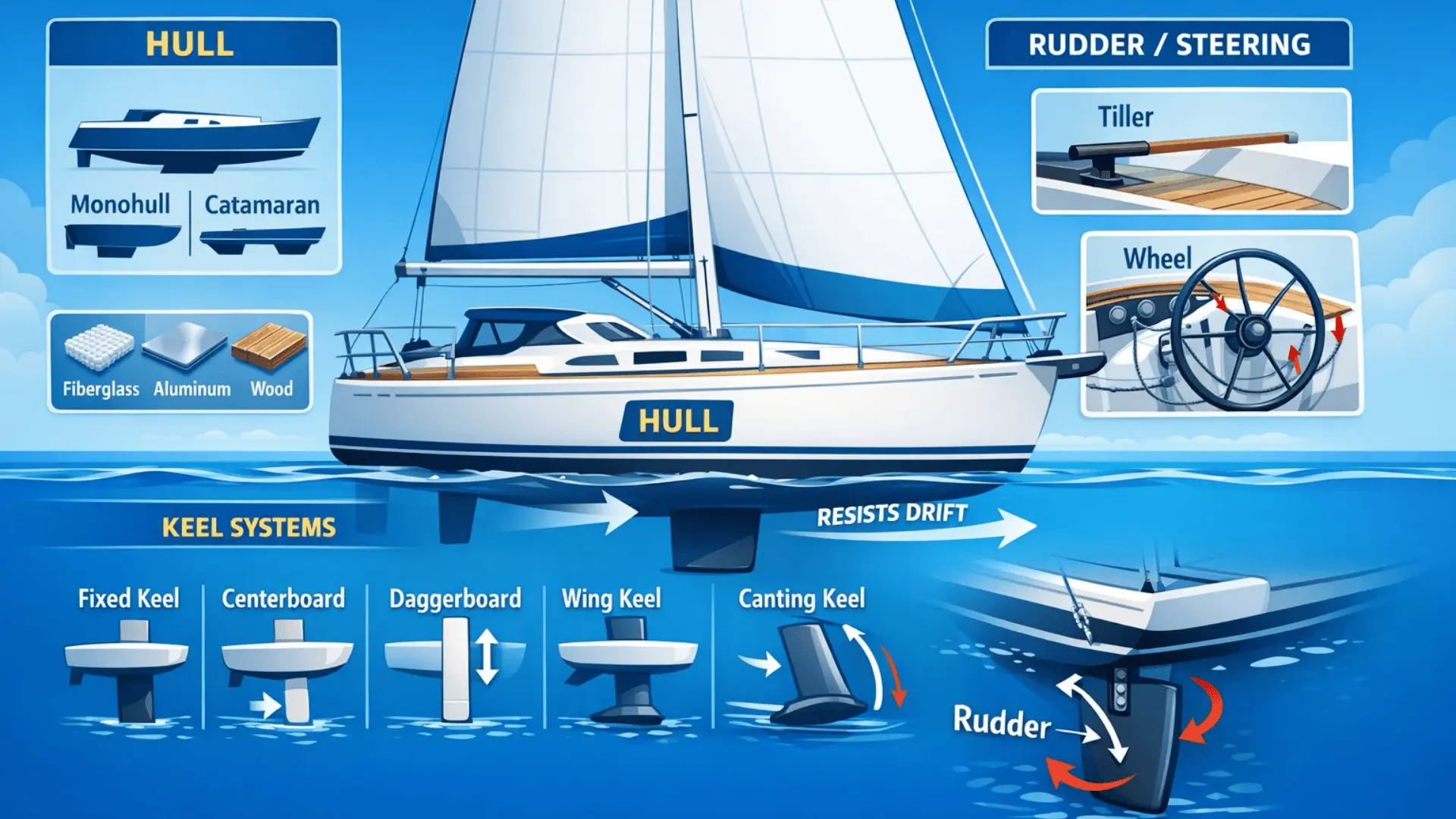
The hull is the boat’s floating body that sits in the water. Monohulls have one hull and are the most common design. Catamarans have two hulls connected by a deck. Trimarans use three hulls for stability.
Common materials include fiberglass, which resists corrosion and requires less maintenance.
Aluminum offers strength and durability. Wood provides traditional aesthetics but needs more care. The hull shape affects speed, stability, and how the boat handles itself.
2. Keel Systems
The keel extends down from the hull bottom and reduces sideways drift when wind pushes against your sails. Fixed keels stay permanently down and provide consistent stability. Centerboards pivot up and down, letting you sail in shallow water.
Daggerboards slide straight up and down through a trunk. Wing keels have horizontal fins that improve stability. Canting keels tilt from side to side for racing performance. The keel weight also acts as ballast.
3. Rudder and Steering
The rudder sits underwater at the stern and controls your direction. Moving it left turns the boat left. Moving it right turns the boat right. You control the rudder through either a tiller or a wheel.
A tiller connects directly to the rudder head with a simple mechanical link. A wheel uses cables or hydraulic systems to transfer your steering input to the rudder.
Both systems give you precise control over where your sailboat goes on the water.
The Mast And Rigging Systems
1. Mast
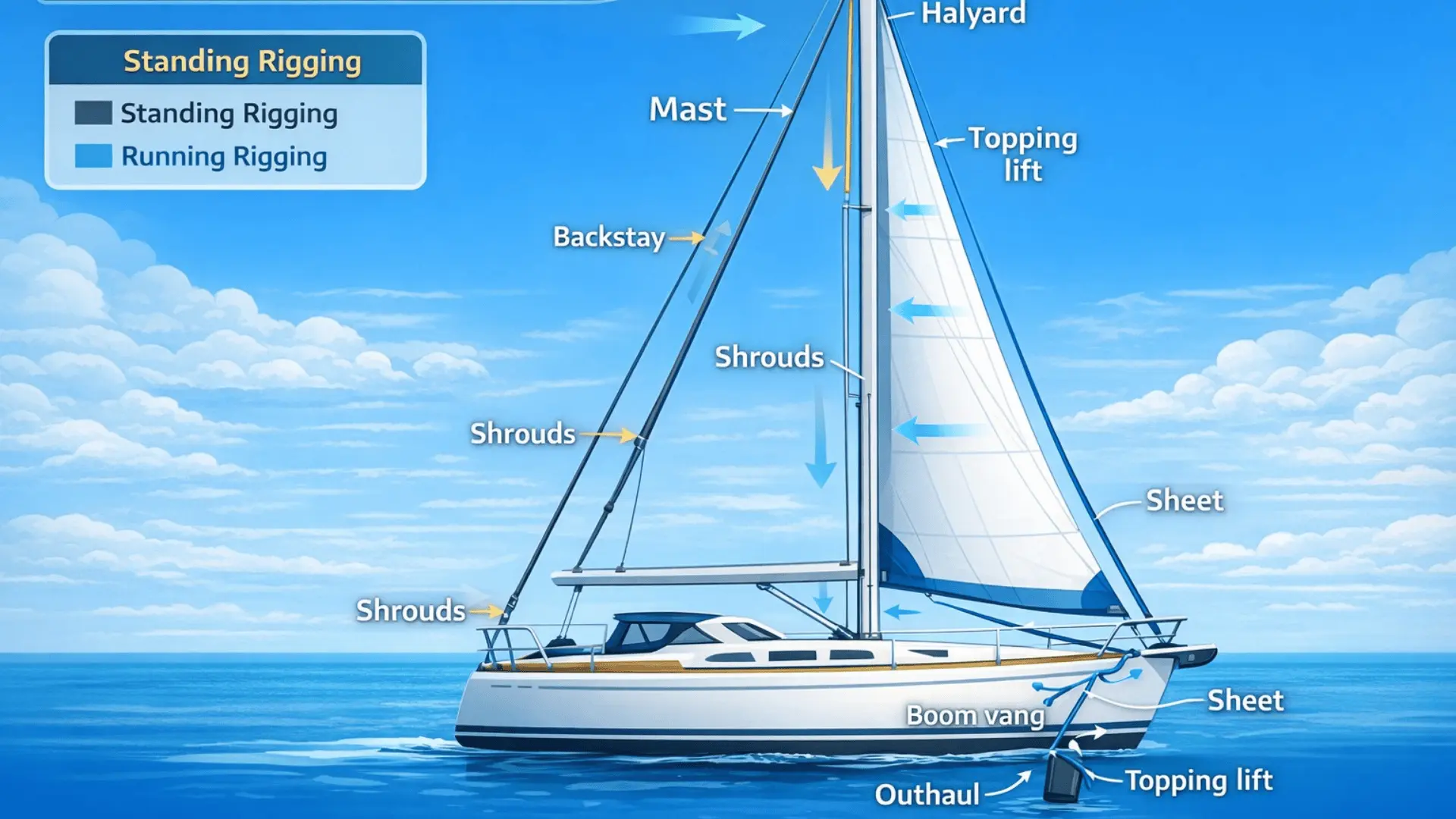
The mast is the tall vertical pole that supports a sailboat’s sails, usually centered on the boat. It can be stepped through the deck into the hull or mounted on deck. Most masts are aluminum, while high-performance boats use lighter carbon fiber.
Spreaders extend outward to support rigging. The mast may also hold wiring and navigation lights. Proper alignment improves sailing and reduces stress.
2. Standing Rigging
Standing rigging keeps the mast upright, using fixed stainless steel cables that usually remain in place while sailing. The forestay runs from the mast top to the bow, the backstay runs to the stern, and shrouds support the mast from both sides.
Together, they prevent movement in any direction. Turnbuckles adjust cable tension. Proper tension keeps the mast straight and stable under sail loads.
3. Running Rigging
Running rigging includes the adjustable lines you handle while sailing, usually made of strong synthetic rope. Halyards raise and lower sails, while sheets control sail angle to the wind.
The outhaul tightens the mainsail foot along the boom, and the downhaul tensions the luff. A boom vang manages boom height and sail twist. Many sailors color-code lines for quick identification during adjustments.
Sail Types And Their Functions
1. The Mainsail
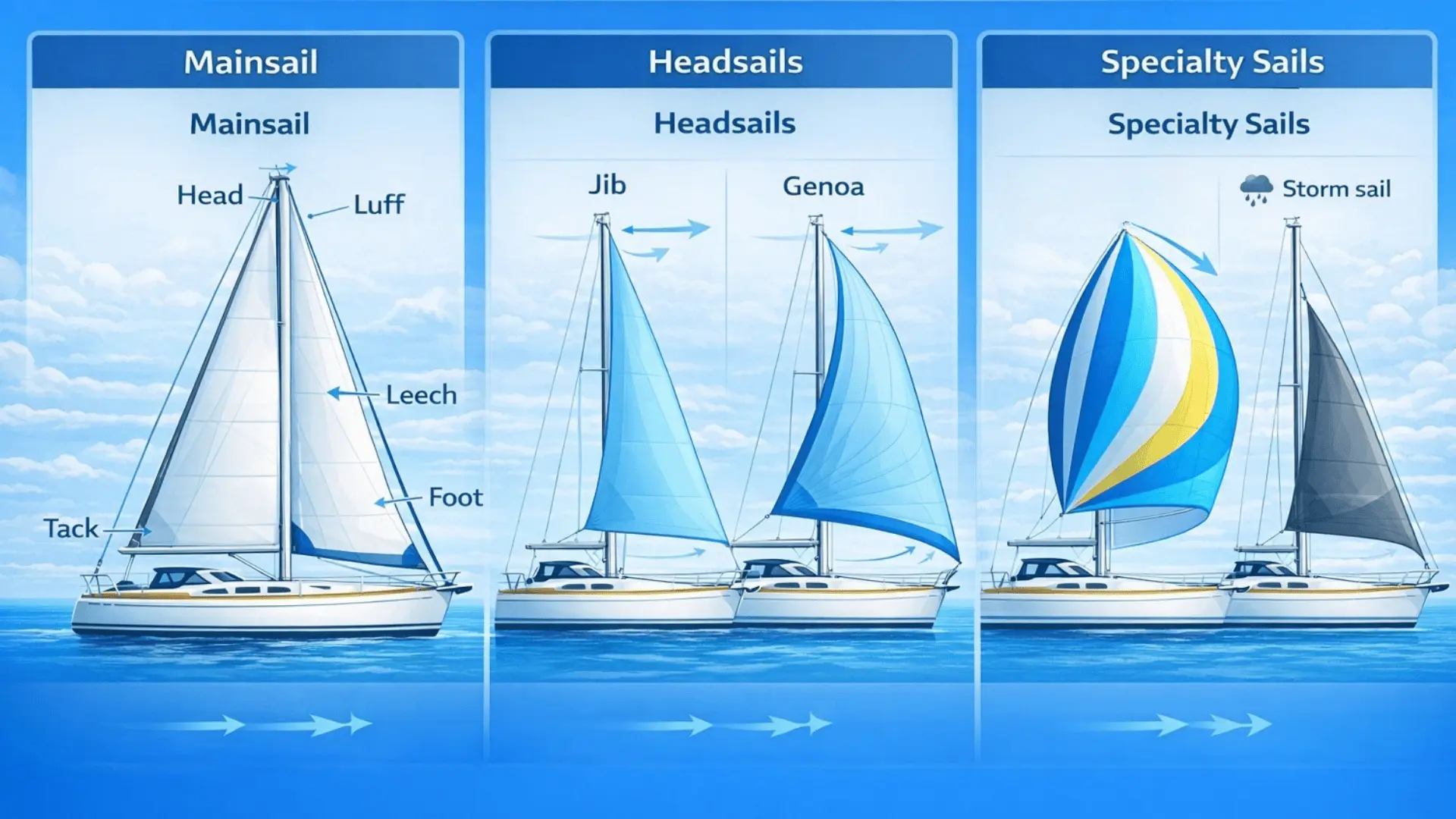
The mainsail is the primary driving sail attached to the mast and boom. The head sits at the top corner. The luff runs along the mast edge and slides into a track or groove. The leech forms the trailing edge where wind exits.
The tack anchors at the mast base where the mast and boom meet. The clew attaches to the boom end and connects to the mainsheet for angle control.
Sail material ranges from woven Dacron to laminated fabrics to improve performance.
2. Headsails
Headsails sit forward of the mast and attach to the forestay cable. A working jib extends back to roughly the mast position and offers easy handling in various conditions. A genoa is a larger headsail that overlaps the mainsail.
The extra sail area generates better speed but requires more skill to manage. Some boats carry multiple headsails in different sizes. You change them based on wind strength.
3. Specialty Sails
Specialty sails are designed for specific wind angles and weather conditions. Spinnakers are large, colorful sails that balloon out in front for downwind runs. They require a spinnaker pole and a skilled crew to handle properly.
Storm sails are heavily reinforced and much smaller than regular sails. They help you maintain control during gales and heavy weather when full sails would overpower the boat.
Code zero sails bridge the gap between genoas and spinnakers for light wind reaching.
The Boom And Sail Control Hardware
1. Boom
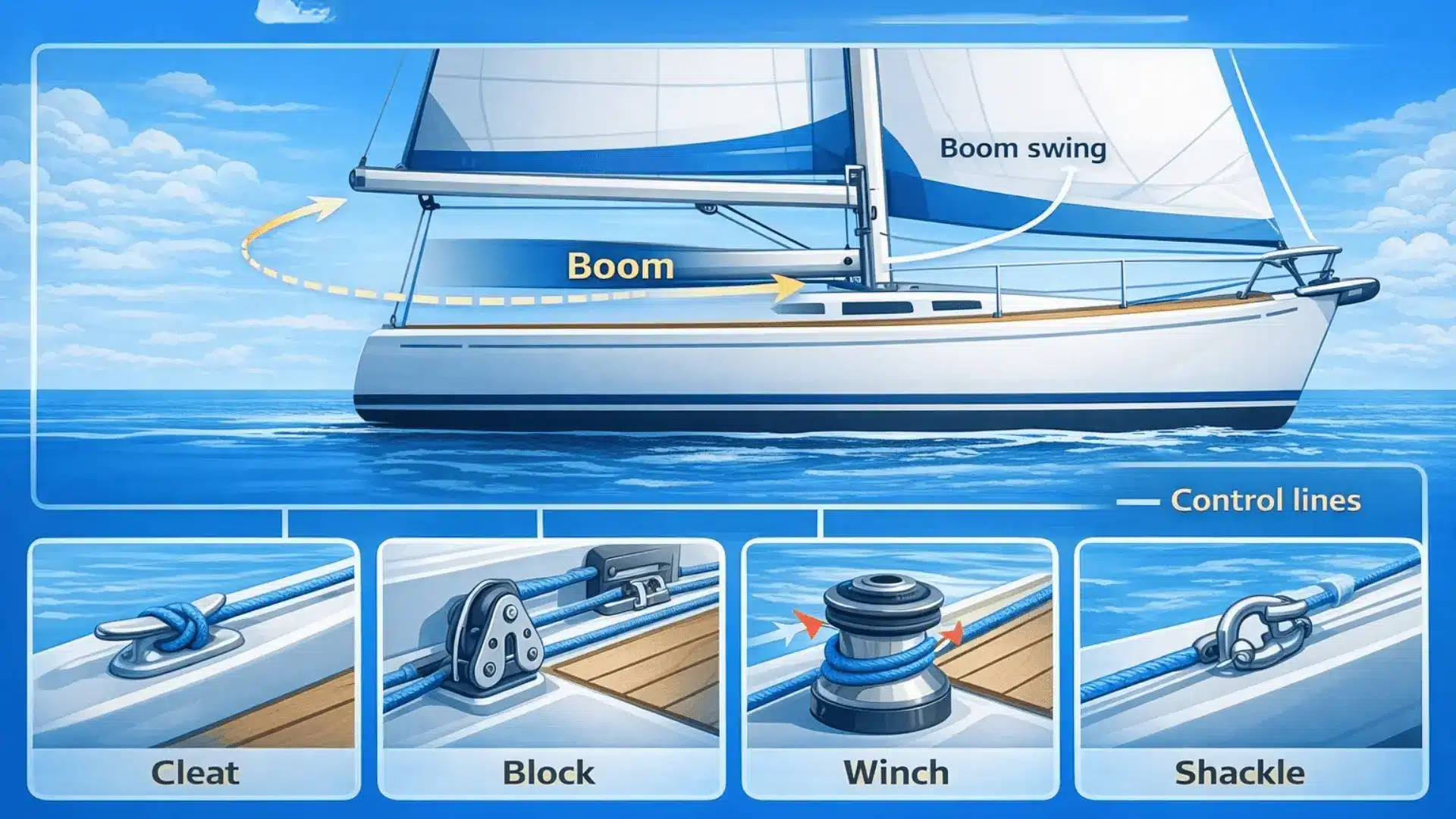
The boom is a horizontal pole attached to the mast that supports the bottom edge of the mainsail. It pivots at a gooseneck fitting, letting it swing side to side and move slightly up and down.
Most booms are aluminum, though some are carbon fiber. It includes fittings for the outhaul, reefing lines, and boom vang. Stay alert, as it can swing fast and cause injury.
2. Sail Control Equipment
Cleats secure lines on deck after you set them, and come in horn, cam, and clam styles. Blocks are pulleys with rotating sheaves that redirect lines and reduce friction.
Winches are drum-shaped tools that boost pulling power for tightening sheets and halyards, with self-tailing types gripping the line for you. Shackles are metal connectors with removable pins for attaching sails and hardware. Together, they help you control the boat.
Important Sailing Terms For Better Communication
Understanding sailing terms is key to clear communication on the water. These terms help you navigate your boat and work efficiently with your crew.
For instance, windward refers to the side facing the wind, while leeward refers to the sheltered side protected from the wind.
Points of sail describe the boat’s angle to the wind, with different angles requiring various sail adjustments.
Common maneuvers include tacking, which involves turning the bow through the wind, and jibing, which involves turning the stern through the wind.
Luffing occurs when sails flap due to incorrect angles. Mastering these terms enhances sailing efficiency and safety, ensuring smooth communication and precise navigation on the water.
Sailboat Parts Maintenance And Care Tips
Taking care of the parts of a sailboat keeps you safe on the water. Regular maintenance prevents problems before they happen.
- Regular Inspection Points for Rigging: Inspect standing rigging annually for rust or wear, check running rigging for frays, and test halyards for smooth movement.
- Sail Care and Storage: Rinse sails after saltwater use, dry them completely, fold loosely to avoid creases, and promptly repair tears or stitching issues.
- Hull Maintenance Basics: Wash hull regularly to remove salt and algae, inspect through-hull fittings for corrosion, and apply bottom paint yearly.
- Hardware Lubrication And Replacement: Lubricate winches yearly, check shackles for corrosion, replace weakened hardware, and protect cleats and tracks from salt buildup.
Understanding these parts of a sailboat and how to maintain them extends the life of your boat. A well-maintained sailboat performs better and stays safer on every voyage.
Conclusion
Learning the parts of a sailboat transforms how you experience time on the water. That confusing tangle of ropes and metal suddenly makes perfect sense.
You now recognize the differences and understand why each part is there.
This knowledge builds your confidence as a sailor. You can ask better questions. You notice potential problems before they become dangerous.
Most importantly, you can join conversations with experienced sailors without feeling lost.
Sailing becomes more enjoyable when you understand your vessel. The mystery disappears. The logic appears.
Ready to put this knowledge into practice? Save this page so it’s handy the next time you’re on the water.






2 Responses