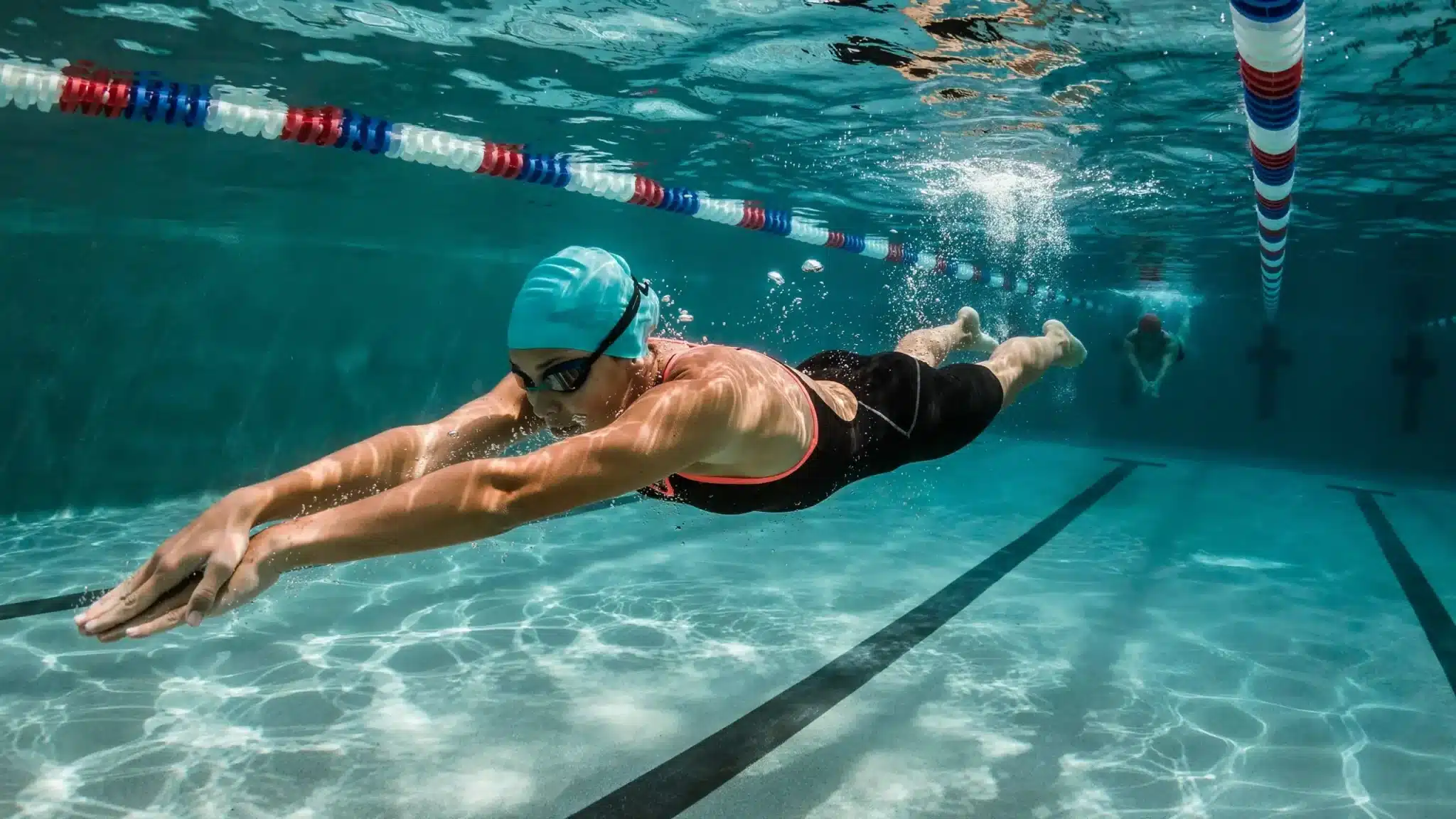
A good swim workout is more than swimming laps until you get tired.
The right mix of distance, pace, technique, and rest can make each session work toward a specific goal.
These swimming workouts range from easy beginner sessions to demanding sets for speed, endurance, strength, and competition.
The key is choosing a workout that matches your current level instead of jumping into a session that is too demanding.
Here are practical workouts you can use based on your experience, fitness goal, and time in the pool.
What Does a Swimming Workout Usually Include?
Most swim sessions break down into three parts: a warm-up to get your muscles moving, a main set built around your goal, and a cooldown to bring your heart rate back down.
The warm-up loosens you up and gets your breathing settled before the real work starts. The main set is where the actual training happens, whether that’s endurance, speed, or technique.
The cooldown lets your body ease off instead of stopping cold. Once you have that structure down, picking the right workout for your level and goal gets a lot easier.
Swim Gear and Terms Worth Knowing
|
Beginner Swimming Workouts
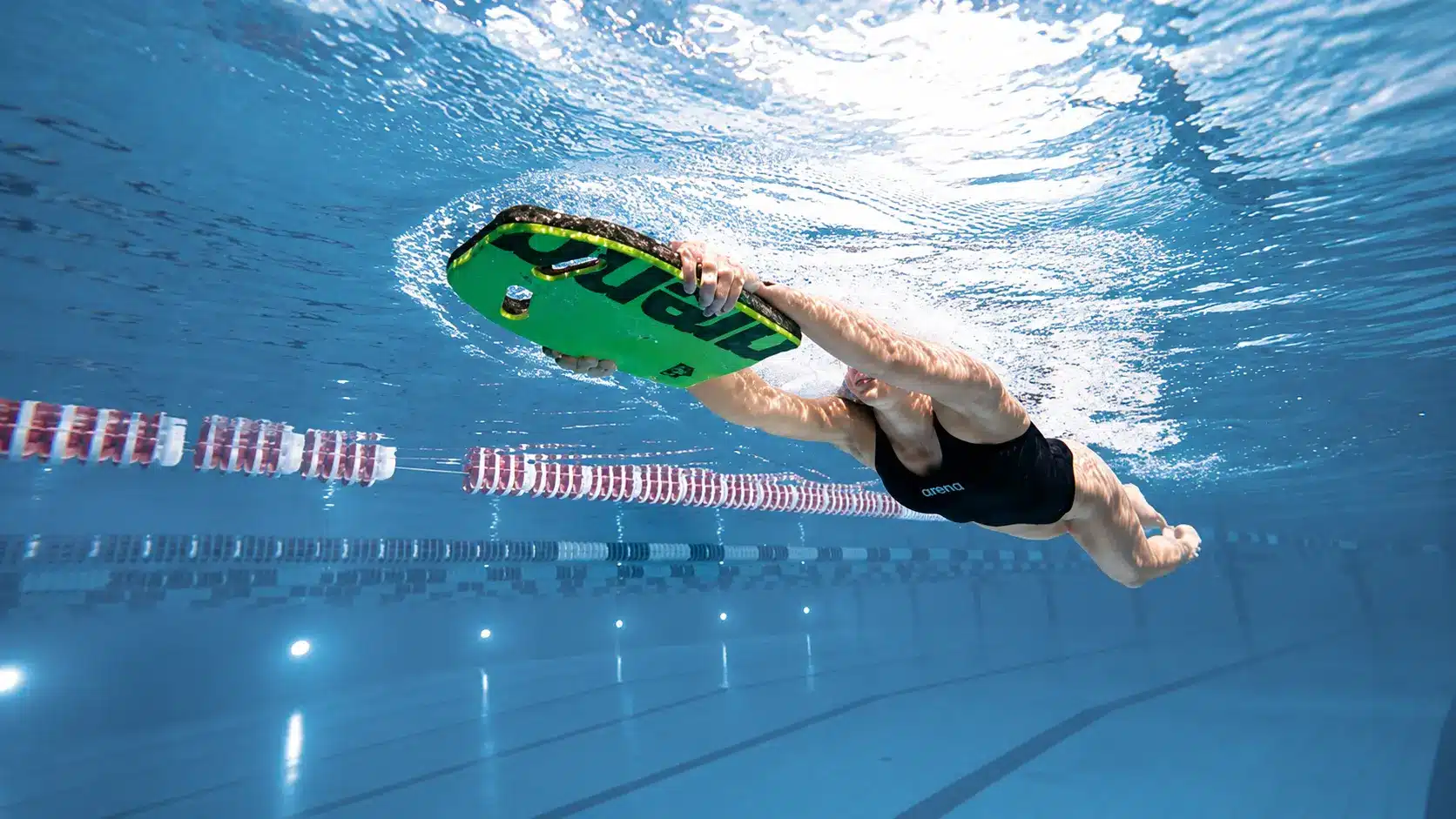
These workouts are built for anyone still getting comfortable in the water. The focus stays on technique, breathing, and building confidence, not speed or distance.
1. Water Confidence Workout
This one is for anyone still getting used to being in the water regularly. It’s less about distance and more about feeling relaxed while you swim.
- What to do: Alternate 25 yards of easy freestyle with 25 yards of rest at the wall, repeated for 15 to 20 minutes.
- Duration: 20 minutes
- Equipment needed: None
- Suggested distance: 300 to 400 yards total
2. Basic Endurance Builder
I like giving new swimmers something they can actually finish without gassing out halfway through. This workout keeps the pace steady so you build stamina without burning out.
- What to do: Swim 4 rounds of 50 yards freestyle at an easy pace, resting 30 seconds between each round.
- Duration: 25 minutes
- Equipment needed: None, kickboard optional
- Suggested distance: 400 yards
3. Breathing and Technique Workout
Good breathing habits make everything else easier, so this workout puts that front and center instead of treating it as an afterthought.
- What to do: Swim 25 yards focusing only on breathing every third stroke, rest 20 seconds, then repeat 8 times.
- Duration: 25 minutes
- Equipment needed: None
- Suggested distance: 200 yards
4. Kickboard Foundation Workout
Legs get ignored a lot when people are new to swimming, so this session isolates the kick to build real strength there. It’s a simple way to feel how much your legs actually contribute once your arms aren’t doing all the work.
- What to do: Kick with a board for 25 yards, rest 20 seconds, and repeat for 8 rounds, alternating flutter kick with a slower recovery kick.
- Duration: 20 minutes
- Equipment needed: Kickboard
- Suggested distance: 200 yards
5. Easy Stroke Rotation Workout
Mixing strokes early on helps you figure out what feels natural before you specialize in anything. It also spreads the work across different muscle groups, so no single part of your body gets overloaded this early on.
- What to do: Swim 25 yards each of freestyle, backstroke, and breaststroke, resting 30 seconds between each, and repeat the rotation twice.
- Duration: 30 minutes
- Equipment needed: None
- Suggested distance: 300 yards
6. Beginner Interval Workout
Short bursts with real rest teach your body to work a little harder without overwhelming you. It’s a gentle first taste of interval training that builds confidence before you move into faster, more demanding sets.
- What to do: Swim 25 yards at a moderate pace, rest 30 seconds, then repeat 10 times.
- Duration: 25 minutes
- Equipment needed: None
- Suggested distance: 250 yards
7. Full Session Starter Workout
This is a complete beginner session with all three parts included, meant as a template you can repeat weekly. Once it feels manageable start to finish, you’re ready to start layering in more structure.
- What to do: Warm up with 100 yards easy freestyle, swim 6 rounds of 50 yards with 20 seconds rest, then cool down with 100 yards easy backstroke.
- Duration: 30 minutes
- Equipment needed: None
- Suggested distance: 500 yards
Stick with these for a few weeks before adding intensity. Once these feel easy, you’re ready to move into intermediate territory.
Intermediate Swimming Workouts
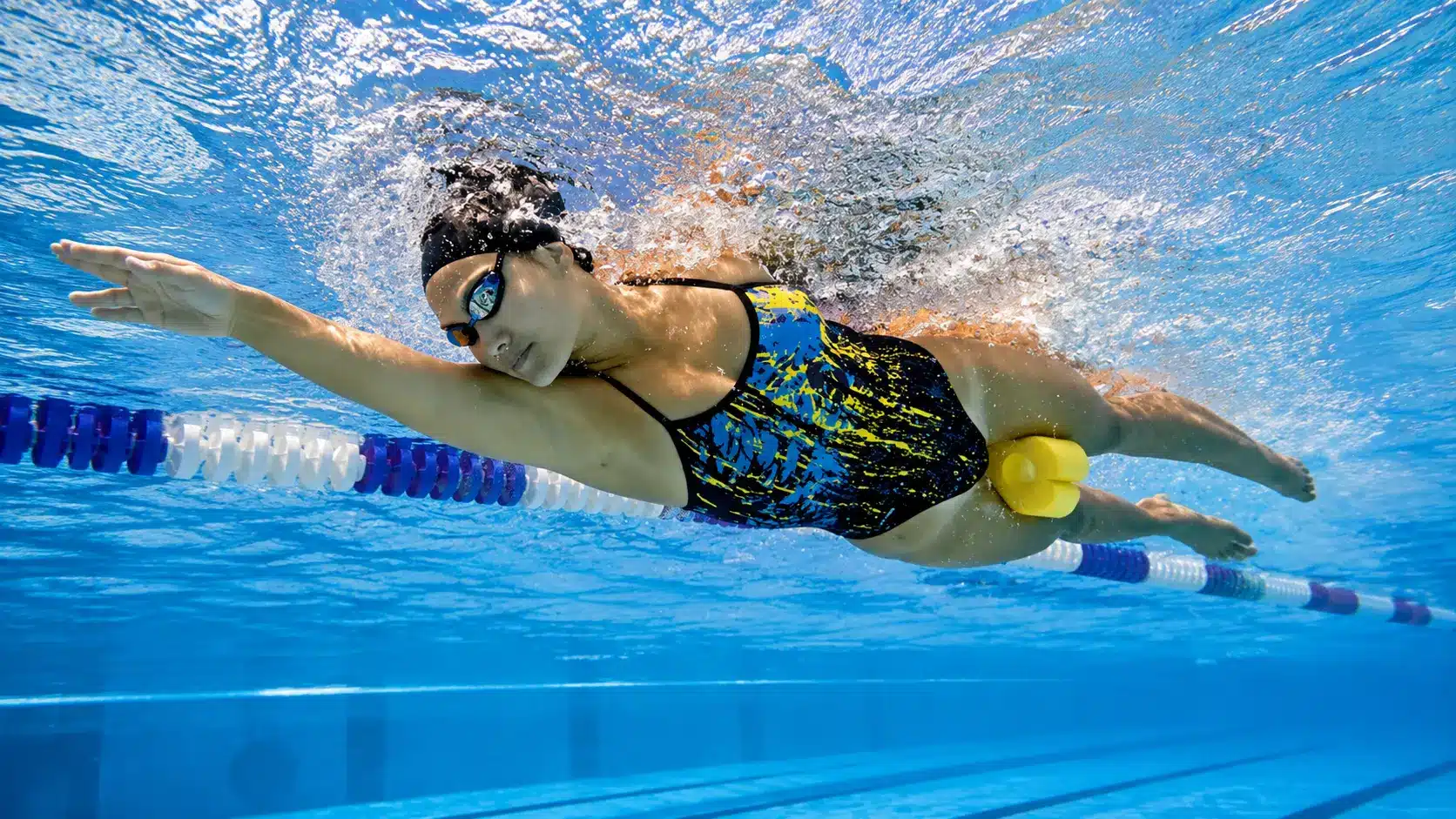
Once the basics feel natural, these workouts add more distance, faster intervals, and real technique work. They’re built for swimmers who already have some time in the water.
8. Pyramid Endurance Workout
I use this one a lot with swimmers who’ve got the basics down and want to push their distance without burning out too fast.
- What to do: Swim 100, 200, 300, then 400 yards freestyle, resting 30 seconds after each, then work back down through 300, 200, and 100.
- Duration: 45 minutes
- Equipment needed: None
- Suggested distance: 1,500 yards
9. Stroke Technique Refinement Workout
At this stage, small technique fixes start making a real difference in your speed and efficiency. Alternating focus points within the same set helps you feel the difference each adjustment makes in real time.
- What to do: Swim 4 rounds of 50 yards freestyle, alternating one length focused on high elbow catch and one length focused on hip rotation.
- Duration: 35 minutes
- Equipment needed: None
- Suggested distance: 800 yards
10. Speed Interval Workout
This session introduces faster efforts with enough rest built in to keep your form from falling apart. It’s a solid way to start testing your top speed without letting fatigue wreck your stroke halfway through.
- What to do: Swim 8 rounds of 50 yards fast, resting 30 seconds between each round.
- Duration: 30 minutes
- Equipment needed: Pace clock or watch
- Suggested distance: 400 yards
11. Pull Buoy Strength Workout
Isolating your upper body teaches you what a strong, efficient pull actually feels like. With your legs out of the equation, you’ll notice pulling mistakes a lot faster than you would swimming normally.
- What to do: Swim 6 rounds of 100 yards freestyle with a pull buoy, resting 20 seconds between rounds.
- Duration: 35 minutes
- Equipment needed: Pull buoy
- Suggested distance: 600 yards
12. Mixed Stroke Endurance Workout
This workout builds stamina while making sure you’re not relying on one stroke for everything. Rotating through all four keeps things balanced and hits muscle groups a single-stroke session would miss.
- What to do: Swim 4 rounds of 100 yards, rotating through freestyle, backstroke, breaststroke, and freestyle again, resting 20 seconds between rounds.
- Duration: 40 minutes
- Equipment needed: None
- Suggested distance: 400 yards
13. Kick Endurance Workout
Strong legs matter more than most swimmers realize, and this one makes that obvious pretty fast. Between the kick sets and the easy swims after, you’ll likely feel it in your legs well into the next day.
- What to do: Kick 4 rounds of 100 yards with a board, resting 30 seconds between rounds, then swim 4 rounds of 50 yards easy freestyle.
- Duration: 35 minutes
- Equipment needed: Kickboard
- Suggested distance: 600 yards
14. Race Pace Practice Workout
Learning to hold a consistent pace instead of starting too fast and fading is one of the more useful skills at this level.
- What to do: Swim 50 yards at 70% effort, 50 yards at 85% effort, then 100 yards at your goal race pace, resting 30 seconds between each segment, and repeat 4 times.
- Duration: 40 minutes
- Equipment needed: Pace clock or watch
- Suggested distance: 800 yards
These sessions will start exposing where your Technique or endurance still needs work. Keep rotating through them before jumping into advanced training.
Advanced Swimming Workouts
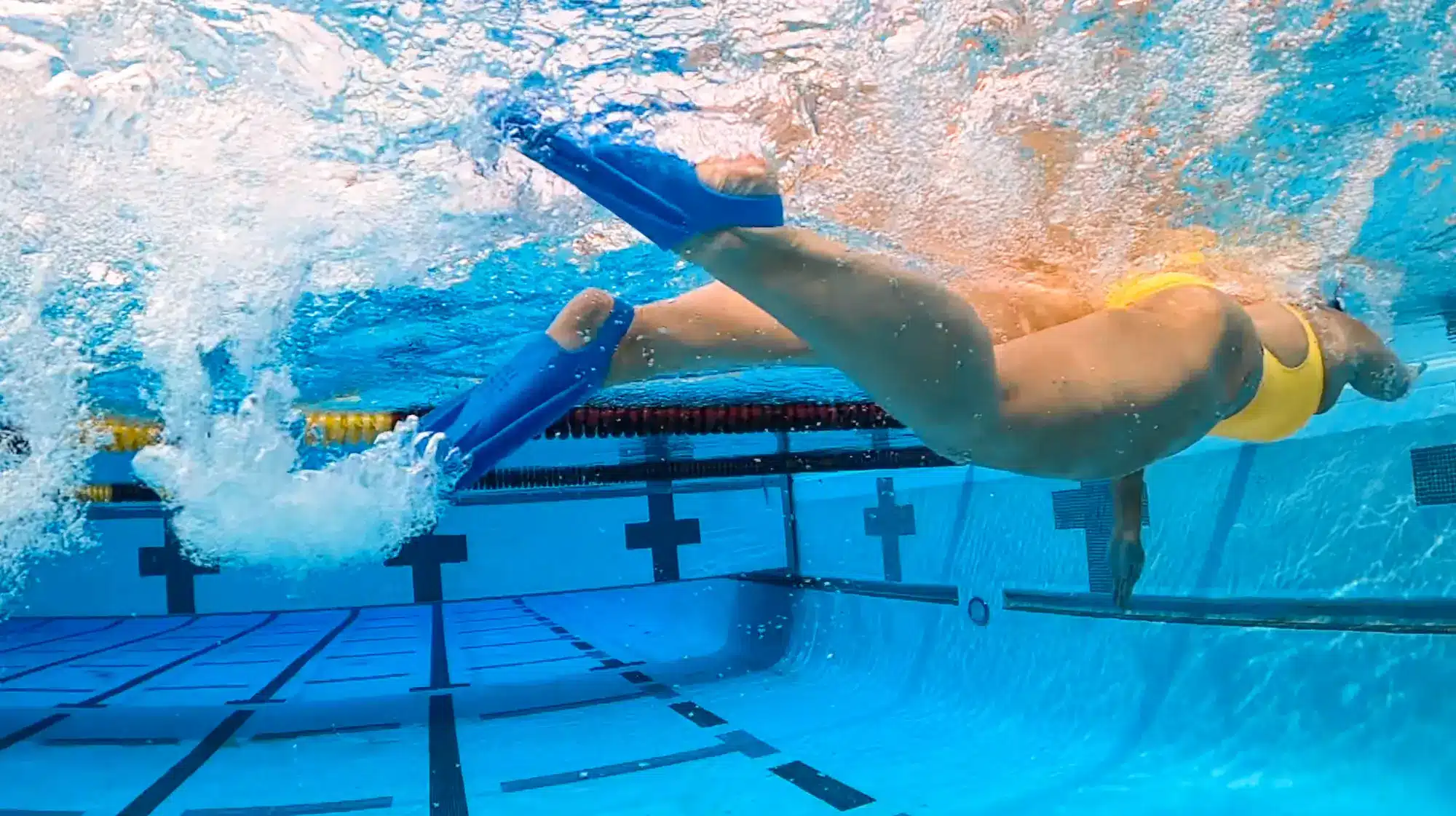
These workouts push pace, distance, and effort further than the intermediate level. They’re meant for swimmers training for performance or competition, not casual laps.
15. Descending Distance Endurance Workout
This demanding session is built for swimmers who want to test their pacing over longer distances. Aiming to go faster as the distances shrink forces you to manage effort instead of just surviving the set.
- What to do: Swim 500, 400, 300, and 200 yards freestyle, resting 20 seconds between each, aiming to swim each distance faster than the one before.
- Duration: 60 minutes
- Equipment needed: Pace clock or watch
- Suggested distance: 1,400 yards
16. High-Intensity Sprint Workout
This workout is built around short, all-out sprints with long rest in between, so you’re training pure top-end speed rather than endurance. Full recovery between reps matters here, since tired sprints just turn into slightly faster easy swimming instead of real speed work.
- What to do: Swim 12 rounds of 25 yards all-out, resting 45 to 60 seconds between each round.
- Duration: 45 minutes
- Equipment needed: Pace clock or watch
- Suggested distance: 300 yards
17. Resistance Training Workout
This workout uses added resistance, like a drag parachute or resistance tubing, to make your stroke and kick work harder than they would in open water. A drag parachute attaches to a belt at your waist and drags behind you underwater, while resistance tubing stretches as you swim and pulls you back toward the wall.
A quick safety note: start with light resistance and shorter distances first, since these tools put extra strain on your shoulders.
- What to do: Swim 8 rounds of 25 yards using a drag parachute or resistance tubing, resting 60 to 90 seconds between rounds.
- Duration: 50 minutes
- Equipment needed: Swim parachute or resistance tubing
- Suggested distance: 200 yards, plus warm-up and cooldown
18. Full Medley Strength Workout
Rotating through all four competitive strokes in one session hits every major muscle group in a single workout. It’s demanding, but it’s also one of the most complete strength sessions you can do in the water.
- What to do: Swim 8 rounds of 50 yards, cycling through butterfly, backstroke, breaststroke, and freestyle, resting 20 seconds between rounds.
- Duration: 50 minutes
- Equipment needed: None
- Suggested distance: 400 yards
19. Threshold Interval Workout
This workout trains your body to hold a hard pace for longer stretches instead of fading halfway through a set. The short rest windows are the whole point, since they force your body to recover while still moving.
- What to do: Swim 10 rounds of 100 yards at 80% effort, resting only 15 to 20 seconds between rounds.
- Duration: 55 minutes
- Equipment needed: Pace clock or watch
- Suggested distance: 1,000 yards
20. Overspeed Fin Workout
Training faster than your normal race pace teaches your body what that speed feels like, which carries over once the fins come off.
- What to do: Swim 10 rounds of 50 yards with swim fins at a fast pace, resting 30 seconds between rounds, followed by 4 rounds of 50 yards without fins at the same effort.
- Duration: 45 minutes
- Equipment needed: Swim fins
- Suggested distance: 700 yards
21. Championship Simulation Workout
This one mimics the demands of a real competition day, with multiple rounds and shrinking rest. Going faster with each round instead of settling into one pace is what makes it feel like an actual race.
- What to do: Swim 3 rounds of 200, 150, and 100 yards freestyle, resting 30 seconds after the 200 and 150, and only 20 seconds after the 100, going faster with each round.
- Duration: 60 minutes
- Equipment needed: Pace clock or watch
- Suggested distance: 1,350 yards
Recovery matters as much as effort at this level. Space these out with easier sessions so your shoulders and upper body get the rest they need.
Swimming Workouts Based on Your Goal
Not everyone gets in the pool for the same reason. This table breaks down which workout type fits which goal, so you can stop guessing and start training with purpose.
| Goal | Best Workout Type | Focus |
|---|---|---|
| Weight loss | HIIT and interval workouts | Burns roughly 400–700 calories per hour |
| Endurance | Pyramid and threshold sets | Typically 1,000–1,500 yards per session |
| Speed | Sprint and overspeed workouts | Short, maximum-effort bursts under 50 yards |
| Technique | Drill-based workouts | Stroke correction, usually 200–400 yards of drill work |
| Strength | Resistance and pull-focused workouts | Upper body and core power, 400–600 yards per session |
| General fitness | Mixed stroke workouts | Full-body conditioning, 400–800 yards across strokes |
| Stress relief | Easy steady swims | Relaxed pace, no time pressure, any distance |
Swimming is one of the activities the National Institute of Diabetes and Digestive and Kidney Diseases recommends as part of a sustainable weight-loss routine, since it burns real calories without the joint strain that stops many people from staying consistent.
Three to four sessions a week is usually the sweet spot if fat loss is the main goal, paired with a reasonable diet.
Endurance work tends to run longer, with pyramid and threshold sets often covering 1,000 to 1,500 yards a session once you’re past the beginner stage.
Once you know which category fits your goal, the next step is figuring out how actually to pick a workout within it.
How to Choose the Right Swimming Workout
With so many options out there, it’s easy to pick the wrong workout for your level or goal. These few checks help narrow it down.
- Start with your current level, not your goal level: Picking a workout built for advanced swimmers when you’re still new usually leads to sloppy form and frustration.
- Match the workout to what you actually want: Someone chasing weight loss needs a different structure than someone training for a race.
- Factor in how much time you have: A 30-minute session and a 90-minute session call for different kinds of sets.
- Pay attention to how your body responds: If a workout consistently leaves you wiped out for the rest of the day, it might be too much too soon.
- Rotate workout types instead of repeating the same one: Doing the same session every time limits how much you improve.
Once you’ve settled on the right workout type, the next question is how often you should do it.
How Many Swimming Workouts Should You Do Each Week?
Beginners generally do best with 2 to 3 sessions a week, giving their body time to adjust to the demands of regular swimming.
Intermediate swimmers can usually handle 3 to 5 sessions, mixing endurance, speed, and technique work throughout the week.
Advanced swimmers training for competition often swim 5 or more times a week, sometimes with two sessions in a single day.
Swimming counts as vigorous-intensity aerobic activity, and the CDC recommends at least 75 minutes of it per week for general health, with more needed if weight loss is the main goal.
Even at that level, rest days matter, since the shoulders and upper body take on a lot of repetitive stress over time.
Whatever level you’re at, consistency matters more than cramming in one brutal session and skipping the rest of the week.
Sample Weekly Swimming Workout Plan
Seeing a full week laid out makes it easier to plan your own training instead of picking workouts at random. Here’s how it breaks down by level.
Beginner weekly plan
- Monday: Technique workout
- Wednesday: Easy endurance workout
- Saturday: Mixed stroke workout
Intermediate weekly plan
- Monday: Endurance workout
- Tuesday: Technique workout
- Thursday: Speed interval workout
- Saturday: Mixed stroke workout
Advanced weekly plan
- Monday: Threshold interval workout
- Tuesday: Technique and drill workout
- Wednesday: Sprint workout
- Thursday: Recovery swim
- Friday: Resistance training workout
- Saturday: Endurance workout
These plans aren’t fixed. Swap days around based on your schedule; try to keep some spacing between the harder sessions.
How to Make Your Swimming Workouts Harder Over Time
Once a workout stops feeling challenging, it’s time to adjust. These are the simplest ways to raise the difficulty without overhauling your whole routine.
- Add distance gradually. Increase your total yardage by small amounts each week instead of jumping too far too fast.
- Shorten your rest intervals. Less recovery time between rounds forces your body to work harder without changing the distance.
- Introduce resistance tools. Fins, paddles, and parachutes all add difficulty once your Technique is solid enough to handle them.
- Raise your target pace. Push your goal times down slightly as your fitness improves.
- Mix in more advanced drills. Swap basic technique work for more demanding drills like closed-fist swimming or vertical kicking.
- Increase session frequency before increasing intensity. Adding a fourth or fifth weekly session can build fitness before you need to make individual workouts harder.
- Follow the 10% rule. Keep your weekly distance increase under 10% so your shoulders and joints have time to adapt. This is the same principle runners use to avoid overuse injuries, and it applies just as much in the water.
Small changes add up fast in the water, so there’s no need to change everything at once.
Common Swimming Workout Mistakes to Avoid
A good swimming routine is easier to follow and improve when you avoid these common mistakes that can limit your progress.
- No workout plan: Swimming random laps makes it nearly impossible to track progress.
- Poor technique: Bad form wastes energy and slows you down.
- Skipping warm-up: Starting too fast hurts your performance and your comfort in the water.
- Increasing distance too fast: Ramping up too quickly leads to fatigue and breaks down your form.
- Training one stroke only: Mixing strokes builds more overall strength and skill.
Avoiding these mistakes helps you build better habits, improve your technique, and get more from every swim session.
Final Thoughts
Your swimming routine should match your fitness level and goal.
Build from technique and steady endurance, then add speed, resistance, or longer sets as you improve.
The right swimming workouts can help you train with more purpose without doing more than your body can handle.
Choose a session that fits your current level, try it at your next swim, and share your favorite workout in the comments.
Frequently Asked Questions
How Long Should a Swimming Workout Be?
A beginner session usually runs 20 to 40 minutes. Experienced swimmers often train for an hour or more, depending on their goals and intensity.
What is the Best Swimming Workout for Beginners?
The best beginner workouts focus on technique and breathing control first, with endurance building gradually. Swimming flat-out from day one usually backfires and leads to sloppy form.
Can Swimming Workouts Help Lose Belly Fat?
Swimming helps with overall fat loss by burning calories and improving fitness, but you can’t spot-reduce fat in one area through exercise alone. It works best paired with a consistent routine and a decent diet.