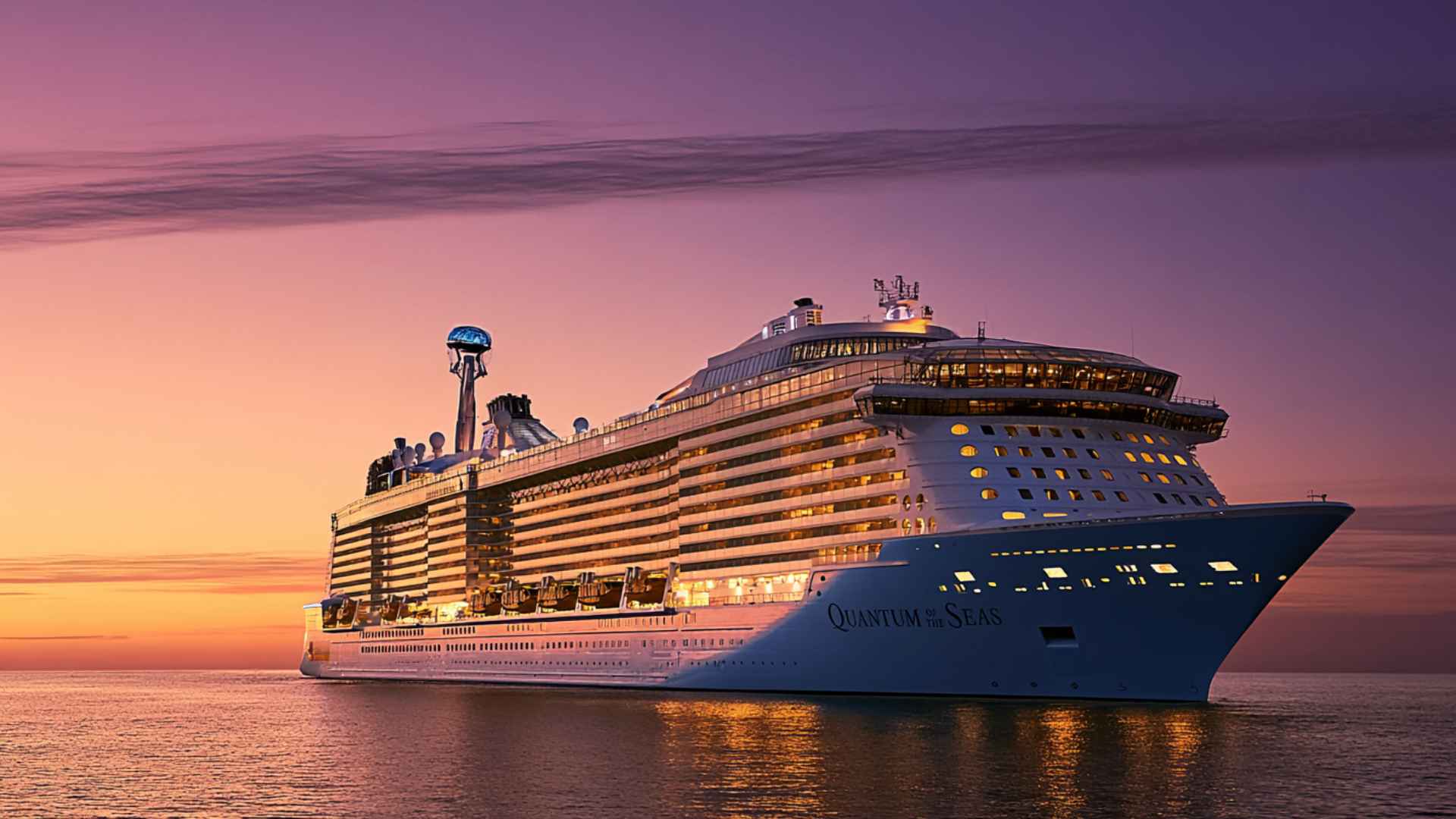
A ship might look like one giant piece of steel floating on water, but it’s really made up of dozens of parts working together at once.
Some of these parts sit right out in the open, like the anchor, the bridge, or the mast.
Others stay hidden inside the hull, quietly doing their job without anyone noticing.
Once you know what each part is called and what it actually does, ships stop feeling like a mystery.
Most ships share the same basic sections, no matter their size or purpose.
The hull keeps everything afloat, the bridge controls direction, and the engine room supplies the power to move forward.
Main Parts of a Ship
A ship is made up of many different parts, but each one has a specific job. Some help the vessel stay afloat, while others control movement, steering, cargo, or safety. Knowing the basic parts makes it much easier to understand how a ship works as a whole.
Most ships share the same key sections, including the hull, bow, stern, deck, bridge, keel, rudder, propeller, and internal compartments.
Their size and layout may change depending on the vessel type, but their basic purpose stays much the same. Below, we’ll go through the main parts of a ship and explain what each one does.
Types of Ships
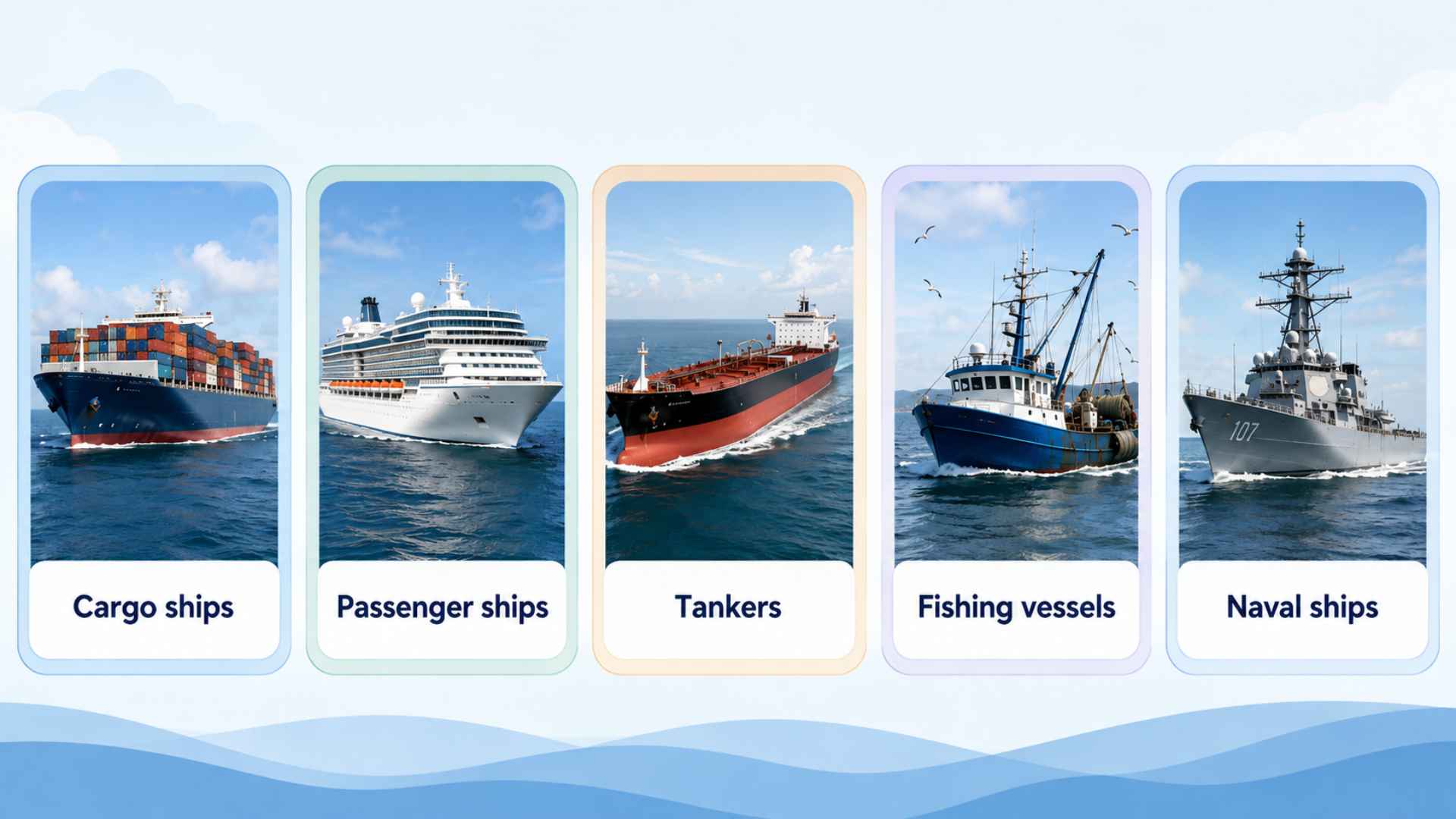
Not every ship is built the same way, since each one is designed around a specific job.
- Cargo ships carry goods like containers, grain, or oil across oceans
- Passenger ships are built for comfort and carry people rather than freight
- Tankers transport liquids such as crude oil or chemicals
- Fishing vessels are smaller and built for durability at sea
- Naval ships are designed for defense and often carry specialized equipment
The basic parts covered earlier, like the hull, bridge, and rudder, stay the same across most of these ship types.
What changes is size, layout, and the equipment added for each ship’s specific purpose. Smaller vessels follow the same logic too.
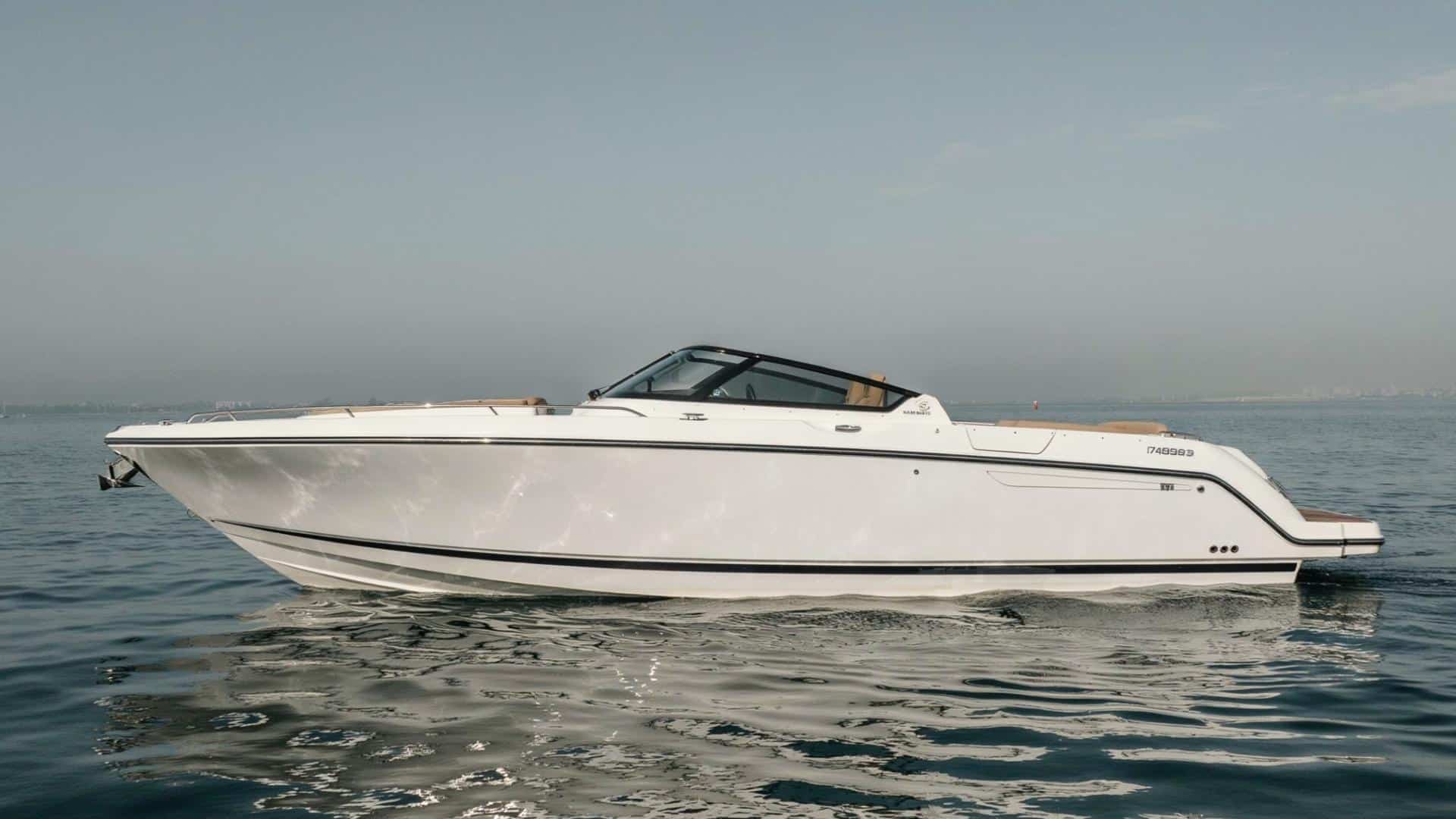
If you’ve ever looked at the basic parts of a boat, you’ll notice the same bow, stern, hull, and deck naming system, just scaled down.
Understanding the Anatomy of a Ship
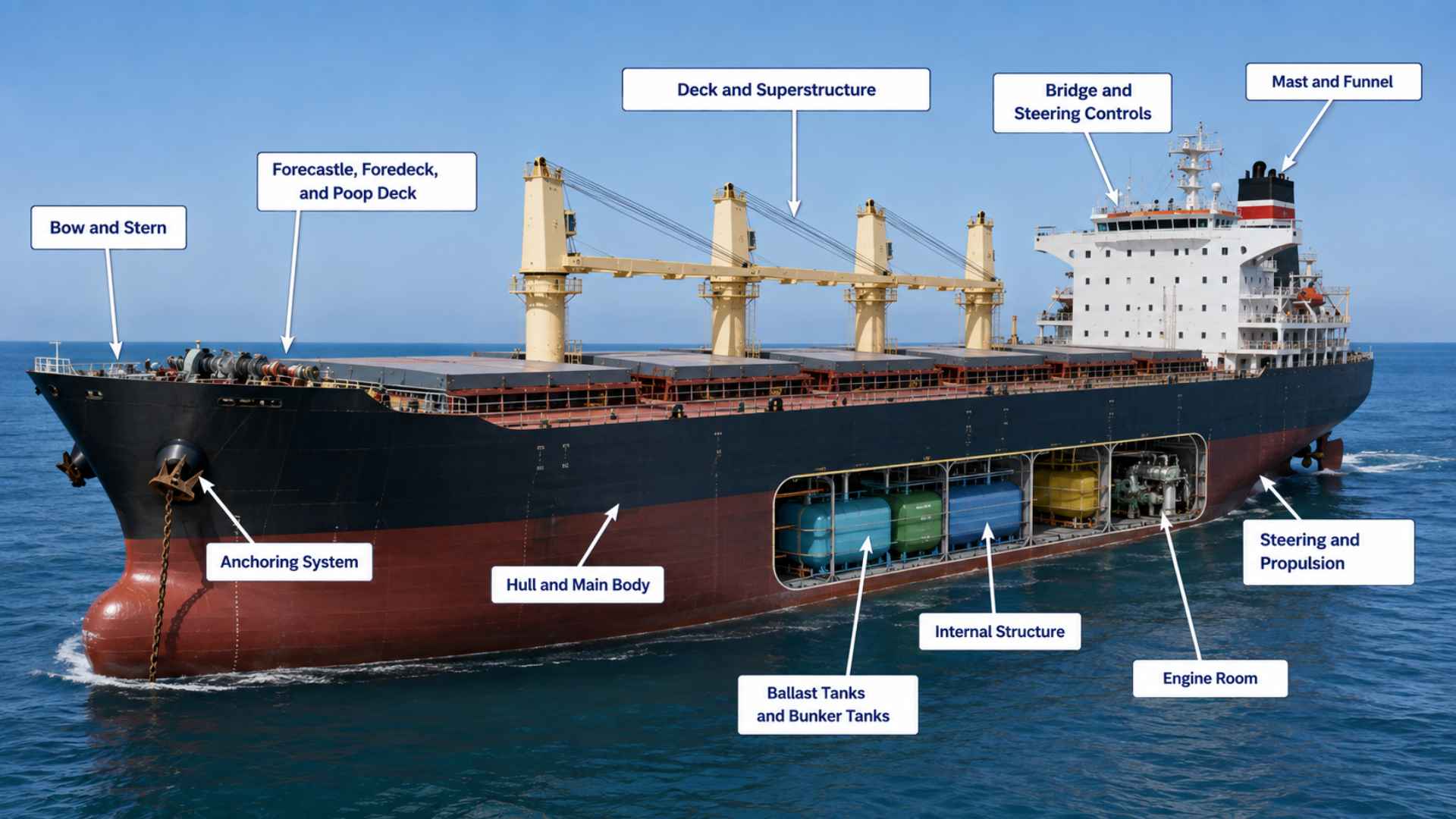
Ships may look complex, but every section has a clear purpose. From the hull and bow to the bridge and propeller, these parts work together to keep vessels moving safely.
1. Hull and Main Body
The hull is the outer shell of the ship. It is the part that touches the water and keeps everything else dry and floating. Think of it like the skin of the ship. Without a strong hull, nothing else on board matters.
A ship’s hull is split into three main sections:
- Bow – the front section
- Midship – the middle section
- Stern – the back section
The keel runs along the bottom of the hull and supports the ship’s overall structure. Freeboard is the distance between the main deck and waterline. More freeboard helps reduce the chance of waves washing onto the deck in rough seas, and it’s also the measurement regulators use to calculate a ship’s safe load line markings under international maritime rules, which set separate limits for tropical, summer, and winter sailing conditions.
2. Orientation Terms Every Ship Uses
Before going further, it helps to know how sailors describe direction on board. These terms show up constantly once you start reading about any other ship part, so they’re worth learning first.
| Term | Meaning |
|---|---|
| Port | Left side of the ship when facing the bow |
| Starboard | Right side of the ship when facing the bow |
| Forward | Toward the bow, or the front of the ship |
| Aft | Toward the stern, or the back of the ship |
| Amidship | The middle section of the ship, between bow and stern |
Sailors settled on port and starboard instead of left and right because left and right change depending on which way a person is facing. Port and starboard don’t, no matter where you’re standing on deck.
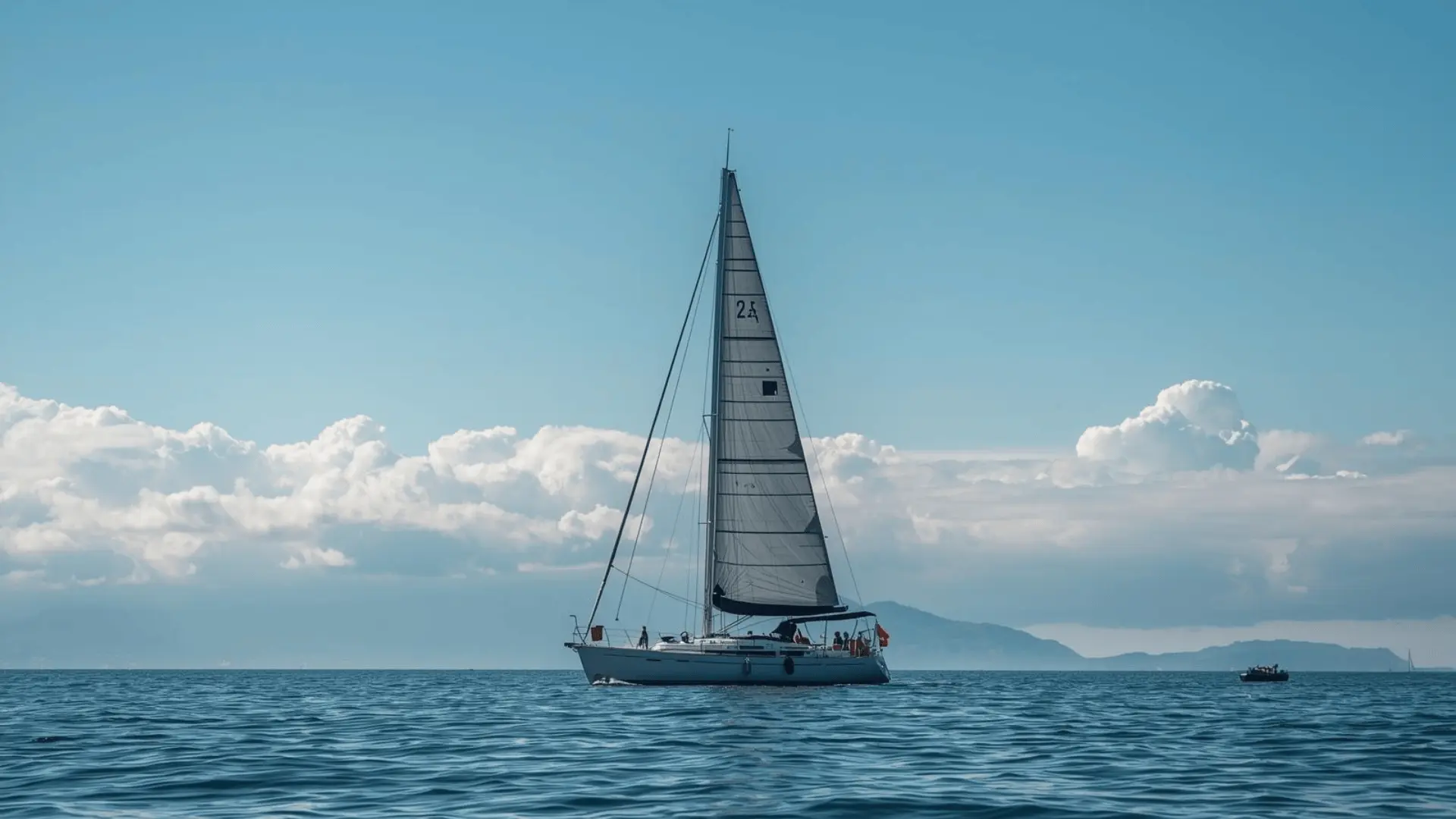
The same rule carries over to smaller craft too, including sailboats and rigging, where crews rely on the same port and starboard calls to communicate.
3. Bow and Stern
The bow is the pointed front end of the ship. It is shaped that way on purpose. A sharp bow cuts through waves instead of smashing straight into them, which saves fuel and keeps the ride smoother.
Some large ships have a bulbous bow, a rounded bulge that sits underwater at the front. It looks odd, but it actually reduces drag and helps the ship move more smoothly through water, often improving fuel efficiency by around 10 to 15 percent compared to a conventional bow.
| Part | Location | Main Job |
|---|---|---|
| Bow | Front of ship | Cuts through waves |
| Bulbous bow | Underwater, front | Reduces drag |
| Stern | Back of ship | Houses rudder and propeller |
| Transom | Flat surface at the stern | Closes off the hull at the back |
The stern is the back of the ship. This is where most of the heavy lifting happens, since the rudder and propeller are usually mounted here. The flat, upright surface that closes off the very back of the hull is called the transom. On smaller boats, the stern also holds the engine and steering controls.
4. Deck and Superstructure
The deck is the flat surface you picture when you think of a ship. But there is more than one deck on most vessels, and each one has a job.
- Main deck – the top-most full-length deck, used for cargo handling and general movement
- Weather deck – the uppermost deck fully exposed to sun, wind, and rain
- Upper deck – the deck that runs the full length of the ship and covers the hull
- Hatch covers – strong lids that seal off the cargo holds below
- Deck cranes – used to lift and move heavy cargo on and off the ship
- Winches – handle ropes and wires during loading, docking, and anchoring
Above the deck sits the superstructure. This is the tall, block-like structure you see rising above the main body of the ship. It usually holds crew cabins, the bridge, and other living and working spaces.
Pro tip: To spot a ship’s bridge, look near the tallest part of the superstructure, where crew needs a clear forward view.
5. Steering and Propulsion
A ship needs two things to move where it’s supposed to go: something to push it forward, and something to steer it. That’s exactly what this section covers.
The rudder sits underwater near the stern and turns the ship by redirecting water as it moves. On most large vessels, the main rudder swings from 35 degrees port to 35 degrees starboard in under 30 seconds, so the ship can respond quickly if it needs to change course fast.
The propeller pushes water backward to move the vessel forward, while larger ships may use multiple propellers. Bow thrusters, fitted near the front of the hull, move the bow sideways, making docking and tight turns easier without relying heavily on tugboats.
6. Anchoring System
Anchoring sounds simple, but it takes a full system of parts working together. A ship’s anchoring system uses several strong parts to hold the vessel safely in place, control the anchor, and manage its heavy chain during use. The design of this hooked weight has changed a lot over centuries, but its basic job of gripping the seabed has stayed the same.
- Anchor: the heavy hooked weight that digs into the seabed
- Anchor chain: thick, heavy-duty chain connecting the anchor to the ship
- Windlass: the machine that raises and lowers the anchor chain
The anchor and its chain are stored near the bow, usually in a space called the anchor pit. When it’s time to stop, the windlass releases the chain, and the anchor drops until it grips the seabed below.
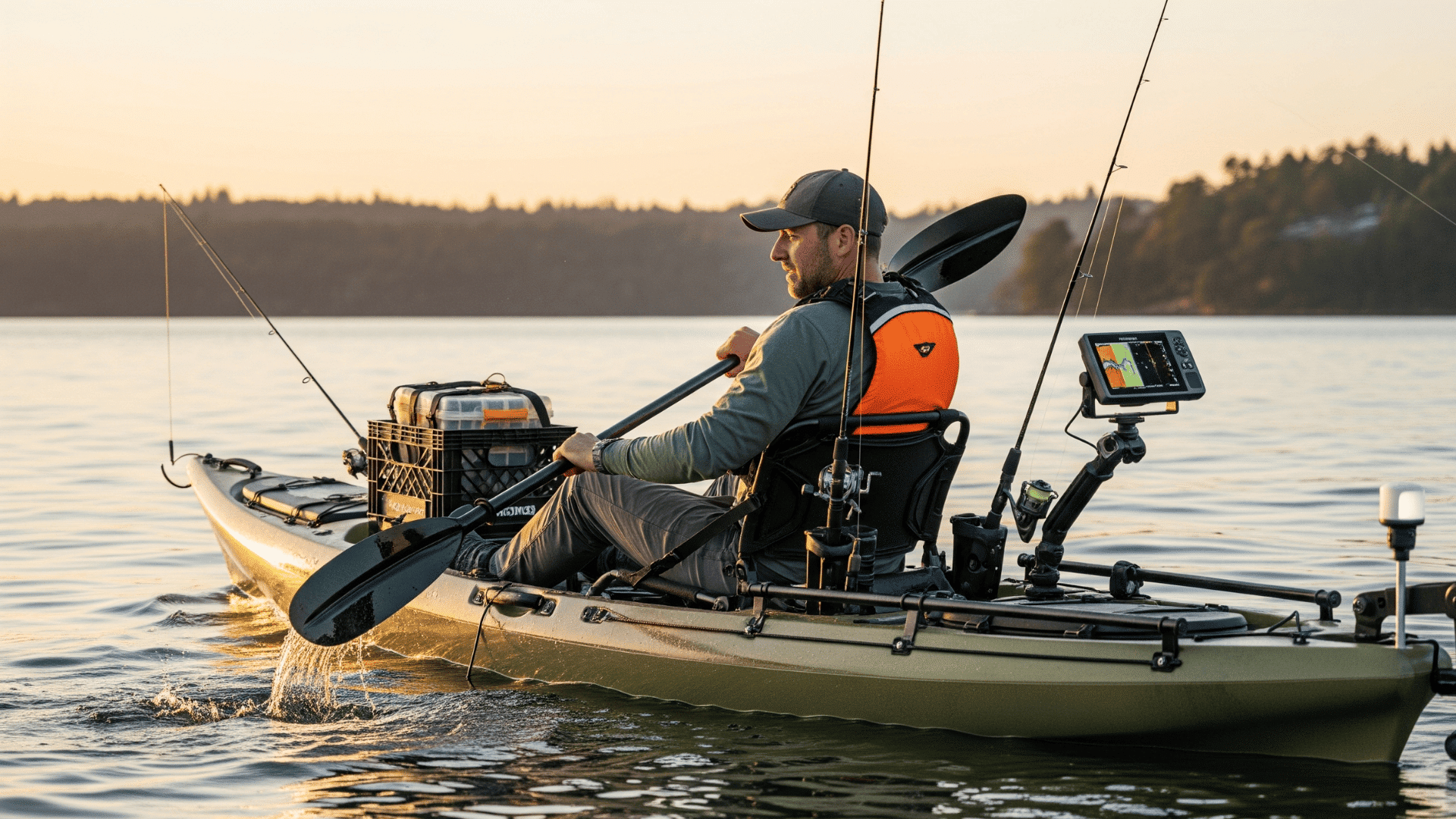
Anchoring is one of the few systems that stays almost identical across vessel sizes; even the parts of a canoe that touch bottom, like a simple drag anchor, follow the same basic hold-and-release idea, just scaled way down.
7. Internal Structure
Many important ship parts sit inside the hull. Bulkheads divide it into sealed sections, helping limit flooding if damage occurs. Frames run across the inside of the hull like ribs, giving the ship its shape and holding the outer plating in place. The double bottom adds another protective layer beneath the hull, while the side shell forms the outer plating along the sides.
At the lowest point, the bilge collects small amounts of water that seep in during normal operation. Pumps clear it out regularly, since letting it build up creates both a maintenance problem and an environmental compliance issue. Cargo holds provide large spaces for storing goods, while hatch covers above help keep the cargo protected from seawater, rain, and rough weather at sea.
8. Bridge and Steering Controls
The bridge is the command center of the ship. Every major decision about speed, direction, and safety gets made here. From the bridge, officers can:
- Control the ship’s speed and steering
- Watch weather and sea conditions
- Communicate with ports and other vessels
- Keep an eye on radar and other safety instruments
Above the bridge, some ships have a small deck called the monkey island. Sailors once used this spot for star and sun readings before modern instruments took over.
9. Forecastle, Foredeck, and Poop Deck
These three terms confuse a lot of people at first, but once you see where each one sits, they’re easy to remember.
| Term | Location | Main Use |
|---|---|---|
| Forecastle | Raised deck at the very front | Holds anchor gear and windlass |
| Foredeck | Flat deck between the forecastle and superstructure | Open work area for the crew |
| Poop deck | Raised deck at the back | Gives crew a clear view toward the stern |
The forecastle usually takes up a small part of the ship, often less than a tenth of its total length. Sailors once lived inside it, and on some older ships, it still holds storage space or small crew cabins.
10. Ballast Tanks and Bunker Tanks
Ships need to stay balanced, especially when they’re not fully loaded with cargo. That’s where ballast tanks come in. These compartments, built into the hull, hold seawater. Crew members can add or remove water from these tanks to keep the ship level and stable, even in rough conditions.
Bunker tanks serve a completely different purpose. They store fuel, the kind that keeps the main engine and generators running for the length of a trip. Both tank types need strong protective coating inside.
11. Mast and Funnel
The mast is a tall, upright pole that sticks up from the deck. It looks simple, but it carries some important gear.
- Radar antennas
- Navigation lights
- Communication equipment
- Signal flags
The funnel is the tall pipe you often spot near the back of a ship, usually with smoke coming out. Its job is to release exhaust from the engine and boilers. Most funnels lean slightly toward the stern. That angle keeps smoke away from the bridge, so the crew can see clearly while steering.
12. Engine Room
The engine room is where the ship’s main power systems operate. It usually contains the main engine, which drives the propeller, along with boilers that produce steam for heating and other systems.
Generators supply electricity throughout the ship, while fuel and oil purifiers clean the fuel and lubricating oil before the machinery uses them.
13. Accommodation and Crew Quarters
Not every part of a ship is about steering, cargo, or power. Somewhere on board, the crew still needs a place to sleep, eat, and rest between shifts. That space is called the accommodation, and it usually sits inside the superstructure.
- Cabins: private or shared sleeping quarters for officers and crew
- Galley: the ship’s kitchen, where meals are prepared for everyone on board
- Mess room: the dining area where crew members eat
- Recreation room: a shared space for downtime, often with a TV or games
Larger ships may add a small gym, laundry facilities, or a medical room, since crews can spend weeks or months at sea without reaching port.
Ship Measurements
Before anyone can understand how a ship handles the water, it helps to know how it’s actually measured.
| Term | What It Means |
|---|---|
| Length | The total distance from bow to stern |
| Beam | The width of the ship at its widest point |
| Draft | How deep the ship sits below the waterline |
Draft matters more than people think. A ship with a deep draft needs deeper water to sail safely, which is why some large ships can’t enter shallow ports or narrow canals.
Safety Equipment on a Ship
Safety gear is not just a backup plan. It’s built into every part of a ship’s design.
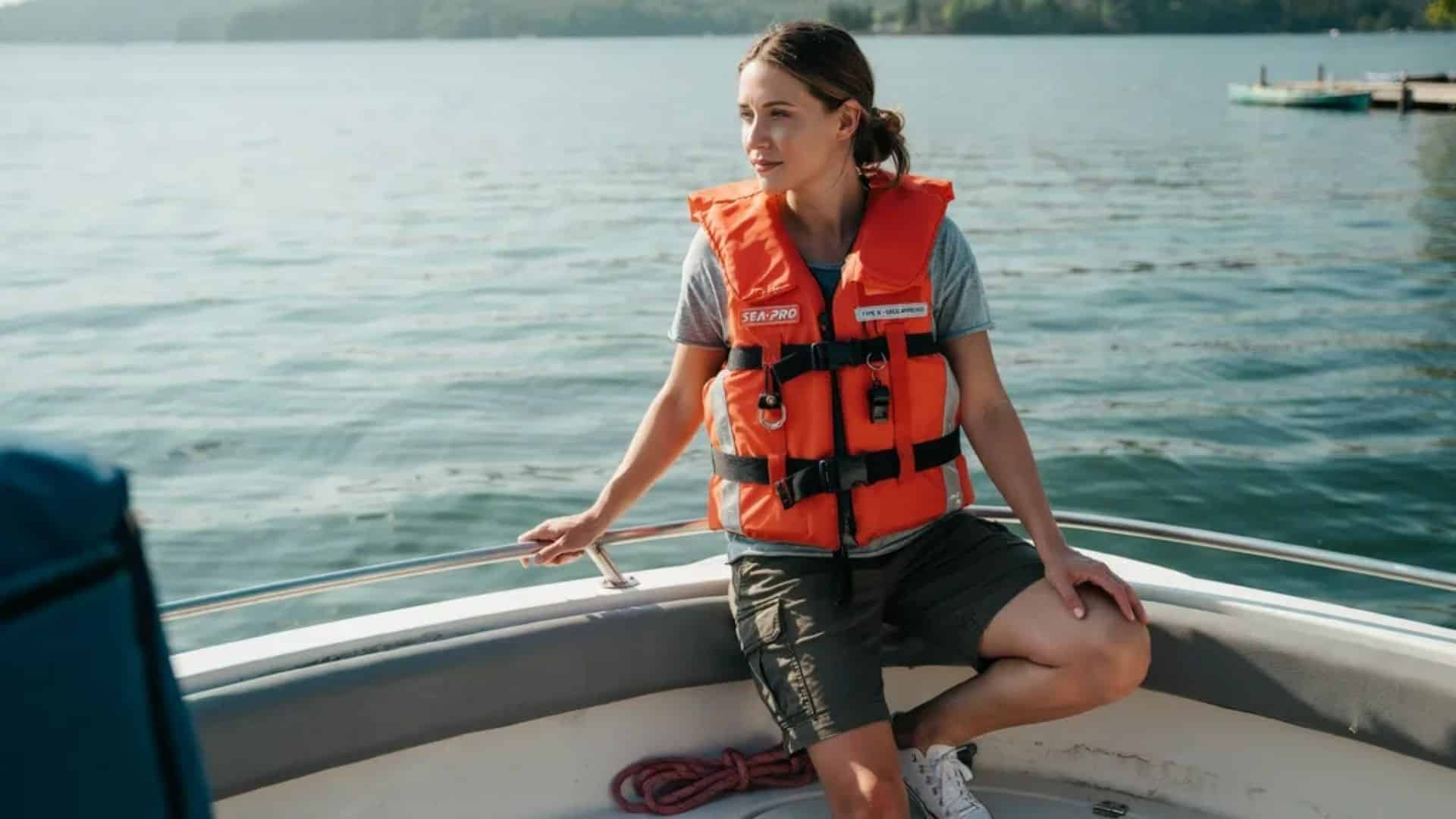
Ships carry several types of safety equipment to protect everyone on board during emergencies, and the exact number required often depends on international safety regulations that every vessel must follow.
- Lifeboats: enclosed boats that can carry crew away from danger
- Liferafts: inflatable rafts stored in cases, ready to deploy fast
- Fire systems: detectors and sprinklers spread throughout the ship
- Emergency alarms: loud signals that alert the whole crew instantly
Ships must carry enough lifeboats and liferafts to hold everyone on board, with extra room built in for safety margins.
Conclusion
Ships carry a surprising amount of engineering packed into one structure, yet every part still has a clear, specific job.
From the keel holding everything together to the small mast carrying radar and lights, nothing on board is there by accident.
I think that’s what makes ships so interesting once you actually learn the terms: a vessel that once looked like a plain metal box suddenly turns into something you can read like a map.
Next time you see a ship at a port or on the water, you’ll probably find yourself naming the parts without even trying.
The naming system carries over everywhere on the water too.
Look at a modern container ship or the sailing-era terms in this anatomy of a ship glossary, and bow, stern, port, and starboard still mean the same thing every time.
Frequently Asked Questions
What Is the Strongest Part of a Ship Called?
The keel is the strongest part. It runs along the bottom of the hull and holds the ship’s entire structure together, acting as its backbone.
What Is the Front and Back of a Ship Called?
The front is called the bow, and the back is called the stern. These terms are used on ships of every size.
Why Do Ships Have Bulkheads?
Bulkheads divide a ship into sealed sections. If one section floods, the walls stop water from spreading, helping keep the whole ship afloat.
What are Port and Starboard?
Port is the left side of the ship, and starboard is the right side, both measured while facing the bow. These terms stay fixed no matter which direction a person on board is facing, which is why sailors use them instead of left and right.