

Long before surfing became the global sport it is today, people were riding waves not for competition or cameras, but as a way of life.
The ocean was not just a resource; for many coastal cultures, it was a social space, a spiritual ground, and a source of identity. That history stretches back far further than most people expect.
So, when was surfing invented? What we can trace is a rich and layered evolution from ancient Polynesian traditions to Hawaiian cultural practice.
If you have ever asked, “Where did surfing originate?” the answer takes you across centuries of cultural change, rediscovery, and reinvention, and that is exactly what this article covers.
When Was Surfing Invented?
The earliest written documentation of wave riding on boards dates to the late 1700s in Hawaii.
By that point, surfing was already a deeply embedded cultural tradition practiced across generations long before any outsider put it on paper.
That gap between practice and documentation matters. It tells us that the absence of early written records is not an absence of history.
Surfing grew out of centuries of ocean culture, shaped by communities who passed knowledge through stories, rituals, and lived experience rather than text.
It existed long before the modern world had the means or interest to document it, which is exactly why tracing its true origins requires looking well beyond any single date or written account.
Where Did Surfing Originate? A History of Surfing
Surfing’s history spans centuries of cultural shifts, suppression, revival, and global growth. The table below captures the defining moments that shaped its path from ancient Pacific tradition to the world stage.
| Period | Key Development |
|---|---|
| Pre-1700s | Wave riding was practiced across Polynesia; oral traditions carry the history |
| Late 1700s | First written European accounts of surfing in Hawaii |
| 1800s | Decline in Hawaii due to colonial and missionary influence |
| Early 1900s | Revival in Hawaii; Duke Kahanamoku spreads surfing to California and Australia |
| 1950s–1970s | Major surfboard innovations; surf culture expands globally |
| 1964 | International Surfing Association was founded |
| 21st Century | Professional global surf tours; Olympic inclusion at Tokyo 2020 |
Each period tells a distinct part of the same story, a practice that survived suppression, crossed oceans, and earned its place among the world’s most recognized sports.
Surfing in Ancient Polynesia and Hawaii

Surfing held a significant place in Hawaiian and broader Polynesian society. Polynesia refers to a large region of the central and southern Pacific Ocean that includes Hawaii, Samoa, Tahiti, and Tonga.
It was not simply a pastime; it was woven into social structure, spiritual belief, and community life.
Traditional Hawaiian boards came in several forms:
- Paipo – Short, prone-riding boards used by younger surfers and commoners
- Alaia – Mid-length finless boards, roughly 7 to 12 feet, made from koa or breadfruit wood
- Olo – Long, heavy boards often over 15 feet, reserved for chiefs
Boards were shaped by hand, sometimes blessed with ritual prayers, and cared for as meaningful objects. The culture around surfing was as developed as the practice itself.
Earlier Forms of Wave Riding Around the World
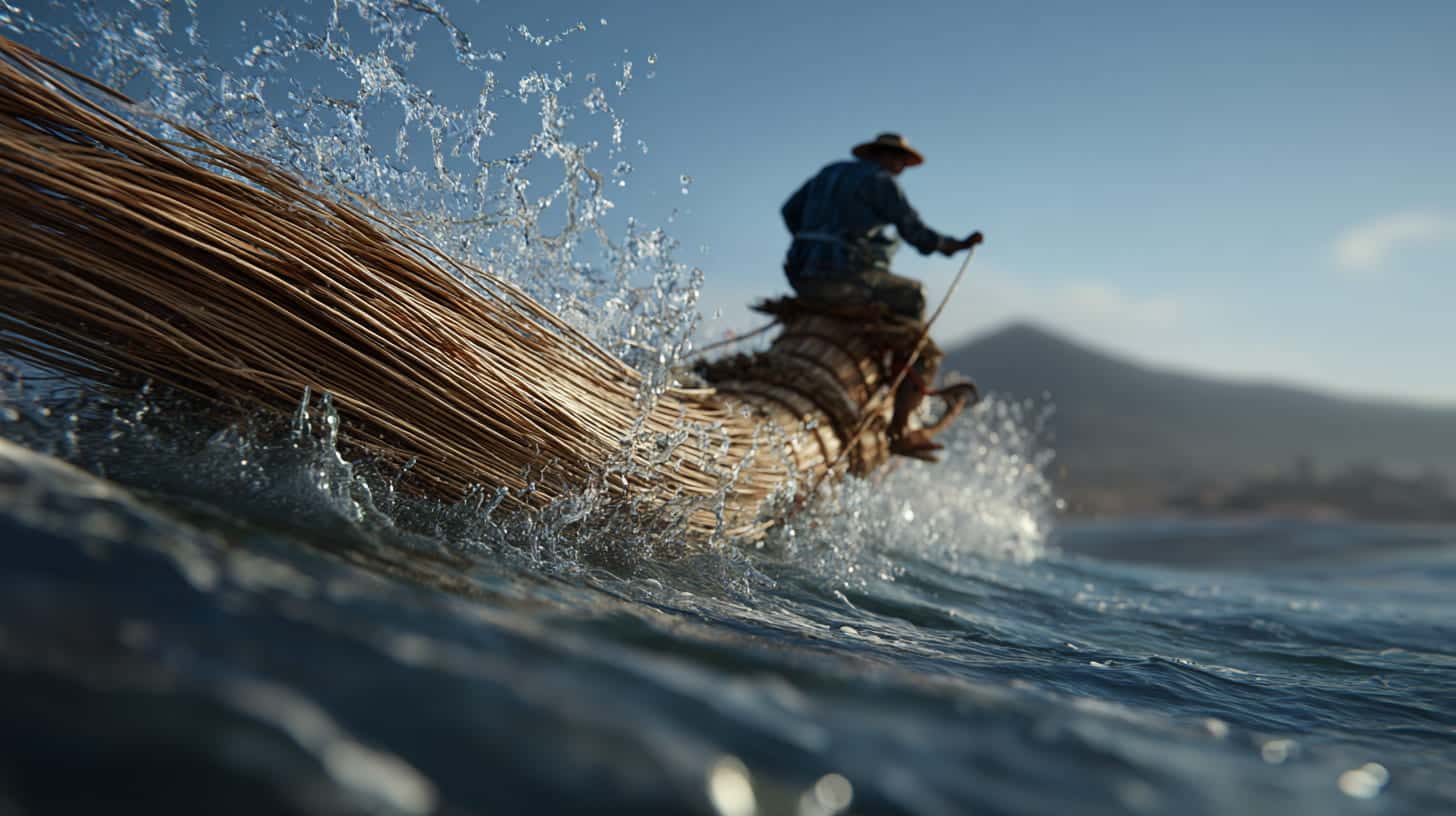
Hawaii and Polynesia hold the clearest and most documented surfing history, but there are accounts of wave riding from other parts of the world that predate or run parallel to those records.
- Coastal Peru: Ancient Andean fishermen used caballitos de totora, small reed watercraft, to ride waves back to shore. While the purpose was primarily practical, the wave riding involved in fishing is undeniable.
- West Africa: Some historical accounts describe coastal communities engaging in plank-based wave riding, though documentation is sparse and the practice appears to have been less culturally structured than in Polynesia.
The key difference between these cases lies in intent and cultural integration. In Hawaii, surfing was recreational, ceremonial, and socially organized.
That said, these traditions show that humans across ocean-facing cultures have long found ways to work with and enjoy waves.
Why There Is No Single Invention Date
Surfing did not begin with an invention. It grew from the sea, shaped over centuries by coastal communities who built their lives around the ocean.
Cultures that practiced surfing passed knowledge through oral traditions and stories rather than written texts. The absence of records simply reflects how those communities carried it forward.
There was no single moment of creation; it developed gradually across generations of practice and observation.
By the mid-1800s, missionary influence and colonial disruption had nearly erased the practice in Hawaii, dismantling the very structures that had kept it alive.
The early 1900s brought a revival, led by watermen like Duke Kahanamoku, whose efforts introduced wave riding to California and Australia, marking surfing’s shift into an international pursuit.
Surfing Becomes a Global Sport
As boards became lighter and surf culture spread through films, magazines, and music in the 1960s and 70s, surfing moved well beyond its Pacific roots.
Early wooden boards gradually gave way to hollow designs, and later to foam and fiberglass constructions, making them lighter, easier to control, and more accessible to a wider range of people.
These technological changes played a major role in expanding participation worldwide.
Competitive surfing grew steadily, with formal contest circuits emerging and professional surfers gaining widespread recognition.
The International Surfing Association, founded in 1964, serves as the sport’s global governing body. Surfing’s worldwide status was confirmed when it made its Olympic debut at the Tokyo 2020 Games (held in 2021).
Surfing in this Day and Age
Surfing has grown far beyond its coastal roots, shaped by technology, global governance, and professional competition. Artificial wave technology is expanding access to the sport, allowing landlocked communities to experience surfing without the ocean.
At the governance level, the International Surfing Association oversees amateur competition worldwide, hosting world championships across Junior, Open, and Masters divisions while maintaining coaching standards.
At the professional level, the World Surf League (WSL) operates the World Championship Tour, a global circuit featuring the world’s top surfers at iconic breaks such as Pipeline, Teahupoʻo, and Jeffreys Bay.
Conclusion
So, when was surfing invented? It was not a single day but a process. The earliest written records date to Hawaii in the late 1700s, but by then the practice was already centuries old.
If we ask where did surfing originate, the most historically grounded answer points to Polynesia, and Hawaii in particular, where it was most fully developed as a cultural and social practice.
Earlier wave riding existed in places like coastal Peru and possibly West Africa, but none carried the same depth or social organization.
What makes this history remarkable is the long arc it traces from ancient Pacific traditions through colonial suppression, revival, and technological change, all the way to the Olympic stage.